



I found these today, they were taken in Grand Cayman, depth of about 70ft. They were in the "Touch Me Not Sponge" and were about 5-7 of them. I've not seen them before, does any know what they are called, I thought some kind of Crinoid Shrimp?

Read-only discussion
I found these today, they were taken in Grand Cayman, depth of about 70ft. They were in the "Touch Me Not Sponge" and were about 5-7 of them. I've not seen them before, does any know what they are called, I thought some kind of Crinoid Shrimp?
Hi Patrick -- Not a crinoid shrimp but it could be a sponge obligate. I don't know this one so will send it on in hopes of a better id. What's much more interesting - at least to me - are all the Haplosyllis polychaetes I can see in the pic. Any chance you have shots where the shrimp is out of the focus but the worms are sharp?
Patrick,
Do you think this is the same shrimp? Taken in Little Cayman on Thursday.
Cheers
James

Hi James, no yours is a spotted cleaner shrimp, I've seen them before mostly around the giant anemone. Leslie I'll take a look and see, if I have one I'll PM it to you.
Hi,
I heard back from Gregory Jensen, and he doesn't recognize it, but feels it is a palaemonid in the genus
Periclimenes. I've sent it off to Dr. Mary Wicksten, one of the experts on these guys. Hopefully she'll know what it is. I know from another shrimp that I found that is similar that they tend to get lumped into Periclimenes yucatanicus, even when the colour/pattern are very different.
I'll keep you posted if/when I hear back.
Cheers,
Marli

Hi Patrick -- Not a crinoid shrimp but it could be a sponge obligate. I don't know this one so will send it on in hopes of a better id. What's much more interesting - at least to me - are all the Haplosyllis polychaetes I can see in the pic. Any chance you have shots where the shrimp is out of the focus but the worms are sharp?
Hi Leslie, Not Patrick, and not a great photo, but perhaps a bit better view of the Haplosyllis polychates for you. Also taken in Grand Cayman over this past winter.
Thanks Quinn. It's amazing how densely packed the worms are on the sponge. Conventional wisdom says the worms are feeding on the sponge. Unless the sponge has an incredible growth rate the worms would soon eat themselves out of a home so they must be feeding on something else. Nice to see that you got the shrimp also so maybe it really is a commensal on that particular sponge.
In a happy coincidence I got some info on the shrimp just this morning from Sammy DeGrave (Oxford Musuem) who's been working on the shrimp fauna of the Caribbean. He feels it's either genus Periclimenes or genus Kemponia (which was recently split off from Periclimenes). It's nothing he's seen before but he adds that "...quite a few of the Caribbean P/K do not have colour photos, nor decent descriptions" which makes it rather hard to match a photo to a species even if it is described.
Hi Leslie, Not Patrick, and not a great photo, but perhaps a bit better view of the Haplosyllis polychates for you. Also taken in Grand Cayman over this past winter.
Hi,
I heard back from Dr. Mary Wicksten, who is an expert on Caribbean cleaner shrimp. Her response does not really add a lot, but confirms what I thought initially:
It's definitely a species of Periclimenes, possibly a variant of P.yucatanicus but I can't tell from a front view. Alas, there are
something like 30 or more species of this genus in Caribbean waters,
many of them known only from preserved and bleached-out specimens.
It's definintely not a species of Lysmata or Brachycarpus, both of which
usually live in sponges. Mary Wicksten
Oh well,
Cheers,
Marli
Thanks Quinn. It's amazing how densely packed the worms are on the sponge. Conventional wisdom says the worms are feeding on the sponge. Unless the sponge has an incredible growth rate the worms would soon eat themselves out of a home so they must be feeding on something else. Nice to see that you got the shrimp also so maybe it really is a commensal on that particular sponge.
In a happy coincidence I got some info on the shrimp just this morning from Sammy DeGrave (Oxford Musuem) who's been working on the shrimp fauna of the Caribbean. He feels it's either genus Periclimenes or genus Kemponia (which was recently split off from Periclimenes). It's nothing he's seen before but he adds that "...quite a few of the Caribbean P/K do not have colour photos, nor decent descriptions" which makes it rather hard to match a photo to a species even if it is described.
Happy to help Leslie. FWIW. each and every time save one, that I came across this sponge on the West side of Grand Cayman, it was always packed with these worms and had multiple shrimp in attendence. At one time even found an Arrow Crab ( Stenorhynchus seticornis)settled into place, perhaps feasting on the worms??
Thanks for helping to fill the ID void for the logbook!!
Hi,I heard back from Dr. Mary Wicksten, who is an expert on Caribbean cleaner shrimp. Her response does not really add a lot, but confirms what I thought initially:
Oh well,
Cheers,
Marli
Thank-you . Looked to see if perhaps I had a side shot of this shrimp, but no such luck, perhaps Patrick does.Problem is they have always been buried down within when I see them, facing out, and never out and about. This is the only place I recall seeing this shrimp, and as mentioned above, always when I find the sponge, the shrimp are there.
I came across this thread while trying to id a shrimp I saw in Grand Cayman last week. Pretty sure it is the same type that you saw. Found at least 2 inside a sponge. here is the best pic I could get

Thanks for posting Terence. It really does look like the same one although sadly, there's not enough detail here either. These shrimp must be very shy about coming out into the open - obviously not cleaners!
Thanks for posting Terence. It really does look like the same one although sadly, there's not enough detail here either. These shrimp must be very shy about coming out into the open - obviously not cleaners!
they were a little shy, that's about as far as it would come out.
Hi everyone --
Some of our members from the Caymans were able to help out Sammy De Grave in his quest to identify this shrimp. This morning he wrote me that the mystery is finally solved. It's Periclimenes harringtoni which was described in 1949. Up to now it's only been known from Bermuda & the Tortugas so this is a major range extension. Even though it's not a new species this is still a very exciting discovery because it hasn't been seen since 1951, the sponge association was unknown, and the live coloration has never been described. Sammy plans to write it up for publication. Has anyone seen it in other areas of the Caribbean?
Congratulations to everyone involved!
Hi everyone --Some of our members from the Caymans were able to help out Sammy De Grave in his quest to identify this shrimp. This morning he wrote me that the mystery is finally solved. It's Periclimenes harringtoni which was described in 1949. Up to now it's only been known from Bermuda & the Tortugas so this is a major range extension. Even though it's not a new species this is still a very exciting discovery because it hasn't been seen since 1951, the sponge association was unknown, and the live coloration has never been described. Sammy plans to write it up for publication. Has anyone seen it in other areas of the Caribbean?
Congratulations to everyone involved!
Leslie, as part of the team, indeed we were greatly disappointed to hear that it was indeed an already described species. Our hopes were, obviously were that that it was something new.
However after seeing and photographing this shrimp for a number of years, it indeed was quite a thrill and educational experience to be part of the expedition and special team of friends and fellow macro enthusiasts,
sent on this discovery.Along with gathering several different specimens for study, we were also able to get a few more photographs which show a perhaps clearer picture of the Periclimenes harringtoni.
This is one;
HAVE YOU SEEN OR PHOTOGRAPHED THIS SHRIMP ELSEWHERE IN THE CARIBBEAN??????
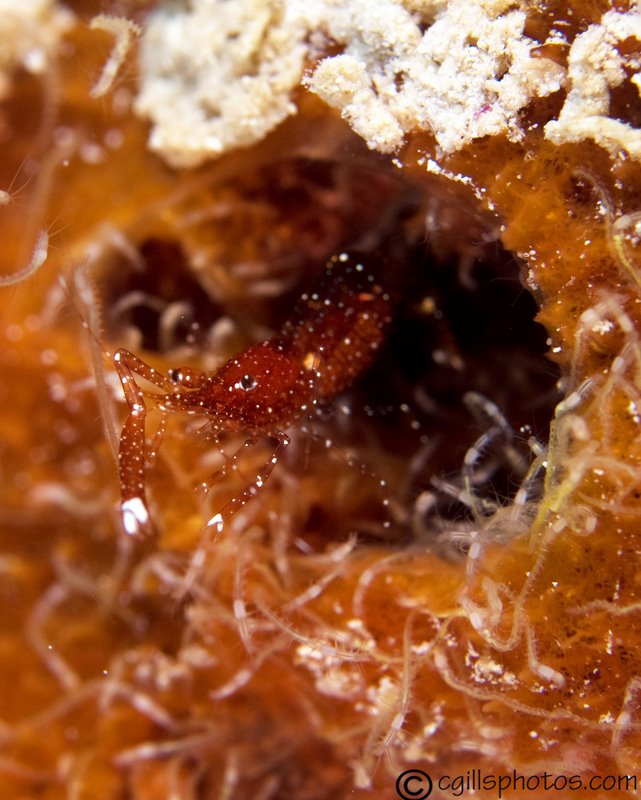
Many thanks to Les Wilk, DiveTech, and Sammy DeGrave for all their help.
Quinn ( aka cgills aka Cindy.)
Cindy -- It's really fantastic that you & the rest of your team were able to help out with this little guy. Even though it's not a new species you've basically rediscovered a "lost" shrimp that hasn't been seen in 60 years, shown that it's distribution is much much larger than reported, and provided great photographic documentation of it's living color, association, & behavior. This is a excellent example of what I've said over & over when pictures of unknown critters have been posted for id: they may be described but we don't know because the living color is unknown & can't be matched to a description. Bit by bit UW photographers like you are adding pieces to the puzzle we call biodiversity!
Let me second Cindy's request for more information & pictures from different areas of the Caribbean. Sammy is thinking of writing this up for publication and would like to know if anyone has observed it from other areas of the Caribbean. Full credit of course to whoever provides additional info & pics. So if anyone is diving in the area & sees a touch-me-not sponge why don't you take a look inside the crater? Cindy PM'ed me that she got the best pictures when she placed her poker near the crater & the shrimp came out to take a look.
Let me second Cindy's request for more information & pictures from different areas of the Caribbean. Sammy is thinking of writing this up for publication and would like to know if anyone has observed it from other areas of the Caribbean. Full credit of course to whoever provides additional info & pics. So if anyone is diving in the area & sees a touch-me-not sponge why don't you take a look inside the crater? Cindy PM'ed me that she got the best pictures when she placed her poker near the crater & the shrimp came out to take a look.
I'm currently in St. Vincent, specifically to get a few more photos of unusual invertebrates. I've made a point of looking for touch-me-not sponges and checking them out for the shrimp. There aren't many of those sponges here but the few that I have found all have the shrimp inside. One sponge with about 10 cavities had a shrimp in each one, some sitting right at the opening. One of my photos is attached.
I've heard from Ned DeLoach that the shrimps are also found around Bonaire. So far the reported distribution is: Bermuda, Dry Tortugas, Grand Cayman, Bonaire, and St. Vincent. Pretty broad. No doubt, over the next year or so, we'll get reports from all corners of the Tropical West Atlantic. I think this species will be found ONLY in touch-me-nots. Its reddish body, transparent appendages, and white spots and claws match well with the color of the sponge and the tiny white worms inside it. Probably an evolved host/guest relationship.
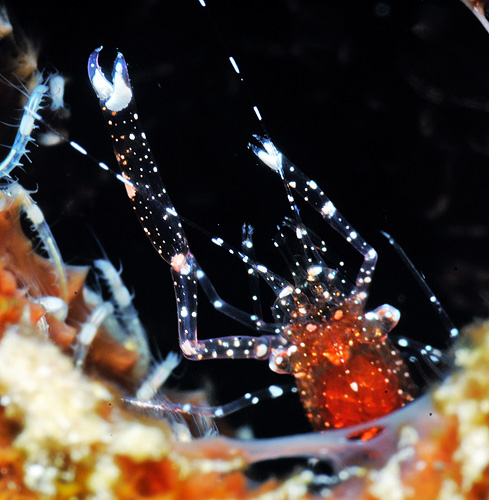
Les Wilk

Terms of Use Privacy Policy Guidelines We have placed cookies on your device to help make this website better. You can adjust your cookie settings, otherwise we'll assume you're okay to continue.

A worldwide community for underwater imaging.
