



I thought at first that this was a piece of algea that was moving in the current as I was looking for little shrimps nearby. Finally I noticed that it moved every time I moved and then I saw the eye stalks!
What is it?

Read-only discussion
I thought at first that this was a piece of algea that was moving in the current as I was looking for little shrimps nearby. Finally I noticed that it moved every time I moved and then I saw the eye stalks!
What is it?
What is it?
It looks like avery cute Orang-utan crab, Achaeus japonicus
cheers
Leander
Thats funny about the orangutan name, when the crab is "standing" on the bubbles it looks very much like some sort of ape with over long arms dragging its knuckles. I went back to the same section of reef and found a much larger one today and took its pic. The larger one is less than 2 inches across its widest area.

Achaeus japonicus is an incorrect identification that's made it into the popular guide books. It's an undescribed crab in the genus Oncinopus (but still an orangutan crab!  )
Achaeus japonicus is an incorrect identification that's made it into the popular guide books. It's an undescribed crab in the genus Oncinopus (but still an orangutan crab!
Yes Leslie I've been interested in that as I sent Paul Humann some pics of the "orangutan-type" looking crab I took in '05 that was the same color as this one posted and one that was a lighter almost greenish/yellowish fuzzy color.
Looking fwd to even more info on it!
Best, Carol
What I wonder about is if the red fuzz is an algae or if it's the crab's own hairs. Related crabs have larger spines or use to attach their camouflage. I'd love to see pics of your greenish one.
OK Leslie,
Here are three. I haven't IDed them - I sent them to Paul and he might include them in the new book coming out. Don't know but they are interesting.
Do you know anything about them?
Location
Bali
Muck
20 ft.
I assume they fall under the category "orangutan-type" crab, but not sure. But I'm afraid because they have so much algae it might be hard to ID them?
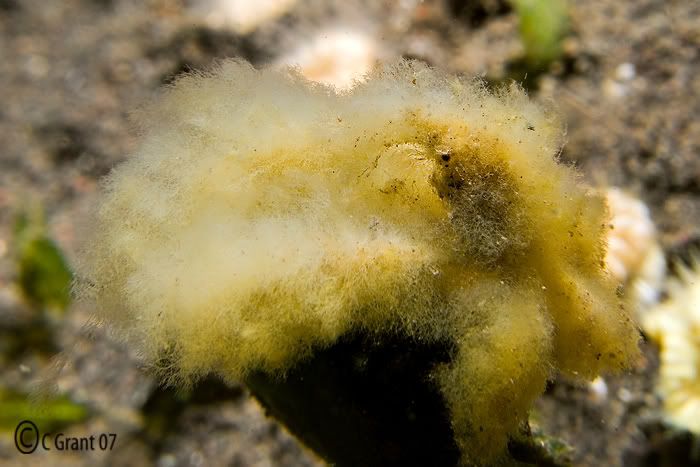

And the more "brownish-tanish-redish" one:
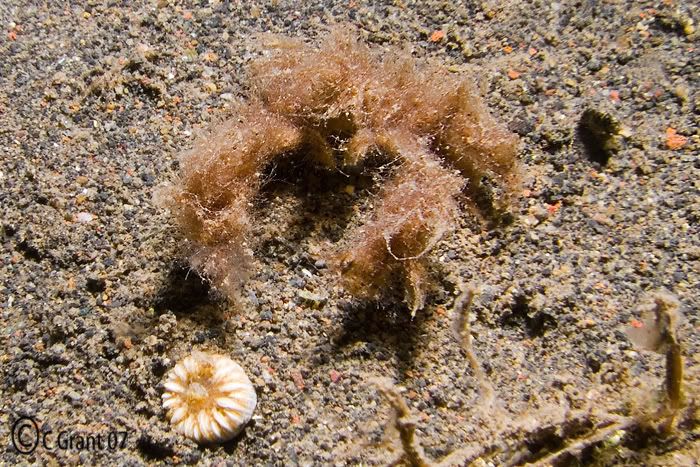
Best, Carol
sorry islandbound 
so Leslie, Carol ... there are quite a few references out there which show "hairless" orang-utan / A. japonicus crabs. Is this taxonomically correct? Are they more generally spider crabs?
 from http://echeng.com/travel/rajahampat2004/i-crustaceans/
Is it that A. japonicus is a misnomer or that some are that and others Oncinopus?
thanx
[btw, if the image links are inappropriate can someone say and I'll delete them:) ]
No problems here Lndr! I enjoy the discussions about these little critters as it makes this hobby just that much more enjoyable!
I have found 3 of these little crabs so far, all the same color and all living on the same species of coral. They are living on an isolated reefhead (large rock) that measures about 60 feet long by 30 feet wide and sticks straight up out of the sandy bottom almost 50 feet to end just 6 or so feet from the surface. If anyone would like specific pictures I am pretty sure I can find one again and ask it for specific poses or maybe I can tug on its hair to see if its really algea? Just kidding, I wouldnt do that!

Im a little confused, what is Achaeus japonicus if not the crab in the picture? Is it an extremelly similar looking crab, and if so, how does one tell the difference? this is a great thread.
Thanks
Hi,
Interesting thread. I was wondering if these are orang-utan crabs too. A little less hairy though and slightly different colours too.
What I wonder about is if the red fuzz is an algae or if it's the crab's own hairs. Related crabs have larger spines or use to attach their camouflage. I'd love to see pics of your greenish one.
Hi Leslie,
I was wondering about the algae vs own hair issue as well, not in orang-utan crabs but in banded boxer shrimps (don't mean to hijack this thread, so if it should be in a separate one, please do tell  )
Banded boxer shrimp covered in green algae(?)
The Ferraris have a Blue boxer shrimp (Stenopus tenuirostris) in their book "A diver's guide to Reef Life" (first printing 2006, p382), but in that shrimp only the body and legs are covered in blue hairs (or algae), not the claws (chelipeds ?)
Own hair? Algae?

Terms of Use Privacy Policy Guidelines We have placed cookies on your device to help make this website better. You can adjust your cookie settings, otherwise we'll assume you're okay to continue.

A worldwide community for underwater imaging.


