



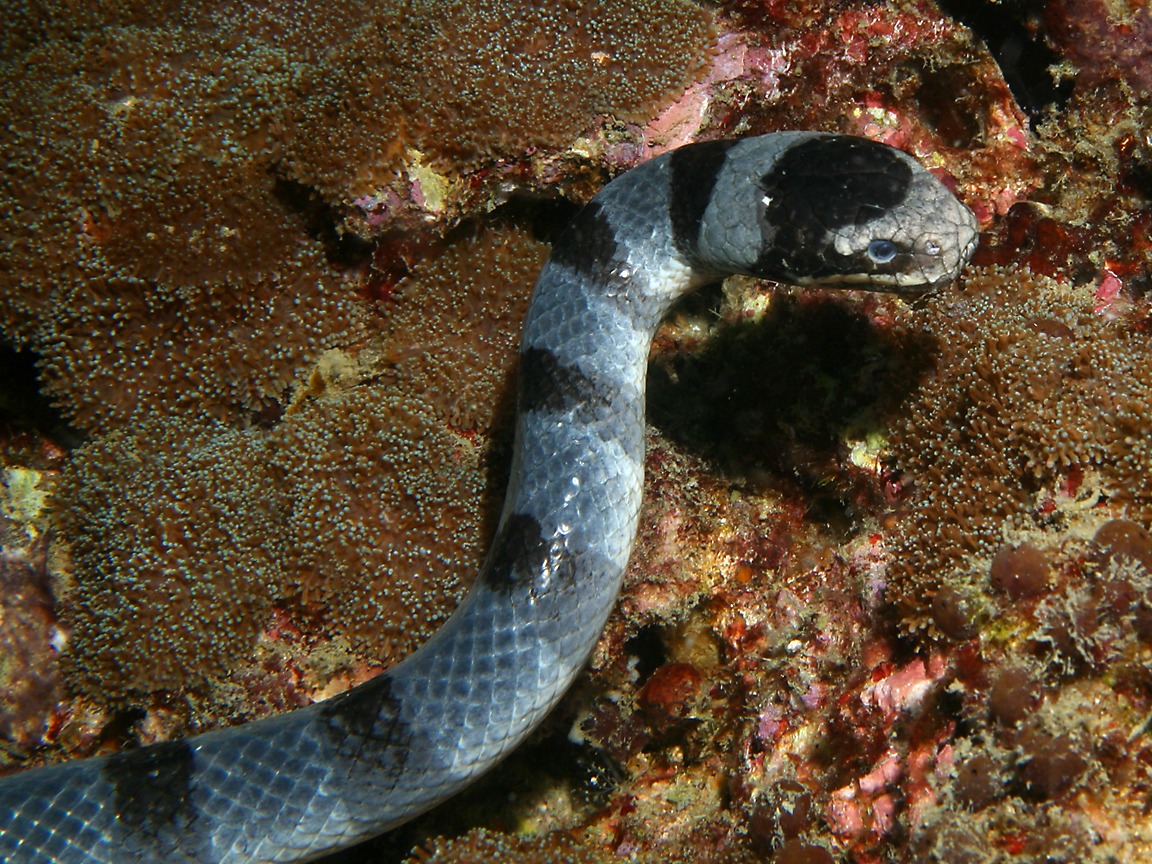
What type of sea snake is this? I'm thinking it's a yellow-lipped sea krait, Laticauda colubrina, but where are the yellow lips? Is this a juvenile? A different species? A variant on the yellow-lipped sea krait theme?
TIA,
Richard.
Read-only discussion
What type of sea snake is this? I'm thinking it's a yellow-lipped sea krait, Laticauda colubrina, but where are the yellow lips? Is this a juvenile? A different species? A variant on the yellow-lipped sea krait theme?
TIA,
Richard.
What type of sea snake is this? I'm thinking it's a yellow-lipped sea krait, Laticauda colubrina, but where are the yellow lips? Is this a juvenile? A different species? A variant on the yellow-lipped sea krait theme?
TIA,
Richard.
This looks like a Banded sea snake which is common in that areas and around the Similan islands.The yellow lipped sea krait seems to have more of a yellowish face and lips.
Hi There
It is a Banded Sea Snake - Laticauda colubrina and are very common in these waters. Nice shot BTW
folks,
Thanks for the info.
Googling "Laticauda colubrina" comes up with many entries which call this species "yellow-lipped sea krait", rather than "banded sea snake". Googling "yellow-lipped sea krait" or "banded sea snake" both result in many websites listing the Latin name as "Laticauda colubrina".
Is this mass internet confusion? Or are "banded sea snakes" and "yellow-lipped sea kraits" one and the same thing?
Richard.
Hi everyone,
Because of the nostrils' position, it belongs to the amphibian sea snakes. It seems to be a sea snake belonging to the Laticauda genus.
I would say it looks like a Laticauda laticaudata, (which for the record is supposed to be much more poisonous than the colubrina species... at least for the fishes that they eat !!).
Either way, they live most of the time on land and go in the water mainly for hunting.
Cheers
Anthony
This is why I used the Latin name to be sure as fish have many common names depending in which part of the world you are in.
Hi ScubaSpen !
you are right, but this time it's not a fish !!!  just joking !
Seriously, even scientific names are difficult to follow, as they are changing as fast as science...
For example, a new sea snake species was described in 2006 by Cogger & Heatwole, Laticauda saintgironsi, which lives in new caledonia and was identified before this as L. colubrina.
The Laticauda colubrina complex is diffcult to distinguish without being an expert but is supposed to be composed of 3 species so far, Laticauda saintgironsi from New Caledonia and the Loyalty Islands, Laticauda frontalis from Vanuatu, and Laticauda colubrina, a widespread species.
Some scientific evidence show that the venom of the L. saintgironsi species is able to paralyse a prey quickly, but does not necessarily kill instantaneously. The prey is then swallowed alive but paralysed...
Cheers
Anthony

Terms of Use Privacy Policy Guidelines We have placed cookies on your device to help make this website better. You can adjust your cookie settings, otherwise we'll assume you're okay to continue.

A worldwide community for underwater imaging.