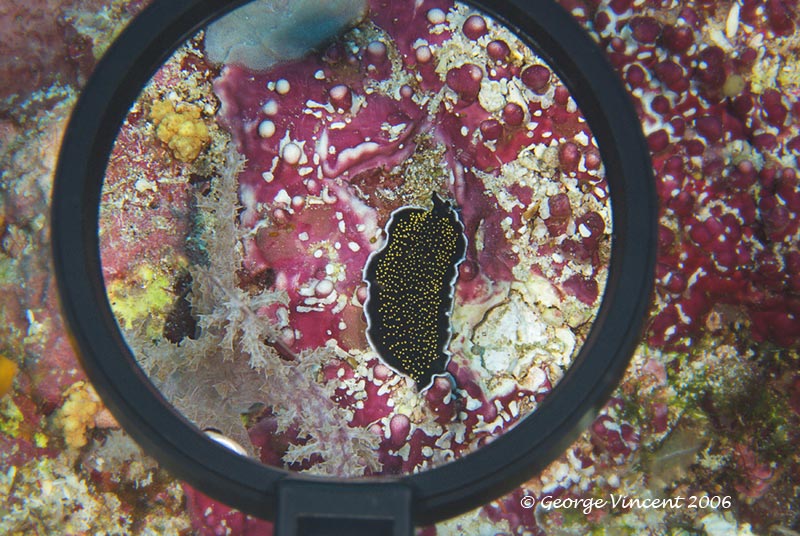
The Inon UCL-165 lens has a 165mm focal length, which makes it a +6 diopter. The ReefNet SubSee is a +10 diopter. That makes the SubSee more *powerful* when it comes to increasing image magnification.
More importantly, the Inon is a "wet contact" lens, meaning that the refracting surface of the lens touches water. This makes it lose almost 70% of its magnifying power as soon as it's immersed in water. By design, the SubSee does not lose ANY power when immersed in water. Yes, the SubSee has a smaller viewing area --- that's the tradeoff for higher power at a still reasonable cost.
Les Wilk
ReefNet Inc.
Les, I was thinking of two stacked Inons when I said it gave greater magnification. The Inon has a +6.06 diopter in water and two stacked have the equivalent of +12.12 and a focal length of 83mm. Using 250mm as the near point distance, I calculate the angular magnification as follows
Subsee (focal length 100mm, +10 dioptre) Magnification = 250/100 = 2.5
Inon (focal length 165mm, +6.06 dioptre) Magnification = 250/165 = 1.52
Inon x 2 (focal length 83mm, +12.12 dioptre) Magnification = 250/83 = 3.01
I don't think it's correct when you say the Inon loses 70% of its magnifying power in water. Perhaps you are thinking of a standard magnifying glass. In air the Inon focal length is 135.6mm, + 7.37 diopter which gives it an angular magnification of 250/135.6 = 1.84 So the magnification of a single Inon lens loses 17% of it's magnifying power in water.
I estimate that a 67mm Inon has between 3 and 4 times the viewing area of the Subsee, which I think makes it more practical to use.