Skip to content

Photo / Video Showcase / Archived topic

Hermit Crab - Macro

Started by rbailey ·

  • 11Posts
  • 11Replies

Read-only discussion

Hermit Crab - Macro

11 posts
  1. Hi,


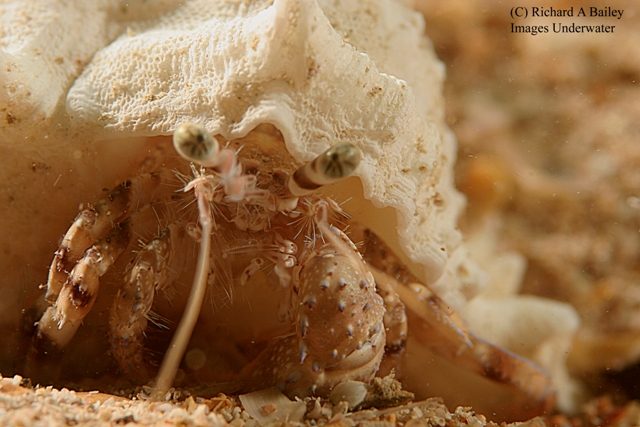
    Photo of a small hermit crab (25mm / 1 inch) from my weekends splash.


    I'm not sure on D.O.F. I would like the eye's crisper but :-

    I'm not sure they are that sharp in life

    They are on stalks so dificult not to loose the sharpness of the face / body.


    Equipment :-

    Canon 350D

    Sigma 105 Macro

    2 x DS125


    Exif Data :-

    f7.1

    1/200s (big surge so tried to freeze)


    Processing, only minor Photoshop :-

    Levels, minor only.

    Sharpen, radius 3 not that harsh.

    Clone, Few sand spots / particle in water only.


    Would a smaller apperture give me what I want ? or any other comments.


    p.s. Hope I've managed to attach photo okay.


    Cheers,

    Richard B.
    post-5552-1219841317.jpg

  2. Nice pic. I personally would crop the right background, as I find it distracting.

  3. I'm not sure on D.O.F. I would like the eye's crisper but :-

    I'm not sure they are that sharp in life

    They are on stalks so dificult not to loose the sharpness of the face / body.


    Equipment :-

    Canon 350D

    Sigma 105 Macro

    2 x DS125


    Exif Data :-

    f7.1

    1/200s (big surge so tried to freeze)


    Yes, it IS a nice picture! And I often wonder too about true detail on UW critters... Not sure if it would have gained what you wanted (sharper eyes), but when you've got all that dual strobe power, why not as a rule stop it down to f22 for macro? For close critter shots on a recent trip, I wound up varying aperture from 22 to 32 (smallest my lens could do), with each Sea & Sea YS-90 at full or near. Of course limiting DOF can be very useful at times, but that wasn't your intent here...


    As an aside, does your Canon 350D make it easy to know when you use aperture-priority to dial "virtual" aperture smaller than the lens mechanically allows? I was surprised to find that my Nikon D200 can give the illusion of say f48 when the lens' real aperture (and real DOF) is limited to f32.

  4. Yes, it IS a nice picture! And I often wonder too about true detail on UW critters... Not sure if it would have gained what you wanted (sharper eyes), but when you've got all that dual strobe power, why not as a rule stop it down to f22 for macro? For close critter shots on a recent trip, I wound up varying aperture from 22 to 32 (smallest my lens could do), with each Sea & Sea YS-90 at full or near. Of course limiting DOF can be very useful at times, but that wasn't your intent here...


    As an aside, does your Canon 350D make it easy to know when you use aperture-priority to dial "virtual" aperture smaller than the lens mechanically allows? I was surprised to find that my Nikon D200 can give the illusion of say f48 when the lens' real aperture (and real DOF) is limited to f32.


    Thanks, think I need to wind right down let the strobes do thier job.

  5. Hello Richard.

    f7.1 on a macro shot is going to give you an extremely shallow DOF. Looking at the photo, I notice that the eyes are outside the critical focus plane, making them a bit blurry compared with the shell and claw of the crab. Most people will tell you if the eye is out of focus, the picture as a whole is as well.

    My recommendation would be to shoot at a higher aperture # (f16 at least) to increase your DOF for such a picture, sacrificing shutter speed or increasing ISO, and always make the eye the central point of focus.

  6. Managed to get another attempt the other weekend and they do not have crisp eyes.

    Musandam_17-10-2008_Low_Rez_08.jpg


    However for crisp eyes I like this one, you can see the coral in the lens of the fishes eye.

    4.jpg


    Cheers,

    Richard B.


    ><(()">

    Check out latest underwater exploits :-


    http://www.images-underwater.net/

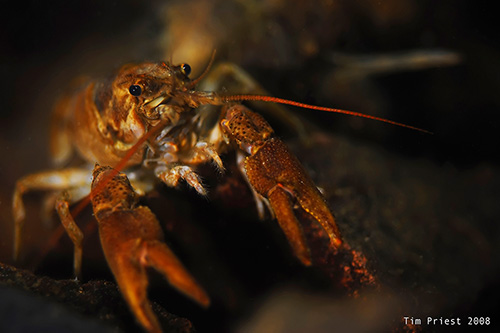
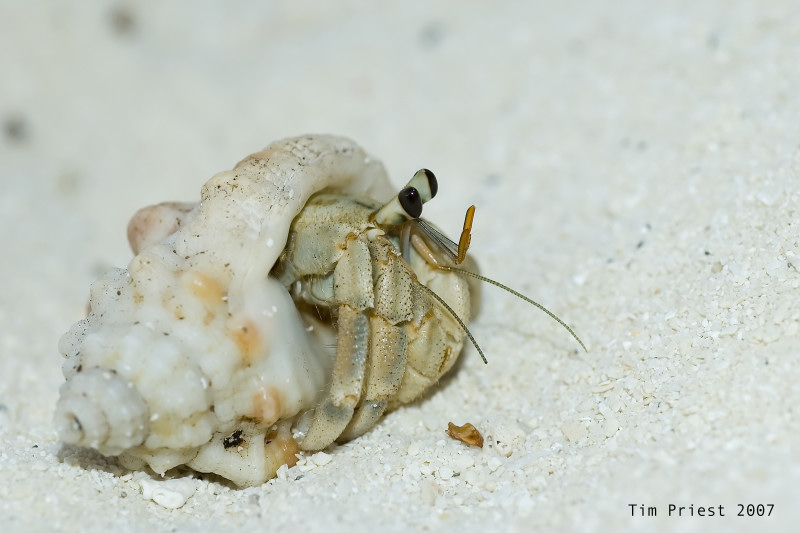
  7. I wonder if the light background is the problem: by exposing for the light background the DOF is reduced, and by focussing on the body, where the detail is fantastic, the eyes are lost. I'm afraid that if the eyes don't work, then the image never looks right. It's pretty difficult, though, as these examples from a warm place and a cold place show:


    Hermit crab, Palau

    post-4522-1227649518.jpg


    Crayfish, England

    post-4522-1227649251.jpg


    It's hard to get a lot more than the eyes in focus.


    post-4522-1227649327.jpg

  8. The last is a cheat, since the hermit wasn't underwater: the high level of ambient light gives a great DOF!


    Tim


    :)

  9. Nice, I'm starting to get intrigued by eyes.


    The most comparable you've shown is the Palau hermit crab it's eyes are only 1/5th of the size to my images so not much more than black spec's. I'd like to see the actual eyes and if they actually have any real detail.


    As part of my on going obsseion with eyes I also noted in a recent photo of a moray that the eye is cloudy ?

    1.jpg


    Is there something about the way the light hits the eyes that effects them (maybe an ophthalmologist out there could comment). With strobes coming from the side is this going to be a problem as the light will always be indirect ? (maybe also why the beach photo is good too ?)

  10. I think that eyes need a reflection to "pop". Dark-adapted eyes work well, particularly if there is a reflective tapetum behind the retina, but crustaceans' compound eyes also work in bright conditions because each facet is surrounded by a pigment cell that creates a light-guide effect. Light reflected from deep within the eye often has a rich appearance with interference colours (iridescent green and blue, in many cases).


    Tim


    :uwphotog:

  11. I think that eyes need a reflection to "pop". Dark-adapted eyes work well, particularly if there is a reflective tapetum behind the retina, but crustaceans' compound eyes also work in bright conditions because each facet is surrounded by a pigment cell that creates a light-guide effect. Light reflected from deep within the eye often has a rich appearance with interference colours (iridescent green and blue, in many cases).


    Tim


    :B):


    :);)

Aquatica

Account

Navigation

Search

Search

Configure browser push notifications

Chrome (Android)
  1. Tap the lock icon next to the address bar.
  2. Tap Permissions → Notifications.
  3. Adjust your preference.
Chrome (Desktop)
  1. Click the padlock icon in the address bar.
  2. Select Site settings.
  3. Find Notifications and adjust your preference.