



Skip to content

Photo / Video Showcase / Archived topic

Rare Caribbean shrimp

Started by reefnet ·

  • 12Posts
  • 12Replies

Read-only discussion

Rare Caribbean shrimp

12 posts
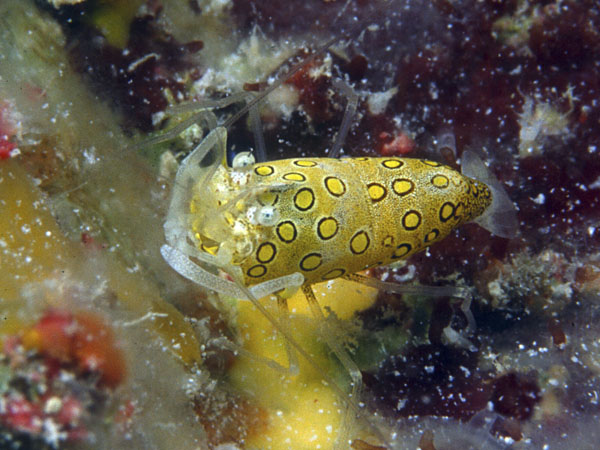
  1. The photo below is of a "circled shrimp" (Gnathophyllum circellus) that I photographed a few years ago in the shallows off Bonaire.
     

    post-3232-1235017416.jpg


    In over 30 years of diving the Caribbean I've only seen that one specimen, so I know it's rare. In fact, I know of only one other photographer that has taken photos of this species. Usually it's hidden deep within the recesses of coral heads where you can't see it, but it's occasionally in more accessible locations. I found mine under a junk sheet of tin that was lying on the sand in 15 feet of water.


    Apparently there is another species, Gnathophyllum splendens, which is very similar in color and pattern to G. circellus, but I've never seen one or even a photo of one. If you have photos of what you think might be a circled shrimp I'd love to have a look at them. They just might be of G. splendens.


    Thanks.


    Les

    Edited by reefnet
  2. Lovely markings. It must be rare, otherwise there would be 1000's of photos of these guys.

  3. It's really neat Les!


    Thanks, Carol

  4. Cool.


    Several years ago, someone posted an image of G. circellus. As I recall, they only noticed the tiny shrimp in the background of an image that was taken of something else - was that you?


    Here's a cousin (G. americanum) - much more common.


    squat.JPG

    Edited by jlyle
  5. There must be more color variation in living animals (not surprising) than reported in the literature. Below is how the 2 species are separated in a big monograph by Chace & Bruce 1993. The color in your animal doesn't really match either of them. I can get the original descriptions if you want them Les.


    Pereopods slender, dactyl of 3rd pair with accessory tooth on flexor margin sharply

    acute, propodus more than 12 times as long as wide; color brown marked with

    discrete darker reddish brown circles

    G. circellum Manning, 1963:54, figs. 3, 4

    (Florida Keys and Bahamas, western Atlantic;

    cryptic in coral heads to depth of 6 meters)


    Pereopods stouter, dactyl of 3rd pair with accessory tooth on flexor margin broadly

    rather than sharply acute, propodus less than 8 times as long as wide; color orange

    marked with cream-colored spots outlined in dark brown or black

    G. splendens Chace and Fuller, 1971:493, figs. 1-5

    (Puerto Rico, western Atlantic)

  6. There must be more color variation in living animals (not surprising) than reported in the literature. Below is how the 2 species are separated in a big monograph by Chace & Bruce 1993. The color in your animal doesn't really match either of them. I can get the original descriptions if you want them Les.


    Thanks Leslie, I do have that monograph. The literature is great for describing anatomical features but not so good for colors. If a paper doesn't give "life colors" then I consider it incomplete and/or misleading. As you know, preservatives can do weird things to pigments. Even if a paper does give life colors, that may only be partial information.


    Several years ago, someone posted an image of G. circellus. As I recall, they only noticed the tiny shrimp in the background of an image that was taken of something else - was that you?


    Jim, you have an excellent memory. The photo was taken by Ellen Muller of Bonaire. She is the only other photographer I know of that has a photo of this species.


    By the way, if anyone has photos of *any* oddball Caribbean shrimps, I'd love to see them.


    Les

    Edited by reefnet
  7. Les,


    very cool photo. What an amazing shrimp. Gnathophyllum circellus must be very elusive. What made you think of this species again?


    Here's a Gnathophyllum from Anilao we found a few months ago, also very rarely photographed, but evidently more often than Gnathophyllum circellus.


    413535399_ZKYN5-M.jpg


    Jim, where is your photo from?


    When I query G. americanum, I get two varieties, my variation and Jim's variation, I wonder if they are different species.

  8. Les,


    What made you think of this species again?


    I'm preparing images, identifying species, writing text, etc. for a Caribbean Reef Creature Identification DVD that we (ReefNet) are preparing in collaboration with New World Publications (Humann & DeLoach). It's shaping up to have about twice the number of species as the book, and about 4000 photos and video clips.


    Les

  9. It's surprising how many people in the taxonomy biz are unaware of the importance of live color. Of course so many species are described from preserved specimens only that we don't know the live appearance of many well known animals.


    Scott -- G. americanum is getting split apart. The first one to be separated was G. taylori from Australia which has thin widely spaced brown bands on a yellow background. I've been told that Hawaiian specimens probably represent another species as do several regional IP populations.

  10. Jim, where is your photo from?


    Cozumel, Mexico.

  11. Grand Cayman comes through once again.:good:


    Found this past week ,on a night, shore dive from Turtle Reef, on the underside of a Sea Cucumber, in 35 feet of water.


    .778482914_PMGy4-S.jpg

  12. That is a gorgeous shrimp!


    Here we have the Gnathopyllum Americanum (rare and difficult to see), the Gnathopyllum Elegans:


    4323125334_893a0612da_o.jpg


    and the almost impossible to see and very beautiful GNATHOPHYLLEPTUM TELLEI (it has Arturo Telle´s name as he was the one who found it here and sent an specimen for classification): http://www.fotonatura.org/galerias/fotos/261137/

Turtle

Account

Navigation

Search

Search

Configure browser push notifications

Chrome (Android)
  1. Tap the lock icon next to the address bar.
  2. Tap Permissions → Notifications.
  3. Adjust your preference.
Chrome (Desktop)
  1. Click the padlock icon in the address bar.
  2. Select Site settings.
  3. Find Notifications and adjust your preference.

