



Skip to content

Conservation and the Environment / Archived topic

Seafood Watch & Safe Seafood Apps For The IPhone

Started by seagrant ·

  • 14Posts
  • 14Replies

Read-only discussion

Seafood Watch & Safe Seafood Apps For The IPhone

14 posts
  1. I just got these, fairly new, apps for my iPhone, thought you might be interested:

    Seafood Watch

    AND

    Safe Seafood


    They are really valuable to have quickly available. Instead of doing "other" things on my iPhone while waiting for my car to be serviced today, I was engrossed in looking up and learning about the seafood we eat; and just learn about the creatures themselves for that matter. Now, I'm sure there will be some debate on the conclusions on the various species that these two apps make, still the apps are absolutely necessary in my mind for those who care about our sealife and want to back positive steps to educate, understand and thus bring about positive change.


    I did a longer post on my blog about these two apps, screen shots, etc., - here


    Also here are a couple of representative screen shots from my iPhone:


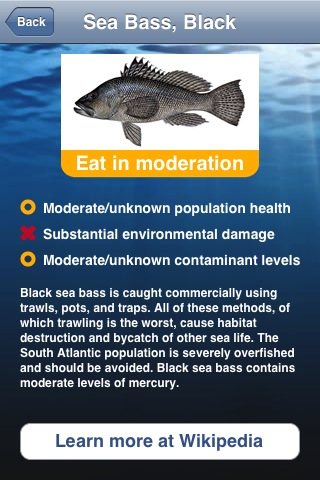
    #2 from Safe Seafood - I was particularly interested because I spent a lot of u/w time at Gray's Reef National Marine Sanctuary, with NOAA, surveying and measuring the black sea bass, and felt the description was accurate:

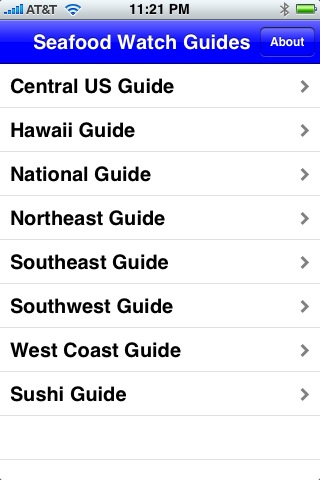
    #1 from Seafood Watch - The app isn't laid out as well as their wonderful cards, but the Sushi Guide is worth the *FREE* price of the app just by itself!

    I applaud these two apps (total cost, .99 cents - free for Seafood Watch, .99 for Safe Seafood-with 10% of proceeds to the Environmental Defense Fund); they have come out within the last three months and I look forward to more apps that help our ocean-life. Carol
    post-5477-1235112454.jpg

    post-5477-1235113210.jpg

    Edited by seagrant
  2. I've used the little Seafood Watch cards for many years now, and to me it's the perfect thing to have as an iphone app. It becomes very accessible and can always be up to date. I wasn't aware of the Safe Seafood one; I'll have to check it out.


    Linda

  3. Nice idea. There's a similar service for cell phones that don't have internet access. You send them text message with the name of the fish, and the service texts you back with info and a rating.


    Now, if only we could somehow force restaurants and marketera s to be honest about the species they are offering on their menus. Think of all the "red snapper" and unidentified "sea bass" and other things that may or may not be what they claim to be. And the quantity of "dayboat" scallops, haddock, and cod that is offered by New York menus every day is far more than the actual dayboats can possibly supply. My brother went to a NYC restaurant a few years ago that advertised line-caught Chatham cod. Being from Chatham, he asked the server if it was really line-caught cod from the Chatham fishery, and she said "Oh yes, it's caught right in Chatham Bay." He knew she was just fed this b.s. by the manager or the chef, so he didn't tell her that there is no such thing as Chatham Bay. The Times recently had an article about this false marketing phenomenon, and the inability if wholesalers and retailers to be accurate about what they're actually selling.


    And unfortunately, Seafood Watch has plenty of errors and inaccuracies on its site and in its recommendations. And they don't update their ratings very often. Here's an example, citing haddock caught by "hook and line" as a reasonable alternative to Atlantic cod. The problem is, they define "hook and line" fishing as rod-and-reel- type fishing, where there's one line that's got a few hooks on it and the line is retrieved quickly, allowing for the possibility that non-target species might be released alive. In actuality, haddock that are "line caught" in the northeast are caught by demersal longlines, which is a very different gear from rod-and-reel. Demersal longlining for haddock is certainly cleaner than trawling and less devastating to the benthos, but not nearly as clean as rod-and-reel. Some guys do some jigging for cod and haddock while the longlines soak, but the amount of fish caught this way is a drop in the bucket.


    Meanwhile, as with "line-caught" cod, whatever haddock that arrives in a kitchen could easily be trawl-caught haddock that a dealer is lying about. Perhaps someday soon we will have real regulations on traceability, and we won't be at the mercy of dishonest people.

  4. I've got Seafood Watch and quite like it (although they REALLY need to add a Search function!), but haven't seen the other one, so THANKS! :D


    At $0.99, it'll be worth it if I use it at all (although I must say that at this point I've spent almost as much on "inexpensive" Apps as I did for the friggin' iPhone!). :)

  5. Yup, everyone.


    I agree these two apps aren't perfect (and yes the .99-cent apps do add up - but not as much as a 4.99 mocha a few times a week!) :)


    Yes, I agree too that the differences need to be clearly stated. I think that both apps have tried to distinguish between long-lining and "pole-caught", but yes getting the truth on the matter is more difficult.


    Still, I think these two apps are a start. We have to start somewhere and the Monterey Bay Aquarium actually took a huge, controversial step in publishing the Seafood Watch cards years ago - when did the first ones come out, 2002?? I think they have made a difference and it will be much easier to update the smart-phone app than the separate cards. I salute MBA for leading the push in this difficult but necessary education. Unfortunately you won't see MBAs Seafood Watch card in some areas because I know of several institutions that have been picketed after distributing them. Clearly, much still needs to be done.


    For myself, I like the Seafood Watch app for the diversity, the Sushi Guide (which cleared up a lot of my misunderstood terms also), and the educated descriptions.

    I like the Safe Seafood app because it lists the fish/seafood Good to Bad (grouped) - faster and easier, it has different items listed and the shorter descriptions are more concise, but still accurate - with a link to much more data at Wikipedia. I think both apps with get upgrades soon, with search - which they both need.


    Anyway, thanks for the response. These apps are a start. Now, the next step is to get popular TV programs like "Top Chef" to stop using (and many times wasting, just for a skills challenge or something), AVOID - fish/seafood like Chilean Seabass and Freshwater Eel (the freshwater eel challenge was particularly disgusting to me recently, not the eels, but the way they trivialized the creature - and then didn't even cook it).


    I expect lots more good info out for the iPhone, and other smartphones soon. My goodness we already have 891 birds, drawings, audio calls, ranges, similar species, taxonomic info, etc etc in iBird Explorer Plus (awesome app!!!!!!!!!!); so I expect the Fish ID Guides out soon also. Its a whole new world with smartphones, Kindle, etc. More info about the environment can result in better understanding and subsequent positive change.


    Thanks, Carol

  6. I was just thinking about how annoying "Top Chef" can be about seafood! First there was Jamie from San Francisco, who regarded herself as this pro-sustainability chef but ended up choosing to cook toothfish in one of the challenges—when she wasn't busy cooking scallops, which she seemed obsessed with. (Jamie also misidentified the small tendon on the side of a scallop as the adductor muscle, when in fact the whole scallop meat is the adductor muscle. I also saw Ted Allen, on "Iron Chef America," misidentify scallop roe as the scallop belly. Arrgh!) Also, Le Bernardin, Eric Ripert's seafood restaurant in NYC, actually makes a point of not serving overfished/threatened seafoods and explaining why they don't, yet they never mentioned that on the show, despite an obvious effort to leave Ripert's bottom utterly spotless via an embarrassing round of ass-kissing. I guess they figure the audience can only stand so much talk about sustainability before they tune out and hunger for more drama or awkward kisses between the chefs. Too bad. Wouldn't it be nice if they had an entire season in which they had to cook sustainable, well-sourced, traceable foods? Or if they at least raised these issues? In general, most of the cooking/eating shows do a terrible job of paying lipservice to these issues. Maybe somebody will give Michael Pollan a show…


    I hope I didn't sound too down on MBA's Seafood Watch program. My wife does some work with them, and works on a similar program herself. I just think such programs ought to be more accurate and quicker to update ratings and details such as the fisheries and gears that factor into those ratings. After all, situations chance, and a formerly overfished stock can suddenly be considered "not overfished"——or vice versa. I emailed MBA about the imprecise descriptions of fishing techniques a few years ago, especially after I'd been out on about thirty different dayboat longline trips targeting haddock. Alas, I think they've had a lot of turnover in personnel, and things have fallen by the wayside. It probably doesn't help that the Packard family took a beating when the dot com bubble burst.


    Personally, I hope these lists and cards will eventually be customizable to the tastes and concerns of the user. For example, if someone doesn't want to have any fish that are caught in fisheries that result in marine mammal mortality, they could plug that into a matrix and get a list that is customized to that primary concern. Or, if someone wants nothing to do with marine fish farms but has no qualms with land-locked farms (trout, catfish, barramundi), they could have guidelines tailored to that concern.


    But still, at the end of the day, we're at the mercy of the loosey-goosey honesty of fish dealers, marketers, and restaurateurs. But that could change. At this very minute, NMFS is on the verge of suspending the Gloucester Seafood Auction for various infractions, including the buying and distribution of undersized or misidentified species, among other things. Maybe with NOAA lead by Jane Lubchenco, NMFS will get more serious about cracking down on cheaters and improving traceability and honesty throughout the seafood industry.

  7. ...We have to start somewhere and the Monterey Bay Aquarium actually took a huge, controversial step in publishing the Seafood Watch cards years ago - when did the first ones come out, 2002?? I think they have made a difference and it will be much easier to update the smart-phone app than the separate cards. I salute MBA for leading the push in this difficult but necessary education...


    I agree! In fact, I had a chance to meet some of the MBA folks at the launch of Ocean for Google Earth a few weeks ago, and was really impressed with everything they're doing! Awareness is the first step in conservation, and tools like these can help day-to-day awareness, whether in the grocery store or a restaurant... And having it on the iPhone is way easier than carrying around those cards! :)

  8. I agree with Carol that these cards are a start, and that's useful. It's all about awareness, and the information needs to be accessible and easy to use. If it gets people asking about the origins of the seafood on the menu or fish counter, it's a good thing.


    I think the Seafood Watch program started in the late 90s. I came across the printable charts on their website in 2000 (also about the time I stopped eating canned tuna). It gave me a basis to just start asking markets about their fish sources before buying. We're very lucky in that we now have a good local market (New Seasons) where the staff are able to provide some answers. Restaurants are more difficult, but here in Portland, there are restaurants that base their menus (and reputations) on sustainability. It's a good trend. There are always going to be dishonest businesses, unfortunately. As these get unearthed, we have to vote with our pocketbooks, so to speak. The thing that I believe is that collectively, small changes can make a difference.


    Also back in the 2000-ish timeframe, Audubon used to have a seafood guide, but I haven't seen it in quite a while. Perhaps due to the same issues that danielanddrewclem brought up about not being able to keep it up to date and accurate. I'm sure it's a huge amount of work.


    Would be nice to see the iphone apps extended to make them even more usable, searchable, customizable as danielanddrewclem mentioned. The easier they are for people to use, the more inclined they'll be to use them. And the apps themselves are indeed a start.


    Linda

  9. Also back in the 2000-ish timeframe, Audubon used to have a seafood guide, but I haven't seen it in quite a while. Perhaps due to the same issues that danielanddrewclem brought up about not being able to keep it up to date and accurate. I'm sure it's a huge amount of work.


    I think Audubon's program was largely the work of Carl Safina, who left Audubon but went on on to create the Blue Ocean Institute, which has its own seafood list and their own methodology. BOI, Monterey Bay, Environmental Defense (based on MB's program, but with an emphasis on health), OceanWise (Canadian), and a few other outfits have seafood lists. Interestingly, but not all that surprisingly, lists are way more popular on the west coast than the east. In South Carolina, cards were being passed out at the aquarium until the community caused an uproar over it. People here on the east coast have old habits that die hard.

  10. In South Carolina, cards were being passed out at the aquarium until the community caused an uproar over it. People here on the east coast have old habits that die hard.


    I was told the whole story, graphically by my friends, one who was Dive Safety Officer of the South Carolina Aquarium and his wife who was PR for SCA; they explained to me how they joined MBA's Seafood Watch Program, promoted it and passed out cards. Then there was a *huge* uproar, hundreds of picketers all around the aquarium, on the waterfront in Charleston. SCA had to quit distributing the cards. Our Florida Aquarium here in Tampa, FL hasn't even tried to distribute the cards on any large scale; you can't blame them, it's a foregone conclusion that the uproar from the Gulf of Mexico fishermen, etc., would be far worse than what happened in Charleston, SC.


    Luckily, the Seafood Watch cards have been distributed by other, smaller, environmental organizations in the Tampa/Clearwater/St Pete area - but they do not receive the wide distribution - like on the West Coast US.


    That is why the iPhone and other SmartPhone apps are so great, they are available to everyone, regardless of region.


    I'm glad the West Coast US folks here can give more data on when the Seafood Watch Pgm, and similar pgms, were started. I'm from California, but having lived in Florida since 1986...., well, I slip a bit out of the "West Coast Conservation Loop" sometimes. Fortunately, there are plenty of people here in the South and on the East Coast US that are spearheading conservations efforts too. It just doesn't follow the time-line of the West Coast US and is a different "animal" as they say....


    Anyway to get the word out is great - these apps can only help and improve in information and usability!


    Best, Carol

  11. Update:


    Monterey Bay Aquarium "tweeted" me this:


    @oceangrant We have a rev of the Seafood Watch iPhone app with search in review w/ Apple. Sorting by rating is on the buildout plan


    As we know, they really care and want this seafood conservation mission to expand and succeed!


    Get MBAs Seafood Watch app, use it, tell others, talk about it, educate, and look forward to the updates soon!


    Thanks! Carol


    PS Still Safe Seafood app can't hurt in addition! It has different information, etc. - valuable too, and easy to use.

    Edited by seagrant
  12. As of today, MBA's Seafood Watch App now has search (update 1.1).


    It is particularly helpful for me in the "Sushi" section; when you know the first few letters of the item, but not the whole correct spelling.


    As they said more updates to come!


    Best, Carol

  13. That is a great idea for communicating to the public, which if informed well, will comply. I personally have handed out 500 of these cards, both from the MBA and ones I printed myself off their site. All of my friends have accepted the cards and use them. A principal from a conservation group told me that MBA has distributed over 40 million of these cards.


    Thanks, SeaGrant, for the update, I really like the MBA and have sent many a Midwesterner there!

  14. That is a great idea for communicating to the public, which if informed well, will comply. I personally have handed out 500 of these cards, both from the MBA and ones I printed myself off their site. All of my friends have accepted the cards and use them. A principal from a conservation group told me that MBA has distributed over 40 million of these cards.


    Thanks, SeaGrant, for the update, I really like the MBA and have sent many a Midwesterner there!


    Yes, and main thanks to Monterey Bay Aquarium! They have been in touch with me re: improvements to the iPhone App-Seafood Watch. Impressive, they really want to make the app better and easier to use. In fact, just a week ago their Sushi section of the App (you get all regions + sushi in the app), really came in handy for us.


    Plus I think MBA has done more good than just their cards & app; by being one of the first, high-profile orgs to promote better seafood choices, other organizations have gotten behind them, or if that wasn't popular - at least develop their own promotional actions to help sustainable choices.


    Monterey Bay Aquarium & others have really set a good example regarding this issue.


    Best Carol

    Edited by seagrant

Account

Navigation

Search

Search

Configure browser push notifications

Chrome (Android)
  1. Tap the lock icon next to the address bar.
  2. Tap Permissions → Notifications.
  3. Adjust your preference.
Chrome (Desktop)
  1. Click the padlock icon in the address bar.
  2. Select Site settings.
  3. Find Notifications and adjust your preference.

