



Hey All!!!
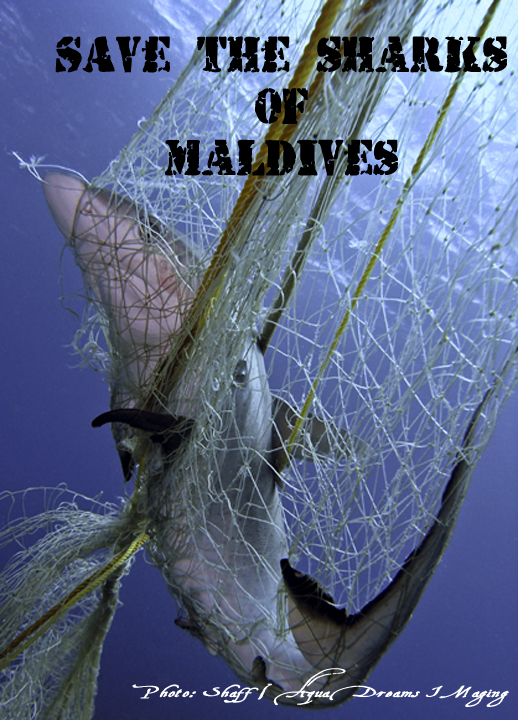
Great news! All Shark fisheries and exports have been completely banned in the Maldives!!!! I will update you with more details in the coming days.
Conservation and the Environment / Archived topic
Started by Shaff ·
Read-only discussion
Hey All!!!
Great news! All Shark fisheries and exports have been completely banned in the Maldives!!!! I will update you with more details in the coming days.
Hey All!!!
Great news! All Shark fisheries and exports have been completely banned in the Maldives!!!! I will update you with more details in the coming days.
That is great news Shaff, the shark numbers IMO were down this year from previous years, especially Grey Reef Sharks. The Maldives is a great place to dive and if there are going to be more sharks in the water that can only make the diving experience out there even better.
Stew
Brilliant news!!!!!!!!!!!!!!!!!!!!!!!!!!!!!!!!
Super News,
Went to Reethi Beach Resort at the BAA ATOLL last July and did not see a single shark except one when they feed the Rays in the evning. In fact the local dive guides said that it had been a few years since they stopped seeing sharks in that area.
Great Shaff please kep us posted.
Cheers,
Diggy
Hey guys,
I'm still not sure how the govt has put this ban into effect. Just read in a newspaper that 'All shark fisheries banned from inside the atoll and from 12 miles out of the atolls'....so i think that means that they can fish for sharks 12 miles out of the atolls...which is going to lead to the same thing. Damn politicians!
Its good news that they can not fish on the reefs, the sad part is that 12 miles from shore is considered international waters and unless they can find a way to ban fishing there, the fishermen are allowed. This is done in most countries, I am looking for some information for you, that I read a while back and will forward it to you when I find it.
Good luck and keep trying, and well done for the achievement so far.
Restriction for fishing the sharks closer than 12 M from the shore is better than nothing. Its hopefully the first step for wider bannings..
This was in one of the newspapers:
Ministry Bans Reef Shark Fishing by Mariyam Omidi
The ministry of fisheries and agriculture has extended the moratorium on reef shark fishing to cover the whole of the Maldives, as part of a historic move towards a total ban on both reef and oceanic shark hunting. A ten-year moratorium was imposed in 1998 to cover the seven atolls where tourism had been established on the assumption that many tourists visited the Maldives to see sharks. But with the spread of tourism to almost all atolls in the country, the ministry has decided to expand the ban to encompass all reef shark fishing across the Maldives within a 12 nautical mile radius.
Marie Saleem, a reef ecologist at the marine research centre and one of those at the forefront of the campaign to ban shark hunting, said she was both “excited” and “relieved” to hear that the efforts of those who had been pushing for a ban were “finally fruitful”. Reef shark populations would now need to be monitored as a matter of urgency in order to observe the effectiveness of the ban, she said.
Total ban
Abdullah Nasir, permanent secretary of the fisheries ministry, has said: “The fisheries law clearly tells us that we can protect any marine species if we feel that it’s threatened or endangered for any reason.” Although oceanic shark fishing is yet to be prohibited by law, Nasir said the ministry was “working towards that” and had set itself a target of banning the export of shark products, both oceanic and reef, within one year. “We have taken very strong action against the protection of sharks simply because they were protected worldwide and are very important for tourism.”
As sharks reproduce at a slow rate their populations cannot handle large-scale fishing pressure. Speaking to Minivan News in December, Guy Stevens, senior marine biologist at Four Seasons resorts, said: “It takes decades and decades for the shark population to recover, but it doesn’t take long to wipe out.” NGO Shark Alliance estimates tens of millions of sharks are killed globally each year either as by-catch or intentionally. The lucrative market for shark fins in Asia, where shark-fin soup is considered to be a delicacy, is believed to be increasing each year.
Livelihoods
One of the hurdles faced by the ministry is the need to find alternative livelihoods for the 100 or so fishermen whose incomes depend on shark fishing. “We need to work with the fishermen to identify alternative livelihoods and to compensate them,” said Marie. “I feel that the tourism industry should play a large role in this change and take the responsibility of compensating the fishermen as they are the ones reaping the benefits out of the loss of fishermen.” Nasir said the government was in the process of finding other means of income for these fishermen.
Robert Tomasetti, a marine biologist at Banyan Tree resort, has said that as shark fishing is not a traditional fishery, the ban should be easier to enforce than the ban on turtle hunting.
“I think that there are only about 100 to 200 shark fishermen and it’s mostly seasonal; other times of the year they will be fishing tuna. Whenever we take something away, we have to provide another source of income.”
Enforcement
Tomasetti stressed the importance of making the leap between “rhetoric and reality”. He said although the move showed live sharks were more valuable for tourists than dead sharks, the ban on sea turtle hunting had proved ineffective. “I think it’s a success but I just hope it will be followed through with action. This government seems to be very environmentally friendly.” One of the ways in which the ban will be enforced is by monitoring exports. But, said Tomasetti, “It’s difficult unless you are a specialist or trained well, to tell the difference between fins of some species and another.” He said it was possible fishermen would hunt reef sharks and palm them off as another species, which is why a total ban was essential. “Ocean fishery is generally less targeted because of the cost of fuel but maybe they will shift towards these sharks because they can’t fish reef sharks.” The extension to all atolls will help the ministry of fisheries check and control reef shark hunting, said Nasir. He added the responsibility of enforcement would need to be shared by atoll offices and the police as well as the ministry. The ministry would ensure customs staff received further training so officers could learn to spot different shark-related products, he said.
"Tremendous"
A recent report by Stevens noted nationwide whale shark excursions were responsible for generating around US$10 million annually while shark hunting produces about US$100,000 a year.
Mohamed Sim Ibrahim, the secretary general of the Maldives Association of Tourism Industry, said the effect of the ban on the tourism industry would be “tremendous”. The long-term effect on the revival of the shark population would need to be monitored along with its impact on tuna fisheries. Crudely put, observations have shown a positive link between shark and tuna populations, he said. “Instead of reducing these species or hunting them to extinction, we are thinking positively about conserving them and keeping them, adding more value to the tourism experience.” According to Sim, around 30 per cent of tourists visit the Maldives for its underwater marine life and in addition to manta rays, sharks would be “their number one priority”.
For more info and photos please go to: http://saltwaterpeople.blogspot.com/2009/0...ep-forward.html
And here are some photos...the photos with the people riding and touching Whale Sharks are from Baa Atoll, the staff of the Four Seasons Resort where they do the Whale Shark research. Nice eh?
The photo of the Whale Shark with a severely cut dorsal fin is from Ari Atoll taken by my friend and dive instructor, Faizan.
Cheers
Shaff
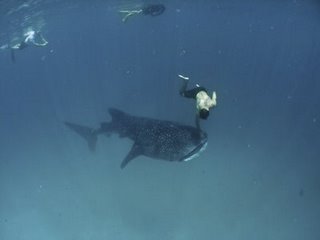
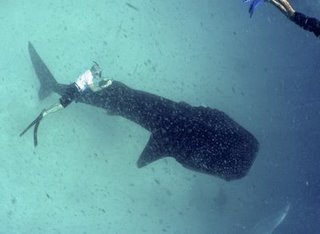
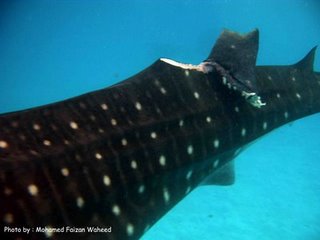
Folks, this is a tremendous accomplishment and sets very important precedent for other important shark areas in the world. Rather than skepticism and criticism, we need to celebrate this victory and encourage and work with the Maldives government to extend the ban to oceanic sharks.
Though not perfect, 12 miles of protected area is huge. For example, the work I have done with addressing illegal shark fishing in Cocos Island (CR) indicated that the vast majority of sharks were caught within 1-2 miles of the shoreline. The close in long-lines has mostly sharks on them. As we moved out, the lines had few sharks and lots of tuna and other pelagic fish. Seems the sharks are aggregating close to the island to be cleaned before heading deeper and further out. When feeding deeper, he long-lines did not reach them.
So point is, a large area of protection gives many shark species a significant period of protection. Certainly they are vulnerable when leaving the area but if they do in fact spend long periods of time hunting in shallower waters, much of their lives will be free of threat.
Great work!
Shawn
great news and not a moment too soon. There were times in the early 90's when I used to see sharks on most dives there, and sometimes in excess of 20 greys and white tips. Last time i was there I saw only a handful of reef sharks in 3 weeks.
I'll never forget the time that the fishing Dhoni that supplied Angaga Island fished the grey reef sharks from Angaga thila - which beforehand was a great shark dive literally 10 minutes from the island. They even took a pregnant female.
It's important to remember that shark fishing has been banned in the tourist atolls for over 10 years, but it's still been happening as it's difficult to police. With a blanket ban on reef shark hunting, at least they only need to determine if it's an oceanic species or not, rather than where it was caught.
Let's all hope that President Nasheed continues to walk the talk and sets an example for the world
http://news.bbc.co.uk/1/hi/world/south_asia/7895953.stm
Steve
great news and not a moment too soon. There were times in the early 90's when I used to see sharks on most dives there, and sometimes in excess of 20 greys and white tips. Last time i was there I saw only a handful of reef sharks in 3 weeks.
I'll never forget the time that the fishing Dhoni that supplied Angaga Island fished the grey reef sharks from Angaga thila - which beforehand was a great shark dive literally 10 minutes from the island. They even took a pregnant female.
It's important to remember that shark fishing has been banned in the tourist atolls for over 10 years, but it's still been happening as it's difficult to police. With a blanket ban on reef shark hunting, at least they only need to determine if it's an oceanic species or not, rather than where it was caught.
Let's all hope that President Nasheed continues to walk the talk and sets an example for the world
http://news.bbc.co.uk/1/hi/world/south_asia/7895953.stm
Steve
Steve,
We'll make sure this ban is implemented properly. Its sad about what happened at Angaga Thila and also from other sites. I was diving in Baa atoll last year and didn't see a single reef shark. Except for fished out ones. I think our president Nasheed try and do his best. Let's hope for the best. He can't change all the damages from the past 30 yrs after 4 months as the President.
Cheers
Shaff
I think it's important to note that export still hasn't been banned. This leaves a loophole where fishermen can say that they caught the shark 12 miles out and just fish them anyways.
.jpg.857dbbfbdc4d79d9c6ebf7b4ba96ed1b.jpg)
Terms of Use Privacy Policy Guidelines We have placed cookies on your device to help make this website better. You can adjust your cookie settings, otherwise we'll assume you're okay to continue.

A worldwide community for underwater imaging.
