Skip to content

Photography Gear and Technique / Archived topic

Canon EF 24-105L underwater preliminary test

Started by Drew ·

  • 7Posts
  • 7Replies

Read-only discussion

Canon EF 24-105L underwater preliminary test

7 posts
  1. I've been trying to find a nice fish portrait and near standard angle zoom lens. I'd considered the 24-70 but it's heavy and the lens is actually longest when it's at 24mm. I've always liked my 24-105 which has supplanted my 24-70 as a travel lens. With IS and 105mm on the long end, plus it's a normal lens whereby it's shortest at its widest. Combined with a domeport, I thought it'd be a flexible lens to take on the hunt for cephalopods and manage perhaps 1:0.5 with a +2/+3 diopter. As there are no custom gears for the seacam housing for this lens, I used an Ikelite gear for the Tokina 10-17 to control zoom.

    I decided to try it with a +3 B&W diopter behind a 8" domeport. On fullframe, the lens has a bit of vignetting at f4. The barrel distortion is evident as well. But it's sharp in the center and the edges caught up around f6.3, with very acceptable corners at f9 (Sorry, tests pics will have to wait a few days).

    With a +3 diopter, the 24mm is effectively 29-30mm, so I'll probably switch between a +1-3 depending on. On the long end, the 105 gives me a tight 4" full frame but there is a bit of softness around the edges even at f16, probably due to the proximity to the dome vertex. It's not a macro lens but it will work as a fish portrait for medium to small fish like flasher wrasse etc while allowing me a decent wider focal length for turtles and nappy wrasse and such.

    Photos will come on Friday. :)

    Edited by Drew
  2. how did you position the lens with respect to the port? the entrance pupil moves a lot when this lens is zoomed.

  3. I positioned for the 24mm. I guessed the EP from using a laser pointer into the lens. Seems I got it right since the corners are pretty decent right out but with focal lengths of 20+mm corners don't usually fudge up as much. I'll try it without a diopter in the pool to get comparison results.

  4. so where does that put the lens mount or some other reference with respect to center of the dome?


    what happens at other focal lengths?

  5. so where does that put the lens mount or some other reference with respect to center of the dome?


    what happens at other focal lengths?

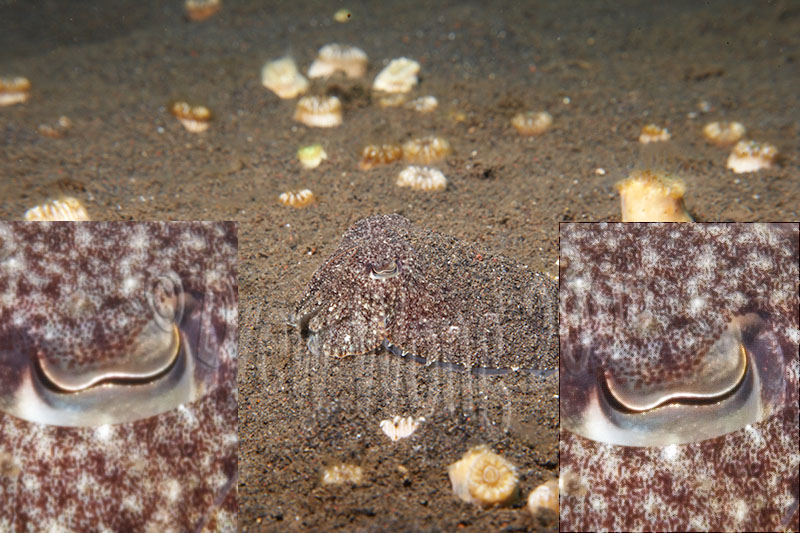
    The lens mount is fixed. The EP moves with the telescoping lens and the virtual image is squeezed as the lens approaches the dome port vertex. What is lost is the 1.33x magnification of a flat port. Here are a few examples at 105mm with a +3.

    post-1861-1240149300.jpg

    As you can see, there is a bit of softness and diffraction from using the diopter but a bit of sharpening will clean that up. You can compare the 100% crops of the eye. One is sharpened in PS and the other straight from RAW.


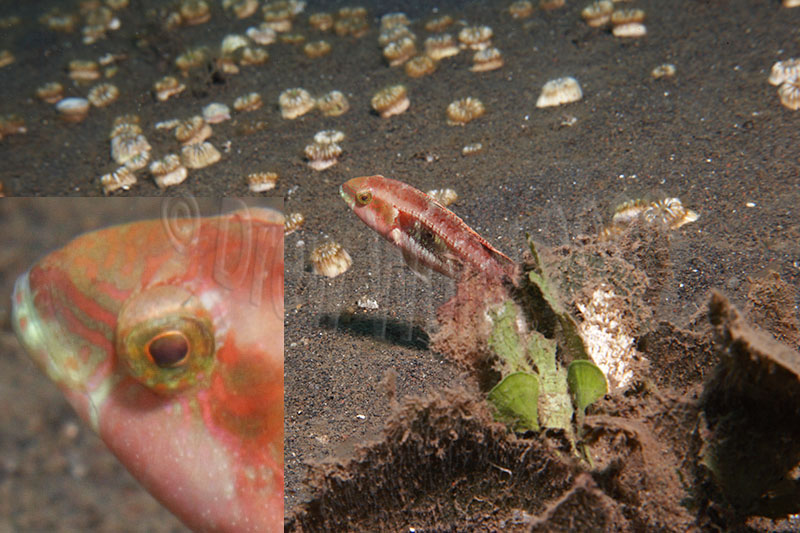
    post-1861-1240149456.jpg

    Same thing but without post.


    I couldn't find anything to shoot at 24mm since the damned fishermen just dragged their net over the site and all the octopus refused to come out of their holes. I don't poke them out of hole as all you get is fleeing behavior. Which is pretty much what many people have.


    I may get a few more dives in at Secret Bay where I'll try the lens combo again and shoot the wide end. The site where I tried this combo didn't have the subjects for this lens (all too small). The 105 with +3 gives a litte under 0.5:1. I may try a 12mm extension tube but that would vignette. probably.

    Edited by Drew
  6. I guessed the EP from using a laser pointer into the lens.

    How does that work? I want to figure out the EP for my 70-200 at various focal lengths for panoramas ...

  7. if your doing panoramas, then you probably have (or should have) a pan head and nodal slide. put the camera and lens on the head and slide, and find (or move into place) a close vertical object and more distant object. pan to the left, if the rear object appears to shift to the left, then the pivot point is ahead of the entrance pupil/nodal point and you need to move the lens forward with respect to the pivot. if the distant object moves to the right, then move the camera/lens back. a bit of trial and error will get you very close, then put some marks on the slide for different focal length. these instructions are in the Really Right Stuff catalog.

Turtle

Account

Navigation

Search

Search

Configure browser push notifications

Chrome (Android)
  1. Tap the lock icon next to the address bar.
  2. Tap Permissions → Notifications.
  3. Adjust your preference.
Chrome (Desktop)
  1. Click the padlock icon in the address bar.
  2. Select Site settings.
  3. Find Notifications and adjust your preference.