If you are going to shoot wide-angle, then most of the wreck will be lit by the ambient light. Your strobes will light objects up to 2m away, at most. Powerful strobes don't help, as you often have to reduce the power to balance the strobe light with the sunlight. The angle of the strobe's beam is more important than the power (I think that the wider, the better). One strobe will often work as well as two. At 35-40m you will be lucky to get f8 shooting at ISO100 and 1/60 sec, even in Turkey. On most historical wrecks the relief is low, and good shade contrast (a relatively long exposure or a wide aperture) is necessary to see the structure of the wreck. Modern wrecks stand proud of the seabed, and can be shot as silhouettes against the surface, allowing a faster shutter speed or higher f-stop.
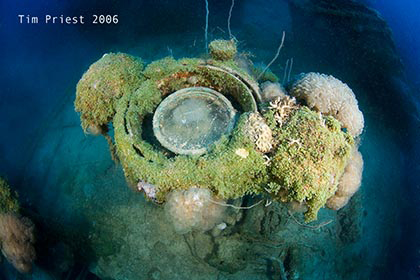
1/125 f10 ISO200
Two Inon wide-angle strobes at 1/2 power
Shot at 40m in the tropical Pacific (Bikini atoll)
Only the binnacle is clearly illuminated. The remainder of the wreck is a silhouette.
For macro, two strobes avoid the problem of harsh shadows. As you're close, the strobes don't need to be that powerful. You will be shooting at f22, though, to get depth of field on artefacts.
If you are shooting around wreckage or working divers, smaller strobes may be easier to position.
If you are shooting around wreckage or working divers, backscatter can be very difficult to avoid. Pull the strobes back well behind the dome, and angle them outwards by about 20-30 degrees. You can use relatively short strobe arms (25-35cm), as long as the strobes' hotspots (the centre of the beams) don't overlap.
If you also shoot on a site that's shallow, have you thought about using ambient light, and a reddish filter, instead of strobes for wide-angle shots? Should work down to 12-15m in Turkey.
I would say that most photographers working seriously don't use Sea & Sea strobes...
... and watch out for corrosion at the bulkheads: Sea & Sea have often used different alloys in the construction of their equipment, setting up electro-chemical corrosion, causing the cables and bulkheads to seize if not washed thoroughly and lubricated every few days.
Tim





 I think Sea&sea strobes are not bad. Unless you have a different experience, I think they are well designed, robust and yet quite compact.


