Skip to content

Lights, Strobes, and Lighting Technique / Archived topic

Inward lighting setup

Started by frisco ·

  • 16Posts
  • 16Replies

Read-only discussion

Inward lighting setup

16 posts
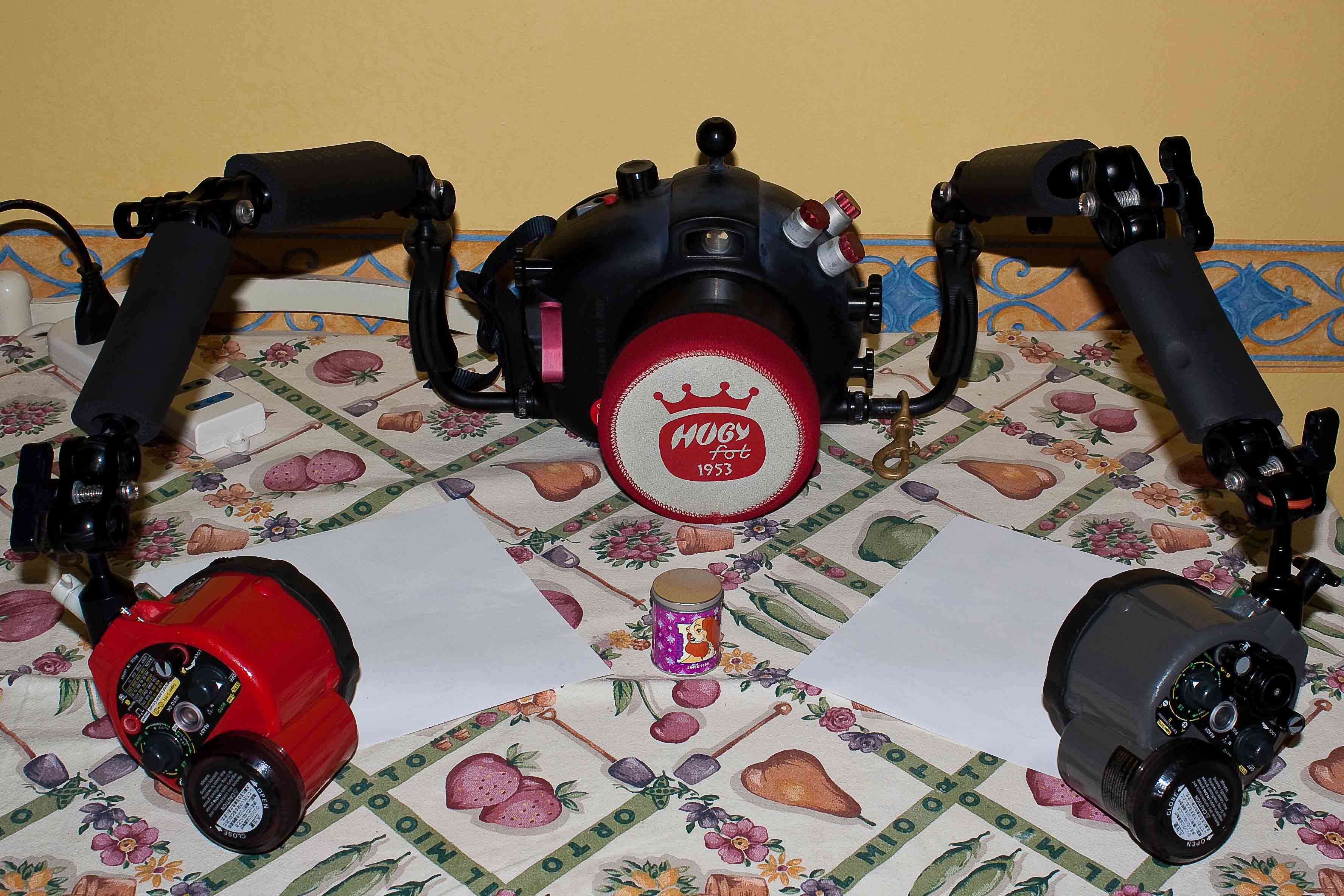
  1. While I am waiting for my copy of Martin Edge's "The Underwater Photographer - 4th edition" I am trying to guess the strobe positioning with a flat port and a 60mm macro lens and a port to subject distance of approx. 15cm
     

    post-23262-1264944812.jpg


    The violet cilinder box represents the subject while the white paper sheats represent the light cone from each strobe (the Inon coverage without diffuser should be around 100° so the cone would be a little wider than the paper sheats); I am on the right path ????


    All the Best ..... Francesco

  2. I am on the right path ????


    Yes!

  3. Yes!


    Thanks Alex !!!!


    let's move one step forward: should the strobe be in line with the housing plane or should they be angled a little downwards ????


    Curious, curious, curious !!!!


    All the Best ..... Francesco

  4. I have to admit that I would never have thought of your set-up. Too many early days in muddy British water, I guess, and too afraid of backscatter with such an inward angle. Have you got any images yet? I'd be fascinated to see how it works.


    Tim


    :good:

  5. While I am waiting for my copy of Martin Edge's "The Underwater Photographer - 4th edition" I am trying to guess the strobe positioning with a flat port and a 60mm macro lens and a port to subject distance of approx. 15cm


    The violet cilinder box represents the subject while the white paper sheats represent the light cone from each strobe (the Inon coverage without diffuser should be around 100° so the cone would be a little wider than the paper sheats); I am on the right path ????


    All the Best ..... Francesco
     

    Won't all the light from the strobes overpower the subject? Seems to me that you would blow out any subject with the strobes facing the lens?

  6. I would guess the effect is to create the opposite to a black background by using the strobes to be the background and partially light up the subject from the sides with a weaker light.


    Like an almost white studio effect i am imagining.

  7. Yes it is giving some very nice results. especially on semi-transparent crustaceans.

  8. Won't all the light from the strobes overpower the subject? Seems to me that you would blow out any subject with the strobes facing the lens?


    Main use is to light only the very foreground of the image, either in macro or wide angle. The effect can be used unsubtly or subtly.


    It is not anything particularly new. It is just that Martin Edge is the first (I am aware of) to really write about it - explain how to do it and the benefits. And I think it is good to give credit to the people who are willing to share ideas and techniques, rather than the guy who says "I have been doing that for years, but didn't want to tell anyone".


    This bleached coral shot is taken with the technique:

    http://www.facebook.com/photo.php?pid=1075...mp;id=796325712


    And this is the best before and after I have (made on land) to show how strobe positioning can make the background black even when close to the subject:

    http://www.facebook.com/photo.php?pid=1071...mp;id=796325712


    Alex

  9. "I have been doing that for years, but didn't want to tell anyone".


    Ouch, I hope that wasn't me Alex - Craig showed me how to do this a few years back but I didn't realize it wasn't a mainstream technique. Sorry :-( As y'all know I certainly try to write about new underwater photography stuff I find interesting, but it's mainly about equipment as I don't feel I've mastered any techniques enough to write about them.


    Cheers

    James

  10. Ouch, I hope that wasn't me Alex - Craig showed me how to do this a few years back but I didn't realize it wasn't a mainstream technique. Sorry :-( As y'all know I certainly try to write about new underwater photography stuff I find interesting, but it's mainly about equipment as I don't feel I've mastered any techniques enough to write about them.


    Ha ha. No not at all.


    But, like you James or Craig, as someone who tries to spread the world on new ideas (that's why we're on Wetpixel and others are not), I am very used two stock responses:

    1) That doesn't work

    2) I have been doing that for years

    I have even regularly seen posts/email with both answers "It has been done before and it doesn't work!"


    There are many things that have been tried before or have been "invented" by several photographers playing with the same ideas in isolation at the same time. Also people try techniques without getting them to work technically or artistically. But I think when it comes to crediting people, it is good to credit those that share rather than horde their ideas and results. It encourages them to share more!


    Alex

    Edited by Alex_Mustard
  11. Woah .. ok that is the exact opposite to the effect I was imagining .. I can see how that would work .. but my mind was just going somewhere else.


    Marting Edges new book being added to my wishlist !

  12. Main use is to light only the very foreground of the image, either in macro or wide angle. The effect can be used unsubtly or subtly.


    It is not anything particularly new. It is just that Martin Edge is the first (I am aware of) to really write about it - explain how to do it and the benefits. And I think it is good to give credit to the people who are willing to share ideas and techniques, rather than the guy who says "I have been doing that for years, but didn't want to tell anyone".


    This bleached coral shot is taken with the technique:

    http://www.facebook.com/photo.php?pid=1075...mp;id=796325712


    And this is the best before and after I have (made on land) to show how strobe positioning can make the background black even when close to the subject:

    http://www.facebook.com/photo.php?pid=1071...mp;id=796325712


    Alex


    Thanks Alex. That is quite impressive! The idea still twists my head a bit. I suppose an U/W slate and some time in the shallows would be the best way to experiment.

  13. This is a great lighting idea! I think it works better (or at least more confortable :good: ) with "short" strobes like inons than with "long" ones like subtronics or ikelites...

  14. It has a place. It is very useful for lighting subject, but not background, even when the background in close. Similar but not exactly the same as snoots. The shot here is with Subtronics and not long arms, but your point is true, David.


    Just remember not to look at the strobes when you shoot. Otherwise you will blind yourself. OK, its not that bad, but if you are not looking through the viewfinder it leaves your eyes flashing like you have DCS!


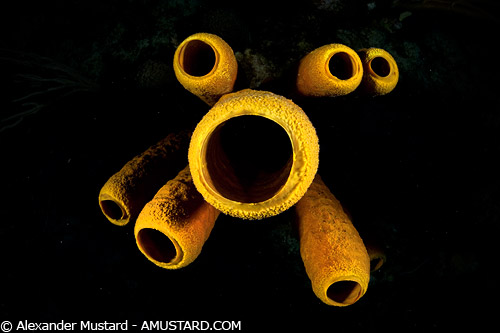
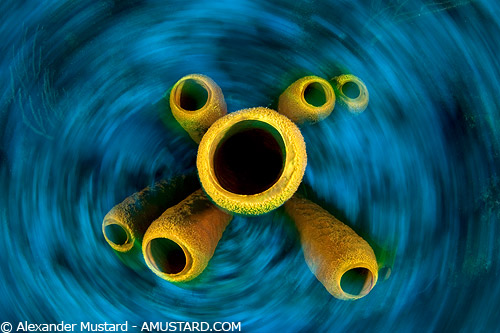
    It is something that you use subtly for me. For this shot the inward lighting allows me to light the sponges, but not the reef - making the frozen sponges and spun reef more clear.


    post-713-1265310643.jpg


    For comparison here are the same sponges shot at 1/320th - so no ambient light - so you can see exactly what the strobes were lighting - and more importantly what they were not:


    post-713-1265310819.jpg


    When I have got my images from Cayman on my website have a look. Quite a lot of macro and wide angle shot this way.


    Alex

  15. Great effect on the sponges Alex, how did you get the whirlpool look?

  16. This bleached coral shot is taken with the technique:

    http://www.facebook.com/photo.php?pid=1075...mp;id=796325712


    And this is the best before and after I have (made on land) to show how strobe positioning can make the background black even when close to the subject:

    http://www.facebook.com/photo.php?pid=1071...mp;id=796325712


    Alex


    Well how impressive is that first image. I thought you had used some kind of lens filter to achieve the sphere. Is that caused by the strobes only lighting that element of the coral and you having the strobes in exactly the right position giving an even arc on either side of the coral. . Why is it Alex that the light from the strobes does not totally wash out the shot. Looking at the positioning and the angle I would have expected the strobe light to head straight into the lens. I will have a go with this positioning next week at Lembeh.


    Stew

    Edited by stewsmith
Aquatica

Account

Navigation

Search

Search

Configure browser push notifications

Chrome (Android)
  1. Tap the lock icon next to the address bar.
  2. Tap Permissions → Notifications.
  3. Adjust your preference.
Chrome (Desktop)
  1. Click the padlock icon in the address bar.
  2. Select Site settings.
  3. Find Notifications and adjust your preference.