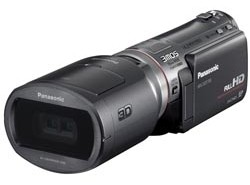
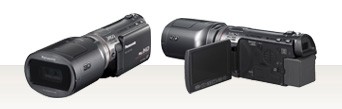
Engadget broke the news today about Panasonic's upcoming consumer stereoscopic 3D camcorder, which is supposedly going to be announced on July 28th in Tokyo. The camera is the HDC-SDT750, which is advertised as the "World's first 3D Shooting Camcorder." They think that it is a modified high-end 3MOS camcorder with a 3D conversion lens attached. Specs say that it shoots 1080p AVCHD 60fps (!).
Very interesting.....wonder how you would house it? Conversion lenses look like a non-starter and not sure it would really work with a dome.....
I'm told that no underwater 3D will ever work with a dome (to proper effect) because lenses focus on a curved virtual image. So you'll get a 3D effect.. but it will be of that virtual image.
I'm told that no underwater 3D will ever work with a dome (to proper effect) because lenses focus on a curved virtual image. So you'll get a 3D effect.. but it will be of that virtual image.
Well, I have been shooting 3D with two GoPro camera, and it seems to be working fine. What does it matter, this proper effect?
I think what Eric meant is that you can't use two lenses behind a single dome. Two separate domes should be OK, as you're finding.
Would love to see some of your Hero HD underwater 3d work- have you posted any online?
No GoPro camera focuses properly underwater, unless you have the modified ones with flat ports?
It looks like a TM700 with a stereo optical splitter...recording two side by side half frames (left eye, right eye). I haven't been able to find many details about the system but I suspect it will only be half horizontal resolution ie the resolution of each image will be 960×1080 pixels.
It will certainly be more convenient for the average 3D shooter, but I think that a dual camera full resolution system is still the way to go for image quality and control over 3D parameters (eg convergence).
It looks like a TM700 with a stereo optical splitter...recording two side by side half frames (left eye, right eye). I haven't been able to find many details about the system but I suspect it will only be half horizontal resolution ie the resolution of each image will be 960×1080 pixels.
It will certainly be more convenient for the average 3D shooter, but I think that a dual camera full resolution system is still the way to go for image quality and control over 3D parameters (eg convergence).
Exactly- not really ideal for acheiving top-quality results. But an interesting move nonetheless.
It may just splice 2 960x540 images onto 1 stream, but the result is still 3D 1080p, but the result is no post convergence, which probably makes color correction interesting Still, I doubt for web and even HDTV use, the quality will be discernible by the lay person. Most still can't tell the difference between 720p and 1080p.
However for pro 3D acquisition, the AG-3DA1 seems to be their answer.
However for pro 3D acquisition, the AG-3DA1 seems to be their answer.
Isn't that the camera with the $20k RRP? I know the cost will come down eventually, but a camcorder somewhere between the two already announced would definitely be welcome!
Cheers, Simon
Camcorderinfo.com has just posted an 11 page review:
I'm told that no underwater 3D will ever work with a dome (to proper effect) because lenses focus on a curved virtual image. So you'll get a 3D effect.. but it will be of that virtual image.
I have successfully built a 3D lens system with twin lenses behind a dome with proper effect. They do need to focus on the virtual image. The limitation is that there is a relationship between interoccular lens distance and dome diameter. When the lenses have a given IO, then the dome must have a given diameter. The math was worked out long ago and empirically tested by Dimitri Rebikoff. It's true the wide angle dome system that Imax built in the 80's didn't produce pleasing effects, but that doesn't mean it can't be done. My 3D dome lens takes really great wide angle close up 3D images...which was sort of a holly grail for me to achieve.
Mark
I have successfully built a 3D lens system with twin lenses behind a dome with proper effect. They do need to focus on the virtual image. The limitation is that there is a relationship between interoccular lens distance and dome diameter. When the lenses have a given IO, then the dome must have a given diameter. The math was worked out long ago and empirically tested by Dimitri Rebikoff. It's true the wide angle dome system that Imax built in the 80's didn't produce pleasing effects, but that doesn't mean it can't be done. My 3D dome lens takes really great wide angle close up 3D images...which was sort of a holly grail for me to achieve.
Mark
Mark -- I, for one, would like to know the details of the math, and see your images. Got any to share?
Mark -- I, for one, would like to know the details of the math, and see your images. Got any to share?
When time permits I'll see if I can find a paper on the math.
Mark
Mark -- I, for one, would like to know the details of the math, and see your images. Got any to share?
John,
I could not find the paper I remember. I did find a reference to an article indirectly covering this topic, but apparently without much specificty. See Optical Aspects of Underwater Windows in SPIE Vol. 208 Ocean Optics VI (1979).




 Still, I doubt for web and even HDTV use, the quality will be discernible by the lay person. Most still can't tell the difference between 720p and 1080p.
