



After the cold, green and murky waters of the Orkneys, cluttered with mouldering warships, the northern divers of Digigreen thought about better visibility and barbecues: September in the Maltese Islands!
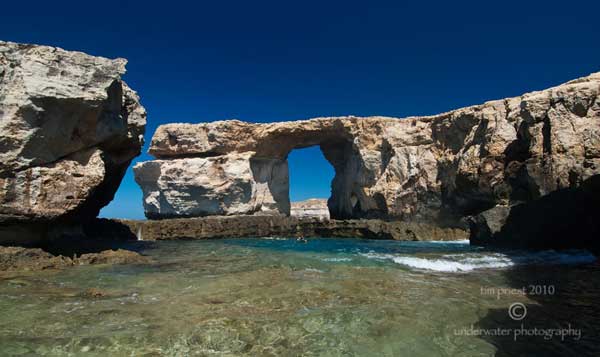
Gozo is a small sister to Malta, inhabited for 6,000 years and, like Orkney, home to massive stone monuments from prehistory and a long, long history of warfare. There are also high winds, and diving needs to move around the coastline to exploit the shelter offered by limestone cliffs and deeply incised bays. The buildings of these densely populated islands are still built from the warm, yellow local stone and face inwards away from the midday heat and glare. The food is fresh, vegetables are home-grown; lamb, rabbit, fish and goat's cheese are typical meals and the local wine improves year on year (and after a day's exercise!).
There is a lot of shore-diving and, although the island is a lot more rugged, it is rather like Bonaire in that the dive shops will hire gear to qualified divers and there are a lot of battered jeeps to hire: many of the dive sites are signposted, but the limestone does make for some interesting entrances to and exits from the water. In September the water temperature was 25C (a respectable 80 F). Some days were calm - some weren't!
I flew to Malta and caught the ferry across to Gozo, arguing on my mobile with my credit card company who couldn't seem to cope with the idea of travel from England to another part of the EU. I perched my GPS on the dash of a Suzuki, and eventually wriggled through the narrow streets to find a rather forbidding wall pierced by a small door, behind which was a warren of irregular rooms, lots of pot plants and a delightful kitchen facing onto a curiously deep swimming pool on the edge of a steep valley running south to the blue sea. I joined the German, Swedish, Dutch and English team and had to admit to my new Nauticam - and that it wasn't 100% fit.
Eight days of diving: caves, caverns, clefts and cliffs. Unfortunately, the dive gear has to get up and down some of the cliffs...
... and the steps are steep. A few sites had ladders into the water, particularly by the artificial reefs at Xatt l-Ahmar. Some of the ladders, however, have collapsed into the sea, like the one at Ta'Cenc (the odd names come from an Arabic heritage, rudely terminated and tenaciously resisted by a confederation of European knights from the Middle Ages; their fortresses opposing Turkish reconquest still dominate the skyline of the islands). A leap of faith into the water, but a bit of a struggle to leave at the end of the dive!
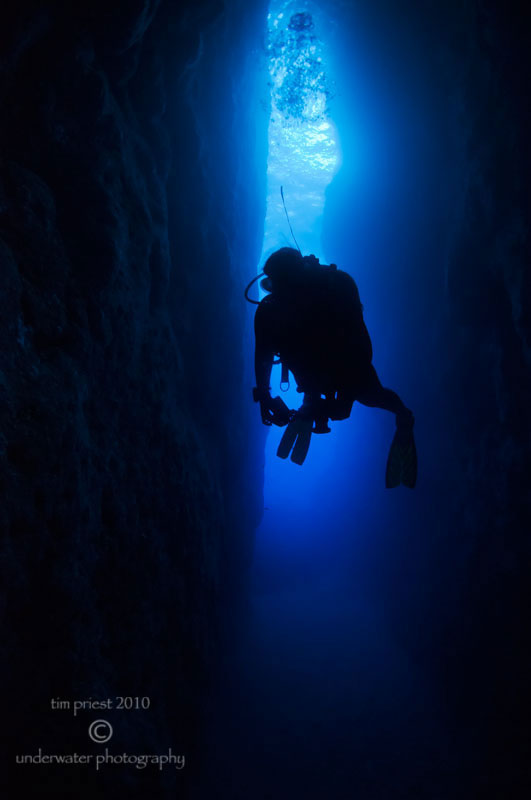
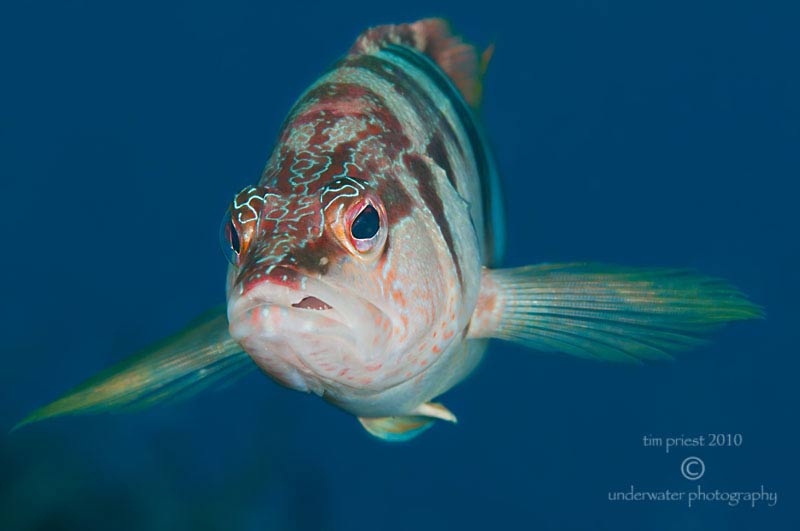
The highlights: swimming across the lake at the "Inland Sea" to enter a narrow tunnel that reaches over 30m or 100' and the open sea; hunting scorpionfish in Xwejni bay; struggling over a fossil reef to the "Blue Hole", a collapsed cavern, smaller but much more attractive than Belize's famous one; the chimneys of Reqqa point where the cliff just keeps on, down and down into the deep blue and a warren of little passages around the tiny island of Comino, midway between the islands of Gozo and Malta.
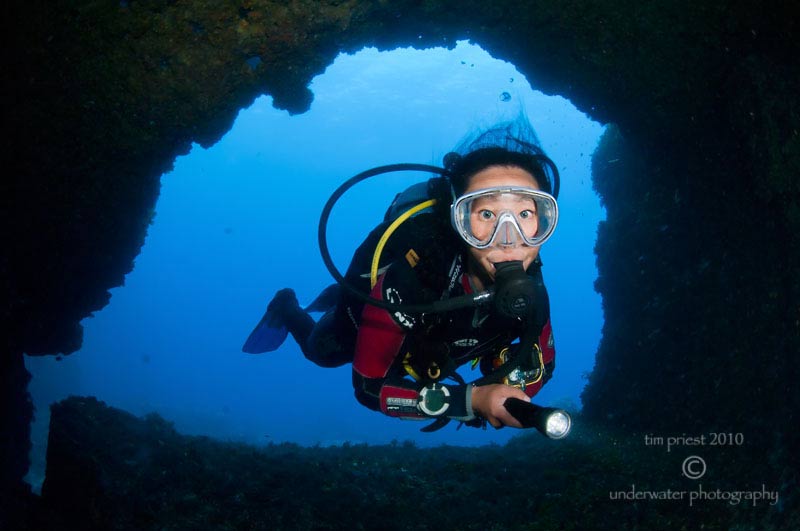
The lows: driven from north to south, and then south to north as the autumn winds whirled around the passage between Sicily and Libya, we never got to dive the WWII Blenheim bomber at Xorb-il-Gaghin (a challenge at 42m, 140'); hunting across endless Posidonia seagrass for the fabled "Double Arch" at Marsalforn; my impressive Nauticam housing being repeatedly dismantled as the LiveView controls jammed and the leak detector took to going off at random and suffering from the new viewfinder not fitting the old acrylic mounting.
However - this was the result: a little European interest, anyone?
http://www.flickr.com/photos/timsdiving/se...57624892249969/
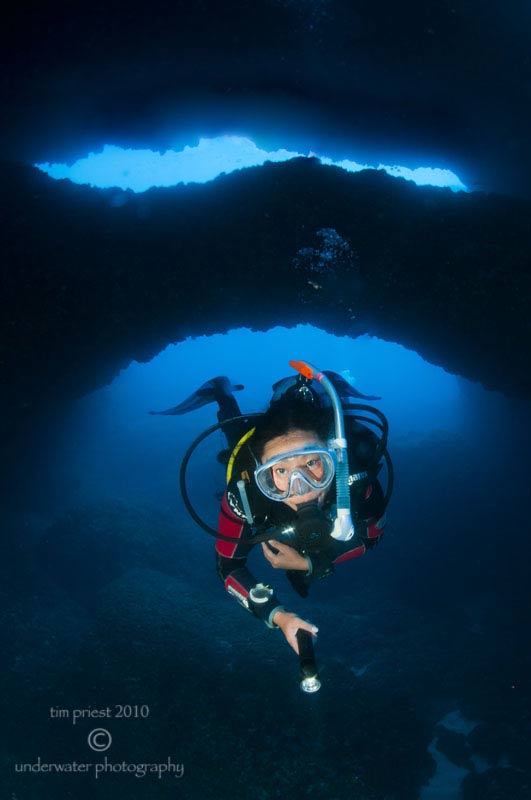
I have to thank Sarah for appearing in so many caves, and for modelling for so many photographers; she also, eventually, abandoned her snorkel!!
Tim



