Dear NW diver,
I can give you some thoughts, based on my actual shooting experience. I held off on going digital for quite a while because I wasn't willing to give up TTL flash which I had come to know very well with my Nikon F5 film cameras, And because I didn't want to spend a lot of money on a new set of lenses for the smaller DX sensor in Nikon cameras prior to the D3. I bought a D3 shortly after they became available, but before there was a housing available for the D3, Nikon introduced the D700, which I decided would be a better underwater camera for TTL shooting. Because because the D700 had a separate flash compensation button which allows you to increase or decrease a TTL flash output without affecting the camera's ambient light exposure metering or exposures on auto-exposure modes.
I had been, and still sometime use, Hartenberger strobes, which like the Subtronic strobes you use, are really excellent. To use the Hartenberger strobes in i-TTL required adding the Heinrichs-Wiekamp i-TTL (HW) converter to the system, between the camera and the strobes. The Sea&Sea i-TTL converter is essentially a "repackaged" H-W converter. I think that your Subtronic strobes would also require this converter, in some form, for you to shoot i-TTL with them.
I took my Hartenberger 250 strobes on a month long trip, in October 2009, to the Lembeh Strait and did 80-90 dives with them. Only days after I received my first housing for the D700. I have since purchased a second D700 housing and several more camera bodies.
In the discussion about my i-TTL experiences, I will use the term "first shot" to refer to the first shot I take of a new subject during a dive. The shot before I have looked at the LCD & histogram to make any corrections.
The HW converter, in general worked well, and many "first shots" were usable. Every once in a while a "first shot" (or a subsequent in a series) was way off. This occurred perhaps two or three times per dive. But in general the strobes, with the HW converter produced consistent and usually predictable results. I was using the HW external converter which is powered by a small battery that needed to be recharged every couple days. And to charge it you had to open the converter. And reseal it after the charge. I do not like the converter's o-ring seal design and feel that the design might make a flood of the converter too likely. But I have experienced no converter floods, even though I have opened and recharged the battery about 15-20 times during the Lembeh trip. And a few additional times on a subsequent November-December 2009 trip to Bali. But I am still a little "paranoid" about this.
In the spring of 2010I purchased several Ikelite 161 strobes and the parts necessary to shoot i-TTL with them. Like my Hartenberger strobes, the Ikelite strobes require an i-TTL converter. One REALLY BIG difference is that the Ikelite converter is powered by the NiMH battery in the 161 strobe. This means that as long as the strobe has enough battery power to fire, the converter has enough battery power to operate. It also means that the converter is not opened and closed for charging (or battery replacement as in the S&S converter). It is simply there, sealed forever. I have take the Ikelite 161 strobes on two trips now - to Australia and to Bali. I have done 60-80 dives with them and they have performed flawlessly. And without the occasional "off the map" wildly wrong exposure. Perhaps because the converter power is coming from a larger, more consistent voltage battery. Or perhaps the Ikelite converter is simply a better design. I also haad the chance to shoot some larger subjects, like wobbegong sharks, in Australia than what I had shot in Lembeh. And the Ikelite 161's handled those well. too.
Digital TTL is different than film TTL, and in my opinion, not quite as perfect and not quite as predictable. It depends on information, some of it from the lens chip which provides distance information which is not often right underwater, especially when a dome port is used. And from a pre-flash, which occurs prior to the actual exposure flash. And conditions may change slightly between the two. But digital exposures are a lot more "forgiving" than transparency film and the result is that I am now getting quite a few usable "first shot" exposures. And if your housing allows you to easily access a flash compensation button (if your camera model has it), you can fine tune your flash exposures from the housing and not have to reach up to the strobe(s) each time you want a little more or less flash power. This allows you to shoot different flash powers much faster and with much less movement which can disturb your subject.
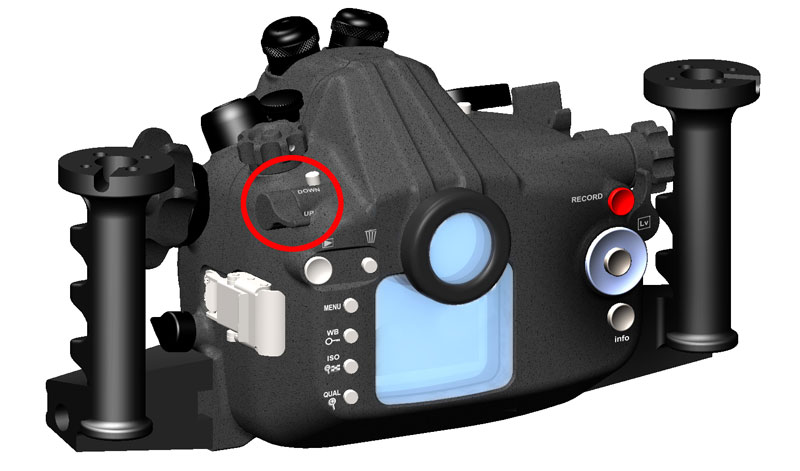
I have not had the opportunity to use and test TTL strobes that "slave" with the camera's pop-up flash. I would think that this could work very well. And Alex Mustard's D700 review with the Nauticam housing seems to indicate that it is. One drawback of shooting this way is that the pop-up flash used the camera battery for its power, which means that you will deplete the camera battery faster. In most D700 housings you have to completely remove the camera from the housing to change the camera battery, which is more work and may not be practical depending on where and how you are diving and the conditions between dives.
My conclusion, based on my experience, it that a good TTL flash system is an extremely worthwhile addition to any underwater camera system.
Fred




 ), I like the simplicity of the optical fiber and the TTL works very well also.