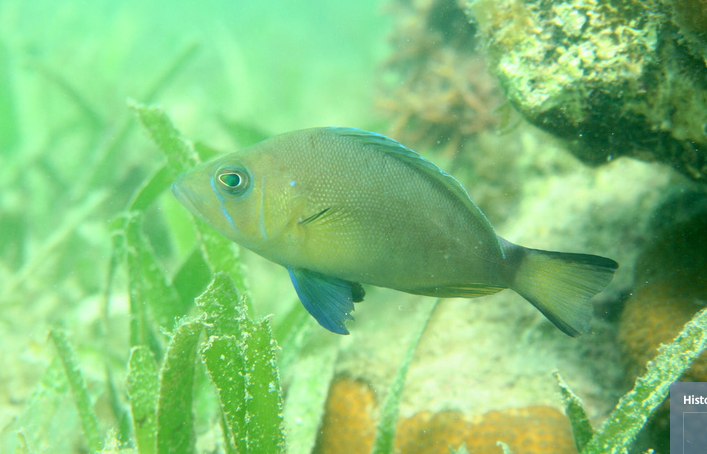
On my recent trip to Roatan I had been hoping to find a masked hamlet which is reported from that region. However, I could not find any resembling the image in the Reef Fish ID book and my dive masters didn't know about it either. Finally I found the hamlet shown below which has the dark margins on the tail and top of the pectoral fins that are shown for the masked hamlet but not the mask on the face. In addition, the colour is darker than shown in the book. So, is this a regional or temporal variation of a masked hamlet that lacks the mask or is it some kind of hybrid?
Bart
All hamlets are very dark when they are young - it could be a young butter hamlet changing to more adult colours - if it was small?
Alex
In the ReefNet DVD under "hybrid hamlet" we have included a photo (11 of 12) from San Andres that is almost identical to yours. We also have a photo of a masked hamlet without a mask. For hamlets, it's extremely hard, and very subjective, to define a dividing line between a "species" and a hybrid.
Les Wilk
Thanks Les & Alex,
This hamlet had adult size so at least in this case I don't think it is a developmental reason. It was in a rather shallow area with mixed sand, seagrass and some limestone boulders/corals rather than a proper reef so maybe that had an effect, or it was indeed a hybrid (I was thinking tan & masked).
Hybrids are confusing but I think it is also fun to see fish that appear to be normal at first but then have or miss some extra markings. It is even more fun when you can start to link such variants to behavioural, regional, sexual, or developmental effects. That is one advantages of the ReefNet DVD because it has multiple images per species so it captures some of the variation. Unfortunately I have switched completely to Linux so unless I get a windows emulator going my ReefNet DVD will be collecting dust.
Thanks for the ideas on this one.
Bart
Yes, hamlets do defy the definition of species these days. They are mostly identical genetically, but there is a strong tendency to mate within the color group- some morphs (species) are more clearly separated than others. Plus there is significant hybridization, several percent, so it is not surprising to see all kinds of mixed forms. Right now we cannot distinguish genetically whether something is a new morph or a hybrid- raises an interesting question when a particular variant is found only in one region, argues more for a local species than the occasional hybrid. I guess hybridization experiments would tell us, but no-one is doing that- it is hard to raise hamlets in captivity.