The Canon Ixus 80is you already have should be just fine for practicing underwater photography, in the Canon underwater housing WP-DC-22 it will be quite OK. It will allow you to take fun pictures from your dives and great memories back home.
I myself started with the very similar Canon Ixus 800is in Canon housing, and took the camera with me to my first big diving trip in Thailand in November 2006. I had done about 30 logged dives & AOWD just before the trip.
Here is a selection from the very first snapshots I took with that camera at Phi-Phi island:
https://picasaweb.google.com/ianleiman/Thaimaa2006PhiPhi#
Followed by that I did a 5 day very memorable liveaboard to Similans, and took maybe a 1000 pictures, out which I think these were among the best (and some just "typical" to show some bad ones too):
https://picasaweb.google.com/ianleiman/Similan#
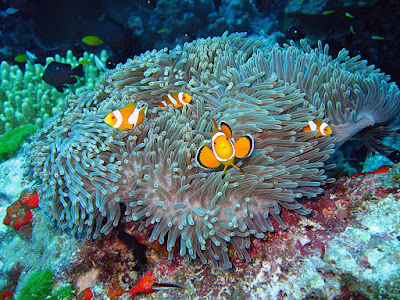
I should expect that you should be able to get similar shots with your camera - eventually. 
My diving and underwater photography skills were very rudimentary at that time, and I certainly have developed enormously since then, but I am glad I took the camera with me and took those pictures. They are great memories. I have since moved to a much more expensive and complicated camera setup, but that Canon Ixus was very good to begin with. In fact I still own a Canon Ixus (a newer 980is) and do have Canon underwater housing for that too, and do still use that occasionally too. The camera is so small, that it is easy to carry with you always. Use the lanyard that comes with the casing to keep it safely on right hand. You might also want to get a double-ender so you can clip it to BCD D-ring at shoulder when not taking pictures.
The Canon native housing is very easy to use, and putting the camera in and taking it out takes just a moment, so you can definitely use it both for diving and on surface. I always have two batteries and memory cards, and on liveaboard trips I swap fresh recharged battery after each dive, and swap the memory card as well. The case should be opened in your air-conditioned cabin only to prevent moisture entering the case. When empty, I keep desiccant packs inside the closed case. On day boat trips I don't open the case, only in the air-conditioned hotel room.
The internal flash on the camera is good for only very short distances, 30...50 cm, and works only in very clean (particle-free) water. For longer range shots you should set flash-off and use manual white-balance setting - this is so called available light photography. You mostly shoot with the zoom at widest setting, so called wide-angle shots, although with this camera you don't really get very wide angle shots. The zoom is good only for shooting small creatures at very close distances with the flash, for taking so called macros - but again you won't be getting pictures from really small creatures with this camera.
My advice is to take lots of pictures, and video too, and try to review them as soon as possible after each dive. It would be good to have a laptop on your trip. Then look at the pictures carefully, think how you can improve and do things better on the next dive. The first pictures will be great disappointements, but don't worry, they will improve quicker than you think
It might be a good idea to buy a current book on underwater photography, and read it well before you go.
The book by Martin Edge is pretty good and thorough.
Just be aware, underwater photography & scuba diving in exotic places can be highly addictive, and you might end up spending a fortune on it
Hello
A little background: I started diving (still doing my PADI OWD course) and got interested in underwater photography. We are going to Thailand on 28.2.2011 and plan on doing dives there. The problem is that I don't have a clue what equipment should I buy?
I currently own Canon Ixus 80is and I am not certain if that is suitable for diving purposes. It has a possible underwater case but I am not sure if that is good combo. The problem is that the camera is my only camera, and inserting it to a case and removing it (for example night time purposes) and then rehousing it in the case is a good thing to do. I think that with each "sealing" you get a chance of getting some dirt between the case and it makes it leak, thus ruining my camera. :/
I do not want to buy expensive equipment right at start because I am just starting the hobby and it can come costly if I happen to realize that it's not my thing.. So I am turning to you now to get help for my newly found hobby.
So few questions:
- Anyone has experience with Canon Ixus 80is underwater photography? Is it "decent quality" or totally rubbish?
- Does it matter which case to get? The points on this: Is others more secure in waterproof way? Does it affect image quality?
- How well does the underwater digital single use cameras work? Mares underwater single usage cameras can be bought for ~50 euros (~60$) from thailand. Should I go with these? Problem is that these add easily up to the case price..
- Is there a camera (small compact) that is waterproof? Up to ~18m that I am allowed to dive now. I mean without a casing? Any examples? Experiences?
- Is it better to have underwater camera and "land camera" or just one camera and using it also in water and in land?
- Any other points of view that should be taken in to account?
Thanks!






