



Taken in Cayman by Tepper.

Read-only discussion
Taken in Cayman by Tepper.
Taken in Cayman by Tepper.
My marine biologist daughter thinks it is some type of isopod.
Seeing and photographing this shrimp for a couple years in waters around Grand Cayman, and not finding anyone to put a name to it, friends and myself enlisted help, got a collection permit , and went to work.
here is an article my friend Dr. Everett Turner wrote regarding the hunt, for UWP 52.
The Great White Footed Shrimp
Expedition
By Everett M. Turner Jr
"Our great white-footed shrimp
expedition was a quest to identify a
small-unknown shrimp. My wife, Essi
Evans and I have been avid fish and
critter watchers (and photographers)
since we started diving in 1987. One of
our favorite dive destinations is Grand
Cayman. That is where this story begins.
In February of 2009 we were diving
Sea Fan Reef, the house reef at Cobalt
Coast Dive Resort on Grand Cayman’s
North Wall. It is a great shore dive with
plenty of fish and lots of creatures,
common and uncommon; enough to
keep a photographer busy for a 2-hour
shore dive. While poking around near
the top of the mini-wall we noticed a
brown sponge with a number of little
-excruciatingly small, actually- whitefooted
shrimp sitting in the out pour
openings. I took a few photos and later
that evening we began our quest to
identify these critters.
Having no luck, the next day I
described them to any one who would
listen. No one had ever seen or heard
of them until I mentioned them to our
friend Cindy (Cynthia Abgarian). She
had seen and photographed them in
the past but had also had no luck in
identifying them. She was very keen to
know what they were. We soon moved
on to other subjects and other finds and
then we were back in Canada and back
to work, the shrimp mostly forgotten.
In June of 2009 we were once
again diving in Cayman and again we
found the shrimp in the same brown
sponge. The shrimp were not too shy
but appeared to dislike the bright light.
They were more active and more out
of the outpour opening when there was
cloud cover or later in the afternoon.
What you cannot tell from the photo is
how small these shrimp really are. They
are about the size of carpenter ants. They
also seem to be constantly associated
with even smaller white sponge worms.
More pictures were taken but still no
identification was made.
Upon return to Ontario, I decided
to send my shrimp photos to Les Wilk
of ReefNet, publisher of the DVD Reef
Fish Identification Florida, Caribbean
Bahamas. Les has often identified other
fish and critters for me. Les reported
back that he had seen other photos of
this shrimp but that he did not know
the identification/classification. He
forwarded the photos on to Dr. SammyDe Grave of the Oxford University Museum of
Natural History, Oxford, U.K.
Sammy wrote back: “It is either an undescribed
or non-colour recorded species of Periclimenes/
Cuapetes. People have promised me specimens
before, but none have materialised. Without an
actual specimen I cannot really be sure which, as
about 4-5 species in that genus in the Carib still
have no colour documentation.” This was now
getting exciting, the possibility of an undescribed
species and perhaps a chance to name it!
I contacted our friend and diving buddy, Dora
Valdez, manager at Cobalt Coast Resort and asked
her about the possibility of collecting specimens.
Having previously shown Dora the white-footed
shrimp, she was very keen to help. She contacted
Nancy Easterbrook, owner of Divetech dive
operation at Cobalt Coast Resort with whom we
have been diving for the last 9 years, to ask for
her assistance in contacting the Department of the
Environment (DOE) on Grand Cayman.
In short order we had a contact, Mr. Timothy
Austin of the DOE. Sammy agreed to contact
him and provide the necessary information and
credentials to obtain a permit to collect specimens
of our little white-footed shrimp.
While waiting for the permit, Dora- also an
avid photographer, set out to get some more pictures
of the shrimp. She enlisted Simon Dixon, friend,
fellow photographer, dive instructor at Divetech
and marine biologist in her quest. They found more
sites with the white-footed shrimp. In addition to
Sea Fan Reef, they found them at Lighthouse Reef,
Sand Hole, School House Reef, and a number of
other sites with shore and boat access. The shrimp
appeared to be always in the same type of sponge,
likely the Touch-Me-Not Sponge.
The Permit arrived very quickly, with very
specific details in regards to who was allowed to
collect, how many shrimp could be collected and
when and where they could be collected. And thus
began our expedition. The members were Essi,
Cindy, Dora, Simon and I. The permit was valid for
September 1 to November 1. We were allowed 6
specimens and they had to be collected outside of
marine zones. Collection took place in October.
Sammy sent us detailed instructions on
collecting, handling, processing and mailing the
specimens. Dora and Simon did some preliminary
scouting prior to Cindy, Essi and me arriving on
island. As we met to discuss our little shrimp
hunt expedition, we soon realized that Sammy’s
directions for collecting the shrimp (shoeing them
into a collection bottle) were not going to work,
as the shrimp seemed to stay within the sponges’
outpour openings. Cindy provided the capture
means, straws from Panera Bread and a 20cc
syringe.
Simon and Cindy were the collectors. Our first
attempt was successful and convinced us all, but
especially Simon, that the sponge was indeed the
Touch-Me-Not Sponge. Simon had decided to forgo
the syringe and just sucked up the shrimp through
the straw, not an easy task at 25 feet of seawater.
This worked well and we got a nice specimen;
however, Simon ended up with quite a burning
sensation in his mouth and on his lips and tongue
The rest of the collections were uneventful with the
syringe and straw.
We processed the specimens according to
instructions and Dora sent them on their way to
Oxford. We talked of our success in collecting
the white-footed shrimp and discussed what we
might name it if it were a new specimen as we all
anxiously waited for word from Sammy.
We were all back home when word arrived.
Sammy wrote: “Unfortunately for me, white foot
is not a new species. Sadly it is one of those
species for which the colour pattern has not
been documented fully. They are Periclimenes
harringtoni Lebour 1949 (Pontoniinae), still quite
an exciting find though. The species is only known
from two locations in the scientific literature:
Bermuda (type locality, single specimen, reported
by Lebour 1949) and Tortugas (4 specimens,
reported by Holthuis, 1951). Interestingly it seems
to have taken another 50+ years before found
again (your find). As far as I know no colour
photos of this beats [beast, sic] have ever been
published, Holthuis (1951) does give a short colour
description, which sort of matches, but omits the
white hands on the chelae. Anyway, it is that
species for certain, the morphology matches the
descriptions perfectly.”
”There may well be specimens in museums,
which have not been reported upon, but the
Smithsonian does not appear to have any.” And so
our little expedition to find and identify a hopefully
new species of shrimp ended, or so we thought.
It turns out that along with the white-footed
shrimp we had collected a few of the sponge
worms. Sammy sent these along with the photos of
the worms we had taken (actually shrimp photos
inadvertently showing the worms) to Leslie H.
Harris, Collection Manager, LACM-Allan Hancock
Foundation Polychaete Collection, Natural History
Museum of Los Angles County, and Los Angles
California. She is of the opinion that the worms are
an undescribed species and confirmation of this is
pending. So check your photos carefully, you never
know!"
Probably more than you ever wanted to know..
Merry Christmas
Quinn.. aka Cindy
To me, that is actually very fascinating. Tepper maybe not so much!
I will let him know and point hi to the article.
Thank you!
Seeing and photographing this shrimp for a couple years in waters around Grand Cayman, and not finding anyone to put a name to it, friends and myself enlisted help, got a collection permit , and went to work.here is an article my friend Dr. Everett Turner wrote regarding the hunt, for UWP 52.
The Great White Footed Shrimp
Expedition
By Everett M. Turner Jr
"Our great white-footed shrimp
expedition was a quest to identify a
small-unknown shrimp. My wife, Essi
Evans and I have been avid fish and
critter watchers (and photographers)
since we started diving in 1987. One of
our favorite dive destinations is Grand
Cayman. That is where this story begins.
In February of 2009 we were diving
Sea Fan Reef, the house reef at Cobalt
Coast Dive Resort on Grand Cayman's
North Wall. It is a great shore dive with
plenty of fish and lots of creatures,
common and uncommon; enough to
keep a photographer busy for a 2-hour
shore dive. While poking around near
the top of the mini-wall we noticed a
brown sponge with a number of little
-excruciatingly small, actually- whitefooted
shrimp sitting in the out pour
openings. I took a few photos and later
that evening we began our quest to
identify these critters.
Having no luck, the next day I
described them to any one who would
listen. No one had ever seen or heard
of them until I mentioned them to our
friend Cindy (Cynthia Abgarian). She
had seen and photographed them in
the past but had also had no luck in
identifying them. She was very keen to
know what they were. We soon moved
on to other subjects and other finds and
then we were back in Canada and back
to work, the shrimp mostly forgotten.
In June of 2009 we were once
again diving in Cayman and again we
found the shrimp in the same brown
sponge. The shrimp were not too shy
but appeared to dislike the bright light.
They were more active and more out
of the outpour opening when there was
cloud cover or later in the afternoon.
What you cannot tell from the photo is
how small these shrimp really are. They
are about the size of carpenter ants. They
also seem to be constantly associated
with even smaller white sponge worms.
More pictures were taken but still no
identification was made.
Upon return to Ontario, I decided
to send my shrimp photos to Les Wilk
of ReefNet, publisher of the DVD Reef
Fish Identification Florida, Caribbean
Bahamas. Les has often identified other
fish and critters for me. Les reported
back that he had seen other photos of
this shrimp but that he did not know
the identification/classification. He
forwarded the photos on to Dr. SammyDe Grave of the Oxford University Museum of
Natural History, Oxford, U.K.
Sammy wrote back: "It is either an undescribed
or non-colour recorded species of Periclimenes/
Cuapetes. People have promised me specimens
before, but none have materialised. Without an
actual specimen I cannot really be sure which, as
about 4-5 species in that genus in the Carib still
have no colour documentation." This was now
getting exciting, the possibility of an undescribed
species and perhaps a chance to name it!
I contacted our friend and diving buddy, Dora
Valdez, manager at Cobalt Coast Resort and asked
her about the possibility of collecting specimens.
Having previously shown Dora the white-footed
shrimp, she was very keen to help. She contacted
Nancy Easterbrook, owner of Divetech dive
operation at Cobalt Coast Resort with whom we
have been diving for the last 9 years, to ask for
her assistance in contacting the Department of the
Environment (DOE) on Grand Cayman.
In short order we had a contact, Mr. Timothy
Austin of the DOE. Sammy agreed to contact
him and provide the necessary information and
credentials to obtain a permit to collect specimens
of our little white-footed shrimp.
While waiting for the permit, Dora- also an
avid photographer, set out to get some more pictures
of the shrimp. She enlisted Simon Dixon, friend,
fellow photographer, dive instructor at Divetech
and marine biologist in her quest. They found more
sites with the white-footed shrimp. In addition to
Sea Fan Reef, they found them at Lighthouse Reef,
Sand Hole, School House Reef, and a number of
other sites with shore and boat access. The shrimp
appeared to be always in the same type of sponge,
likely the Touch-Me-Not Sponge.
The Permit arrived very quickly, with very
specific details in regards to who was allowed to
collect, how many shrimp could be collected and
when and where they could be collected. And thus
began our expedition. The members were Essi,
Cindy, Dora, Simon and I. The permit was valid for
September 1 to November 1. We were allowed 6
specimens and they had to be collected outside of
marine zones. Collection took place in October.
Sammy sent us detailed instructions on
collecting, handling, processing and mailing the
specimens. Dora and Simon did some preliminary
scouting prior to Cindy, Essi and me arriving on
island. As we met to discuss our little shrimp
hunt expedition, we soon realized that Sammy's
directions for collecting the shrimp (shoeing them
into a collection bottle) were not going to work,
as the shrimp seemed to stay within the sponges'
outpour openings. Cindy provided the capture
means, straws from Panera Bread and a 20cc
syringe.
Simon and Cindy were the collectors. Our first
attempt was successful and convinced us all, but
especially Simon, that the sponge was indeed the
Touch-Me-Not Sponge. Simon had decided to forgo
the syringe and just sucked up the shrimp through
the straw, not an easy task at 25 feet of seawater.
This worked well and we got a nice specimen;
however, Simon ended up with quite a burning
sensation in his mouth and on his lips and tongue
The rest of the collections were uneventful with the
syringe and straw.
We processed the specimens according to
instructions and Dora sent them on their way to
Oxford. We talked of our success in collecting
the white-footed shrimp and discussed what we
might name it if it were a new specimen as we all
anxiously waited for word from Sammy.
We were all back home when word arrived.
Sammy wrote: "Unfortunately for me, white foot
is not a new species. Sadly it is one of those
species for which the colour pattern has not
been documented fully. They are Periclimenes
harringtoni Lebour 1949 (Pontoniinae), still quite
an exciting find though. The species is only known
from two locations in the scientific literature:
Bermuda (type locality, single specimen, reported
by Lebour 1949) and Tortugas (4 specimens,
reported by Holthuis, 1951). Interestingly it seems
to have taken another 50+ years before found
again (your find). As far as I know no colour
photos of this beats [beast, sic] have ever been
published, Holthuis (1951) does give a short colour
description, which sort of matches, but omits the
white hands on the chelae. Anyway, it is that
species for certain, the morphology matches the
descriptions perfectly."
"There may well be specimens in museums,
which have not been reported upon, but the
Smithsonian does not appear to have any." And so
our little expedition to find and identify a hopefully
new species of shrimp ended, or so we thought.
It turns out that along with the white-footed
shrimp we had collected a few of the sponge
worms. Sammy sent these along with the photos of
the worms we had taken (actually shrimp photos
inadvertently showing the worms) to Leslie H.
Harris, Collection Manager, LACM-Allan Hancock
Foundation Polychaete Collection, Natural History
Museum of Los Angles County, and Los Angles
California. She is of the opinion that the worms are
an undescribed species and confirmation of this is
pending. So check your photos carefully, you never
know!"
Probably more than you ever wanted to know..
Merry Christmas
Quinn.. aka Cindy
To me, that is actually very fascinating. Tepper maybe not so much!
I will let him know and point hi to the article.
Thank you!
Very fascinating!! It is hard to communicate how small these things are-- i compared them to the size of the tip of a pencil (although carpenter ant makes more sense given the shape). Thanks for the input y'all. It is one of those critters that can only be found if you spend an entire 70 minute dive on one single sponge:)
When Cindy and Everett brought this shrimp to my attention a couple of years ago, they noted that they were finding it only in touch-me-not sponges (Neofibularia notitangere). Since then I've made a point of looking inside touch-me-nots whenever I've gone diving in the Caribbean, and I have asked many others to do the same. I'm finding the shrimp inside about 25% of the sponges I check, and from the reports I've been receiving it's pretty clear that it has a very broad distribution in the tropical West Atlantic --- wherever you find the touch-me-not sponge. The main reason this shrimp is so "unknown" is that its body color perfectly matches that of its host environment, i.e. the inside of the sponge's excurrent opening, and its white claws (not mentioned in the original 1949 description, and unusually subdued in Tepper's photo) blend in perfectly with the white worms that live inside the sponge. When the worms are out you'll have a hard time seeing the shrimp. Another reason is that divers are told to keep away from touch-me-not sponges, which is not a bad suggestion.
This is a great example of how underwater photographers can contribute to the advancement of science. The colors of preserved specimens can differ greatly from life colors, for two reasons: the specimens are dead, and they have been immersed in preservative. Both can cause dramatic color changes. Underwater photographers can supply not only the missing color information, but also accurate information about habitat, behavior, and geographical distribution.
Thanks to Cindy and Everett and their friends, Periclimenes harringtoni has been "resurrected" after 60 years of obscurity, and now has a common name --- the "whitefoot shrimp". Look for it.
Les Wilk
Certainly knowing where to look, and happening to have a 50mm or 100mm macro AND a +10 is as beneficial as know to check every touch me not I swim by.
Now if I can remember what a touch me not looks like..
Very cool stuff
Merry Christmas, and Happy Holidays!
Certainly knowing where to look, and happening to have a 50mm or 100mm macro AND a +10 is as beneficial as know to check every touch me not I swim by.
Now if I can remember what a touch me not looks like..
Here are two photos of a touch-me-not sponge.
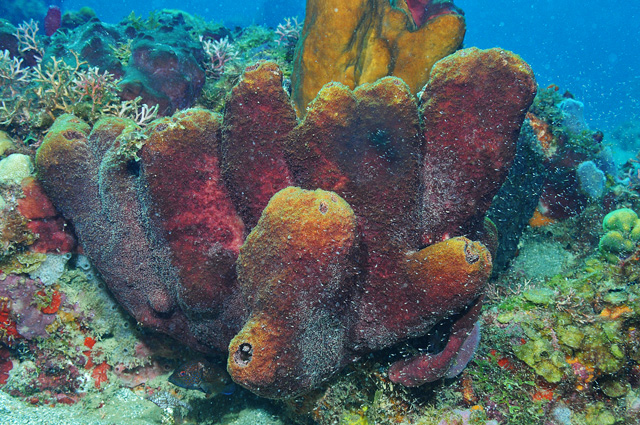
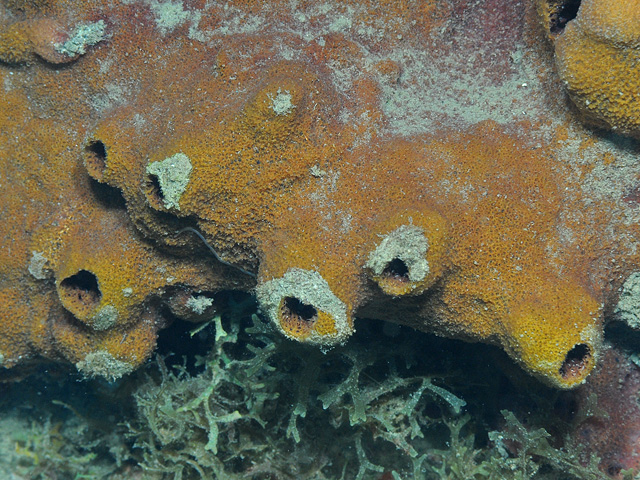
Here are two more photos of the shrimp. I took the first one in Dominica inside the sponge, Ray Haberman took the second in St. Vincent on the outside surface of the sponge. It is rarely out of the sponge.
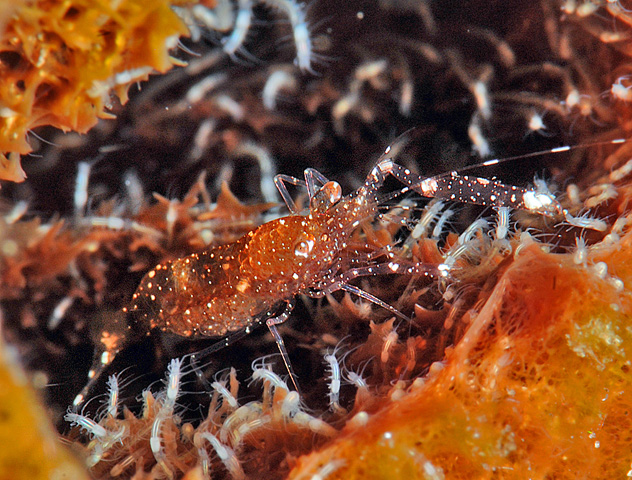
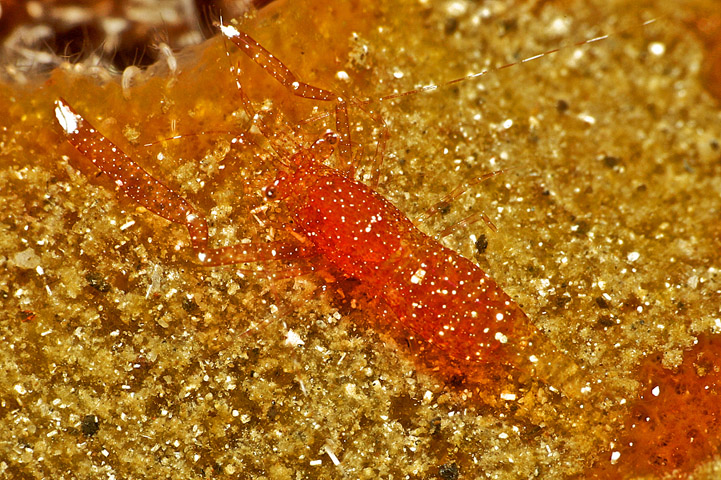
Les Wilk

Terms of Use Privacy Policy Guidelines We have placed cookies on your device to help make this website better. You can adjust your cookie settings, otherwise we'll assume you're okay to continue.

A worldwide community for underwater imaging.