



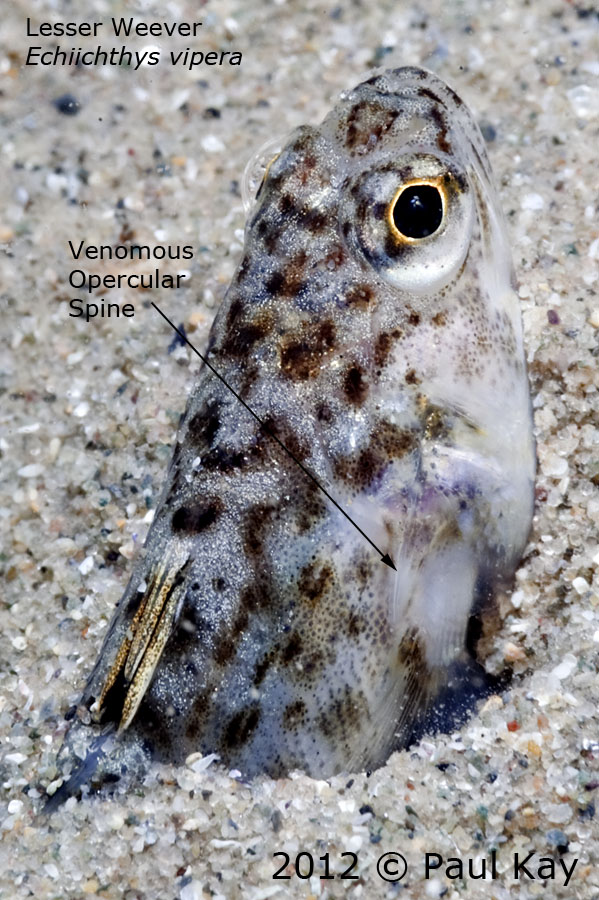
At last I've managed to get some decent shots of the UK's most poisonous fish. So for what its worth here is the detail that I was after. The venom is injected via the opercular spine and can be treated by using hot water (as hot as is bearable) for around 15 minutes or so. The heat denatures the venom. At least one cafe at the top of a local beach has a bucket handy on hot days when paddlers are most likely to get 'stung' as they tread on these fish. Divers are unlikely to have problems unless digging in sand with bare hands.
- 9Posts
- 9Replies
Read-only discussion
Weever Warning
-
-
Cool shot. Like one ever needed a reason not to wade in UK waters.

-
Is this how they sit Paul? I did always think they would bury themselves all under the sand but flat (like flatfish) just their head sticking out
-
Is this how they sit Paul? I did always think they would bury themselves all under the sand but flat (like flatfish) just their head sticking out
It was just about to swim off. Usually just their eyes show but this one was concerned by the port. It was a small (~5cm long) one so probably young and wary. Most people think that its the dorsal which injects the venom (apparently including anglers who get 'stung' when holding them carefully to avoid the dorsal when de-hooking them).
-
Good one Paul - I can never get near the little sods
-
Good one Paul - I can never get near the little sods
Hi Jim
They are! I've been trying for a decent shot for over 20 years and have shot just 1 mediocre one. I've now got three - not as perfect as I would like but far better than anything I've previously shot.
-
great shot Paul
-
Great shot Paul,
i would like to add that Weever - at least here in the Mediterreanean Sea can act very aggressive if they are disturbed.
I know several persons got chased and stung after they missed them with the harpoon or teasing them.
Sure it is not right to spear fish or tease them, but they can act also aggressive seeing them self in a dome port or getting
scared of a approaching diver coming too near.
Weaver often sit in a circle buried under the sand and often they are found as groups of several individuals.
One note if somebody should get stung:
Stings from Weaver are extremely painful, i saw adults rolling on the floor crying and yelling, but the poison is not
particularly venomous and is not a sever health issue for humans except if the are allergic.
last year a woman died in Italy because of a anaphylactic shock after a weaver sting, but this is rather uncommon.
Anyway, if stung, apply hot water as soon as possible as the heat will destroy the protein base venom and
DON'T APPLY ICE as it would worsten the situation!
Chris
-
.....Weever - at least here in the Mediterreanean Sea can act very aggressive if they are disturbed.
I know several persons got chased and stung after they missed them with the harpoon or teasing them.
Sure it is not right to spear fish or tease them, but they can act also aggressive seeing them self in a dome port or getting
scared of a approaching diver coming too near.
Weaver often sit in a circle buried under the sand and often they are found as groups of several individuals.
Chris
Chris
Are you referring to the Greater Weever (Trachinus draco)? These do occur in British and Irish waters but are rare - I've never seen one. You natural history information is interesting, but I think that the Lesser Weever is essentially a solitary fish up here.

