Skip to content

Lights, Strobes, and Lighting Technique / Archived topic

Some Help for Understanding Guide Numbers?

Started by guyharrisonphoto ·

  • 9Posts
  • 9Replies

Read-only discussion

Some Help for Understanding Guide Numbers?

9 posts
  1. Would like to learn a little about the relationship between guide numbers.


    How is the brightness difference measured between different guide numbers. For example, how much brighter is GN24 than GN 20. Same question between GN 20 and GN 32 or 34? What about GN 40? Is GN 40 twice as bright (one stop?) or even brighter than GN 20. Let's assume, for now, the same angle of coverage to keep it simple.


    Thanks for any help!


    Guy

  2. Guide number is basically how far the subject could be properly lit with ISO setting of 100 and lens at f/1. So a strobe with GN of 20 would light a subject properly 20m away when the camera is set to ISO 100 and lens at f/1.


    A strobe w/GN of 40 would reach twice as far as one that is 20. Power wise, the strobe with GN of 40 would actually be 4x as powerful since at 40 m away, the light is 4x weaker given it has spread to an area 4x greater.


    For UW use, it is not quite the same, since the returning light of the strobe from the subject would also become bluer the farther away it is. So a strobe with GN of 20 could light something properly 10m away when using f/1 and ISO 100, and another strobe with GN of 30 would do so for subject 15m away. In acdtual use, it would be even less since you are also competing with ambient light.

  3. So, if I put 2 strobes of GN 20 side-by-side and synced them so they fire together, do I have a 40 GN equivalent?


    Thanks for the response!

  4. No, you will get a strobe with a GN of 28. Twice as powerful, but only can reach to 28m (assuming a single strobe can reach 20m). Same reason f-stops goes in increments of 2.0, 2.8, 4.0, 5.6, 8.0. One f-stop (half the light) goes from 2.0 to 2.8, not 2.0 to 4.0

    Edited by Lwang
  5. To guy, the answer is no, you would need 4 strobes.

    The guide number formula is simple, GN=fstop x distance (meters), but you need to be careful, sometimes GN are given in air (mostly) and sometimes in water and sometimes in meters (mostly) and sometimes in feet.


    Let's take the new S&S D1 as an example. It has a GN of 24 (with the diffuser that everyone uses) in air and an UW GN of about 12 (depends on clarity of the water obviously). A GN of 12 means that for a shot at 1 meter from the subject you can use F12 or to use f22 you need to be about half a meter away (.54 meters or 21 inches or so), if the water is quite clear. YMMV in the real world that isn't the NASA pool. In any case, take the GN of the strobes with some salt, since measuring them is not at all trivial.

    Bill

  6. OK, here is my question. Am I better off connecting two ys-01s (GN 20 at 100 degree coverage) to use as a single strobe than I am using a single YD-D1 (GN 24 with 100 degree diffuser).


    I use a two strobe set-up and thus would have 4 YS-01s (one pair on each side).


    According to the above, the YS-01s will give a GN of 28 (each pair) at 100 degrees. I have tried this with two (to make a single strobe), and they are very bright and the recycle seems almost instant even shooting at night and at f16, with a 14mm lens about 15' from the test wall (my garage door). It does, as expected, seem about twice as bright (one stop) as a single ys-01.


    Of course, you have to deal with two strobes, two sets of batteries and it is larger than the YS-D1 but surprisingly it is not at all unmanageable.


    Against these disadvantages there is always redundancy in my dual strobe setup if one strobe fails, where if I have only 2 ys-D1s then I am down to one strobe. Also, for shooting macro, I can just use single strobes for getting into tight places.


    I can get two used YS-01s for about $600. A single new YS-D1 costs about 700.


    Opinions, anyone?

  7. One doesn't use dual strobes to get more power out of it. The purpose of it is more creative way of lighting the subject. When shooting macro, it is hard to have the light facing toward the subject, thus you frequently will end up creating shadow areas. Thus a 2nd strobe could light up some of the opposing area to give more shadow details.


    Alternatively, you can use a white card on the opposite side of the strobe to bounce some light back to the shadow side, but you can't carry a giant white board when the subject is a little farther away.


    If you want to light up subject 5 ft away in situations where there is alot of ambient light, then the YS-D1 w/o the diffuser has much more power than even 2 YS-01 and produce better result.


    The YS-D1 has better TTL and slave TTL, which is not avail in the YS-01.

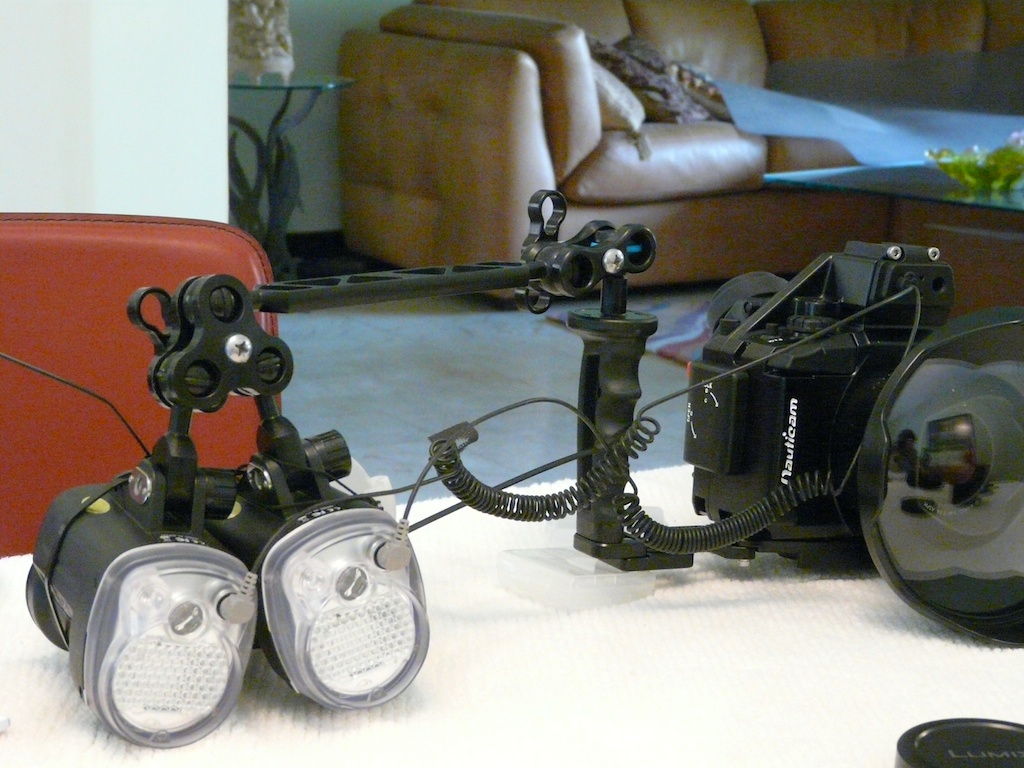
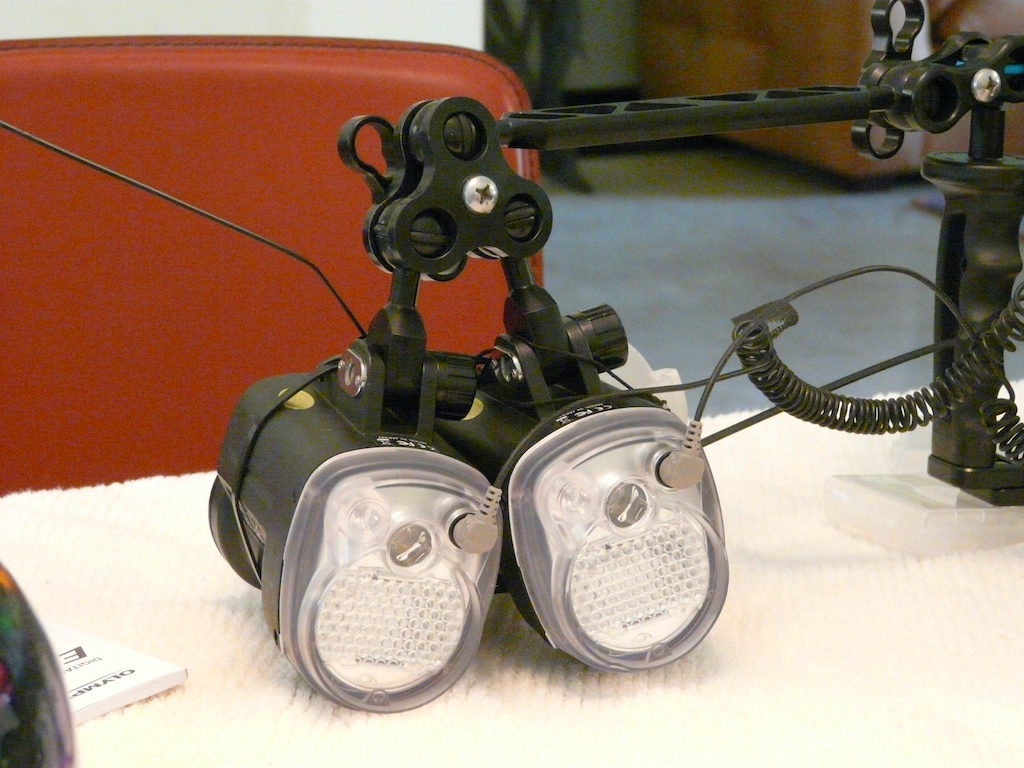
  8. My question wasn't clear. It is: instead of using 1 YS-D1 on each side of my dual strobe setup, I would use 2 YS-01's on each side. The 2 YS-01's would be taped together, side by side, and connected to fire simultaneously as if they were a "single" strobe. Thus, the comparision is between two different "dual strobe" setups. First,(one each side). Second 4 YS-o1s (a linked pair on each side) See photo below. There would be the same set-up on the other side of the camera.

    post-34289-0-94464900-1351462237_thumb.jpg

    post-34289-0-14485400-1351462260_thumb.jpg

    Edited by guyharrisonphoto
  9. If you always want to have wide coverage, then the YS-D1 is at a disadvantage. Since at 100 deg coverage, its GN is only 24 vs 28 for 2 YS-01. But if you want to light up a distant subject that does not take up the full frame, then you can take the diffuser off on the YS-D1 and it can be almost 30% more powerful than 2 YS-01.


    4 YS-01 would have GN of 40, much more power than 1 YS-D1. If you use a pair of YS-D1, then its GN would be 45 (at 80 deg coverage). You definitely will have less batteries, arms fiber optic cables, etc to work with.

Fotosub Shop

Account

Navigation

Search

Search

Configure browser push notifications

Chrome (Android)
  1. Tap the lock icon next to the address bar.
  2. Tap Permissions → Notifications.
  3. Adjust your preference.
Chrome (Desktop)
  1. Click the padlock icon in the address bar.
  2. Select Site settings.
  3. Find Notifications and adjust your preference.