I recently went cage shark diving in South Africa and below are a couple of examples of shots I got. I was shooting a Canon G12, RAW format, 1/250 shutter speed (messed around with this a bit and found this to work best) and auto ISO. Due to the nature of the cage diving, I was explicitly told I was not allowed to take strobes in with me. So it was just the camera, the housing, and the wide angle port attached to the housing.
I'm unhappy with the amount of backscatter present in the photos, so I'm just wondering if there's a way that might be avoided in the future should I do something similar? Are there more suitable camera settings I should consider? I would appreciate any constructive feedback!
It looks like you had the camera flash firing. It's better to use natural light for these shots- it probably doesn't have the power to reach the subject anyway.
Were you shooting into the sun? You should try to get the cage oriented so that the sharks are swimming into the sun: they will be more colourful, the background will be darker and the surface less "blown" if the sun is behind your shoulder.
You can still have trouble: the visibility doesn't look that great, and you then have to wait for the sharks to get close, right up to the cage, to reduce the "Blahs" and cut out as many of the particles as possible.
1/250 may well not be fast enough for a large animal: they move faster than you think. 1/500 can be better (and even that can be a bit slow for the star performers, like dolphins).
We recently had the same problem when shooting whale sharks at the surface in Cenderwasih.
We tried 2 strobes, 1 strobe and 0 strobes.
No strobes and some time in Photoshop provided the best results!
No strobes and some time in Photoshop provided the best results!
Have you tried increasing the contrast and taking the blue out of the highlights?
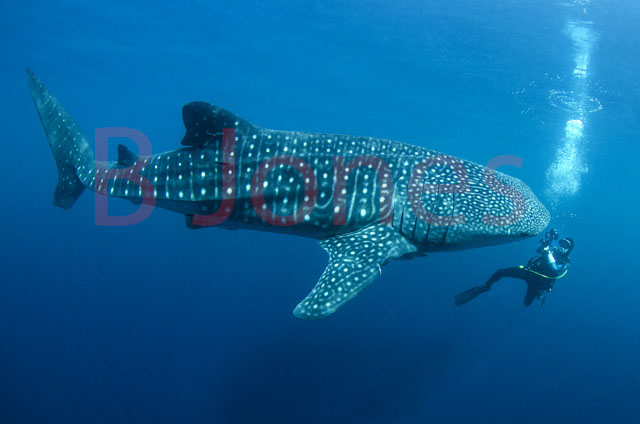
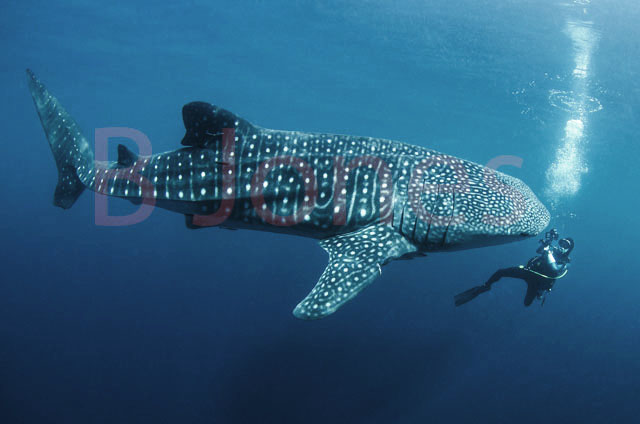
The water quality in South Africa can be challenging. The backscatter in the first image looks excessive. Make sure your dome is clear of bubbles. I know mine will have thousands of micro bubbles upon first entering the water. having the sun at your back is a good idea too. In dark water you can get some wierd glare and reflections in your shots when shooting into the sun. In low vis water the closer you are to your subject the better. In my attached photo I was about a foot and a half from the whaleshark. You can see how cloudy the water was as his tail almost disapears. Also I set my camera to shutter priority so I only worry about adjusting the and shutter speed and let the camera worry about the iso and aperature.
Unfortunately I had no control over the position of the cage (and subequently the position of the sun). But it's something to bear in mind should I do something similar in the future.
Also, the flash was indeed turned off, so that wasn't the issue.
Thanks for all the tips
your first image is unsharp and looks like shot with a flash; it is also underexposed.
another advice: go to Guadaloupe instead, clear and blue waters....