Skip to content

Shooting Technique, Workflow and Editing / Archived topic

Trimming the buoyancy of your rig using float or float arms

Started by Interceptor121 ·

  • 14Posts
  • 14Replies

Read-only discussion

Trimming the buoyancy of your rig using float or float arms

14 posts
  1. Interesting to see the comparisons laid out in chart form. I think you missed a couple of important options, though. Stix makes its own arms that are fairly economical and I think are a bit lighter than the ULCS. On the 9" stix arm one can fit 3.5 jumbo floats. I believe that would make them tthe most buoyant in that length and my calculations suggest that 6" and 9" arms on each side (with a total of 11 jumbo floats) would be more buoyant than any other option. An added benefit of the stix floats (either on stix or ulcs arms) is the ability to remove floats or change sizes to alter buoyancy.


    The Nauticam are definitely the coolest looking, though.

  2.  

    I thought it would be worth sharing this with all of you...


    http://interceptor121.wordpress.com/2014/03/15/floats-and-float-arms/


    It's much more important with large housings, but the air inside the port, particularly a large dome, which twists the housing upwards is more annoying than a negatively bouyant system. It's difficult to offset this with bouyant arms.


    Out in the wild the Wetpixies seem to voting for the Stix floats...

  3. Interesting to see the comparisons laid out in chart form. I think you missed a couple of important options, though. Stix makes its own arms that are fairly economical and I think are a bit lighter than the ULCS. On the 9" stix arm one can fit 3.5 jumbo floats. I believe that would make them tthe most buoyant in that length and my calculations suggest that 6" and 9" arms on each side (with a total of 11 jumbo floats) would be more buoyant than any other option. An added benefit of the stix floats (either on stix or ulcs arms) is the ability to remove floats or change sizes to alter buoyancy.


    The Nauticam are definitely the coolest looking, though.

    I have put the data for the STIX arms and they are not the most buoyant, they are the cheapest though on a gram/$ and the lightest on land but don't come anywhere near the nauticam or inon in terms of buoyancy for mm.

    I did not include them because their core is plastic and I have no record on how durable they are.

    I can update the charts but considering the amount of lift those arms offer they are quite far from nauticam and inon simply because their diameter is smaller

    I guess it depends on what you need really if you are ok with the mid value the stix floats are good and can be removed so very flexible. if you need a lot of buoyancy they just can;t provide it

    Edited by Interceptor121
  4. Thanks for updating. Interesting comparison and surprising to me. I did some rough comparisons previously and clearly made some miscalculations. FWIW, I have used both ulcs and stix arms and have had no durability issues with the stix arms.


    (Or the ulcs arms, but that is pretty much a given with the ulcs stuff)

  5. Surprising to me too. But the metrics I calculate depend on the weights and on the effective lengths, what happens is that Stix arms are actually longer than ULCS and Inon are even shorter.

    In general you have large floats or 2" diameter floats that provide very limited lift on a ratio of 1.5:1 buoyancy to weight ratio if consider an handle is at least 100 grams negative and a strobe plus a few clamps get easily to 270 grams. So using a few segments like those only works with a housing that is nearly neutral or an acrylic dome where the whole housing is a few hundred grams.


    If you have something really negative you need a solution with a ration of 2.5:1 in terms of lift per weight the Stix based solution do not manage to get there.


    In very broad terms assuming a slightly negative housing I would say large stix floats work ok for DSLR with acrylic ports and plastic housings where you only have to sustain the arms and strobe weight


    If you have a glass port or a negative housing or a few additional focus lights etc etc then you need more lift as you run out of space on the arm segments to put more floats


    Anyway I thought it was interesting to do some form of semi scientific comparison as I have not found it anywhere else

  6. I am using 11 Jumbo stix floats and my setup, with glass dome or macro port, two strobes and focus light is just a little more negative than I would like. I might change somethig out to get just a bit better balance.


    Are you sure the Stix arms are plastic? Their website says anodized aluminum. I haven't gone to dig any of mine out and look but have never seen them flex.

  7. The balls are plastic the arms are aluminum I corrected the blog

    This is the reason why they do not differ much from ULCS plus stix floats

    You can take out two 8" segments and replace them with two inon mega M and you have eliminated 6 of your floats but actually have lift for 9 of them. Which means you have now additional 480 grams or 17 Oz more lift that may resolve your problem

    If that is not enough you need to look at having also the 5"segments as float arms but from my calculations that is generally not required it is enough to put stix floats or the set up becomes positive. Each inon or combo 8+5 mega float offers 40 Oz or 1140 grams per arm you don't need 80 Oz or 2.25Kg lift usually

  8. So, I think what we see here is a whole mix of different buoyancy control mechanisms. Buoyancy of your camera is a personal thing I believe. Different people have different preferences. At ADEX I was talking to a german guy from h2o tools. I got a few float arms of them. They guy expressed that he wants his camera perfectly neutrally buoyant, and he said that was the way to go. I told him I disagreed. I personally want my rig to be slightly negatively buoyant and in a decent trim. Having it negatively buoyant gives me a more stable feeling when handling the rig. The guy actually insisted neutrally buoyant was the way to go, and I just told him again I preferred slightly negative, and said its a personal thing (I'm actually wondering if he was trying a sales pitch, which I absolutely hate. Especially when someone already expressed their preferences, which should indicate they experimented and found what they prefer).


    Anyway, my point is, because it's a personal thing, you can play with any and all mechanisms to do a mix and match for your personal optimum.

  9. Yep it's all down to personal preference and your set up. For video neutral is more important as you hold the camera whilst shooting for a period of time. For stills you can choose some people like around 1 lbs negative. My photo rigs are between 1/2 lbs and 1 lbs negative

  10. So, I think what we see here is a whole mix of different buoyancy control mechanisms. Buoyancy of your camera is a personal thing I believe. Different people have different preferences. At ADEX I was talking to a german guy from h2o tools. I got a few float arms of them. They guy expressed that he wants his camera perfectly neutrally buoyant, and he said that was the way to go. I told him I disagreed. I personally want my rig to be slightly negatively buoyant and in a decent trim. Having it negatively buoyant gives me a more stable feeling when handling the rig. The guy actually insisted neutrally buoyant was the way to go, and I just told him again I preferred slightly negative, and said its a personal thing (I'm actually wondering if he was trying a sales pitch, which I absolutely hate. Especially when someone already expressed their preferences, which should indicate they experimented and found what they prefer).


    Anyway, my point is, because it's a personal thing, you can play with any and all mechanisms to do a mix and match for your personal optimum.

    I'm with you ie when shooting stills I'm happier with a rig that's negative (although video I want it to be neutral). But more important to me is getting the rig trimmed so it sits level, having to fight any significant rotation is a pain I can do without.


    Nothing off the shelf worked for our video rig, so we had to go DIY. We ended up carving up an EVA yoga block. It's very buoyant, durable and easy to work with... And a block providing about 2k of lift will put you back around £5!!


    Use so far has been restricted to 5 metres, so I can't comment on performance at depth, although hoping to get it down to 30-40 metres next week.

    Edited by Stuart Keasley
  11.  

    Nothing off the shelf worked for our video rig, so we had to go DIY. We ended up carving up an EVA yoga block. It's very buoyant, durable and easy to work with... And a block providing about 2k of lift will put you back around £5!!


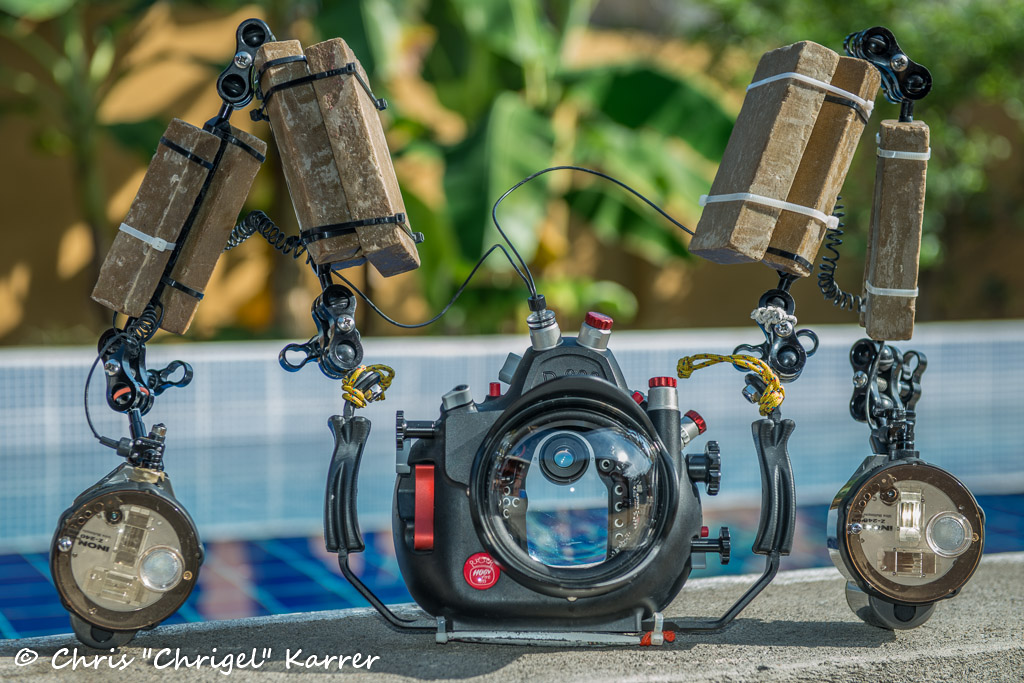
    I bought THIS closed cell foam, cut it in stripes to fit my ULCS arms, covered them with a thin layer of marine expoy putty to make them more resistant,

    cut them to the right size to have my rig in the worst sitation still about 150 grams positive.

    Under tray or on the handles i add fishing weights to correct the different buoyancy of the various port/lens combinations to have my rig always 98% neutral.

    I don't use a big dome anymore, but on my D90 Ikelite housing the dome had so much lift that the housing fliped always over to a very uncomfortable dome up position.

    A shin stripe of lead (got it from a plumber) wraped around the extension ring of the dome balanced the whole rig and relaxed my before hurting wrists.

    I am aware that this don't look very fancy or professional but it works great and i am fine with that look.

    Chris


    post-31002-0-35135000-1398608142_thumb.jpg


    As the buoyancy is working fine i will glue and screw the single parts together and to the arms to eliminate this ugly looking zipties.

    This armes travelled with me in checked luggage Sardinia-Oman-Costa Rica-Panama-Brazil and have approx 200 dives done and still looking "good"


    Edited by ChrigelKarrer
  12. Nothing off the shelf worked for our video rig, so we had to go DIY. We ended up carving up an EVA yoga block. It's very buoyant, durable and easy to work with... And a block providing about 2k of lift will put you back around £5!!


    Use so far has been restricted to 5 metres, so I can't comment on performance at depth, although hoping to get it down to 30-40 metres next week.

    Having now tried the yoga block to 24 metres, I can categorically say that it's a big pile of dog do, having crumpled up to the size of a discarded crisp packet.


    Ah well, back to the drawing board :)

    Edited by Stuart Keasley
  13. For small trim floats I use divinycell h35 painted black with permanent market and then covered in epoxy glue. The glue is instrumental to harden it and make it look smooth after a good amount the floats are harder than corresponding stix however they don't look pretty and have the same issue of Chris having to have cable tie. So I gave up and only use them as 100 grand trim with M10 screws. The original bars i used were half a meter and would provide in excess of 3kg buoyancy. I would think those are adequate for a video rig but you need to find a quicker process to paint them and coat them as otherwise it would take forever let me know of you want the link of the shop ingot them from

    Correction divinycell H60 even stronger bought from a boat equipment shop as kelp t2 sponson material bars

    Edited by Interceptor121
Backscatter

Account

Navigation

Search

Search

Configure browser push notifications

Chrome (Android)
  1. Tap the lock icon next to the address bar.
  2. Tap Permissions → Notifications.
  3. Adjust your preference.
Chrome (Desktop)
  1. Click the padlock icon in the address bar.
  2. Select Site settings.
  3. Find Notifications and adjust your preference.