Skip to content

Critter Identification / Archived topic

Triplefins X 2

Started by JimG ·

  • 7Posts
  • 7Replies

Read-only discussion

Triplefins X 2

7 posts
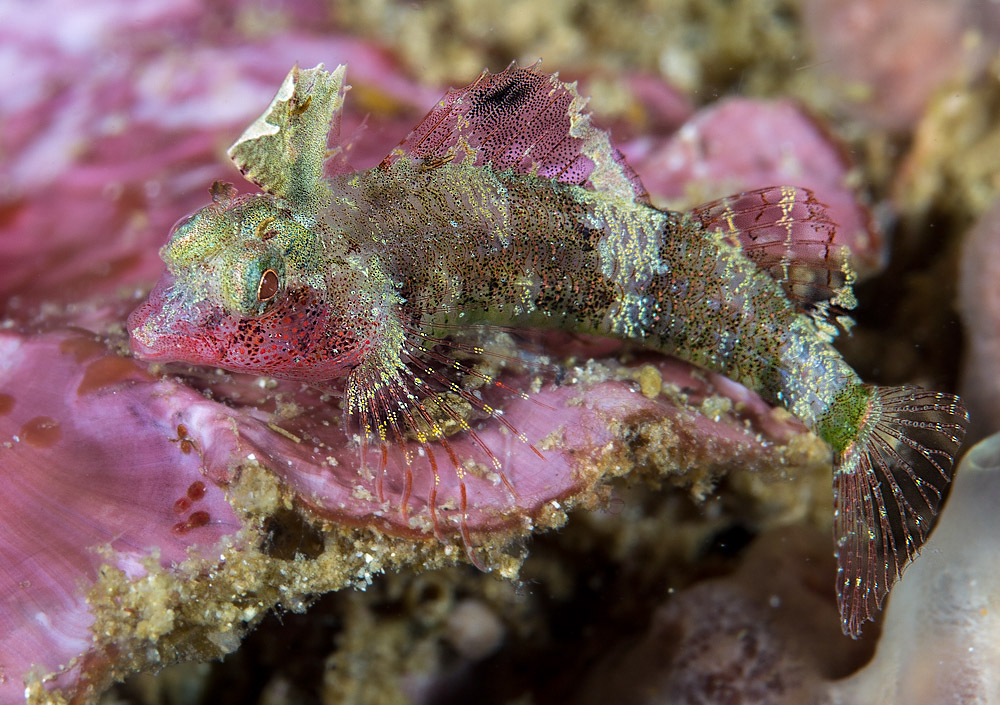
  1. Taken in Ambon, Moluccas. They were just feet apart so possibly male and female as they have a few similarities e.g. pectoral fins.

    Pretty sure they fall into the genus Enneapterygius which is pretty poorly covered on Fishbase. Grubbing around on Google and a small, not too clear pic in the Tropical Pacific fish book, leads me towards Enneapterygius mirabalis - Miracle Triplefin. However, the sources on Google are not ones well known to me.

    Can anybody help please?

    post-2843-0-95994200-1415377690_thumb.jpg

    post-2843-0-12141200-1415377718_thumb.jpg

  2. I'm away from my reference books right now so I can't be positive, but you should check out the dragonets.

  3. Thanks Bryce

    I had them down as Dragonets initially - Bartel's, Synchiropus bartlesi, seems the nearest. However, they don't seem to have the very accentuated mouthparts nor the skin flaps on the eyes to tie up with the photos. Hope you find something in your books or that somebody else chimes in.

  4. Hi Jim,


    I agree on the Enneapterygius genus. In my "big books" there are two potential matches; the mirabilis you mentioned and flavoccipitis. Third option is that these two form a species complex with yours being a third member. Either its own species or some regional variant.


    Your images show white edging on the 2nd and 3rd dorsal fins and a big first dorsal. These would point to mirabilis. In addition, flavoccipitis, the yellownape triplefin, is named after yellow-gold specks between eyes and first dorsal which are not on your image and it also has a smaller first dorsal. However in terms of general appearance I find it a closer match to the yellownape. Both species are reported from Indonesia and should include the Ambon area. The yellownape is found in 0-22m including rocks, reefs, and tide pools. Mirabilis is described as living on coral, sponge and rock substrate in 8-37m.


    General appearance is not a good ID criterium so I think E. mirabilis is the best bet. What makes your images different from both of these is the finely spotted pattern plus the larger black spot in the 2nd dorsal fin. In addition, your images are the prettiest I have seen for this species. Congratulations.


    Bart

  5. Many thanks for your trouble Bart - most useful. Had a look round and can find even less about E. flavoccipitis. I have a couple of shots of the heads of mirabilis and there are no yellow/gold specks at all. Might try asking R. Fricke who described the species.


    Your tome is excellent. It is available on iPad (which I don't have) at a very reasonable price and was supposed to come out for Android (which I do have) last May but has never appeared. Shame.


    If I get any further with it, I'll let you know

  6. Just to close this one off - I asked Fishbase if they had an expert to whom they could refer this ID . The photos have now been seen by Dr Jeff Williams in the US and Wouter Holleman in Zambia. Both have advised it is not E. mirabilis but E. tutuilae, the High-hat Triplefin. They say that the whitish first dorsal and the white bands on the other two dorsals running onto the body are diagnostic. Apparently it is a complex species with versions present in the Red Sea, west Indian Ocean, Gt. Barrier Reef, as well as Indonesia. Further work is needed to clarify and sort them out.


    Thanks again Bart

  7. Thanks for the update. E. tutuilae is in my books but I would never have guessed it. The description states that is the most widely distributed and most common species of the genus and that its coloration is variable. The one thing Reef Fishes of the East Indies is less good in than the Reef Fish ID books is hightlighting exactly what aspects of the appearance are visually distinguishing marks. Fin ray counts may be of interest to their scientific audience but for us visual ID cues are critical.


    By the way, the image for the male shows it with a bright red cheek, chest and leading part of the central dorsal fin. The description never mentions it so I expect it may be a mating or territorial coloration. It is supposed to also occur in the Red Sea so I can keep a look out for it on my next trip in May.


    Bart

Reef Photo & Video

Account

Navigation

Search

Search

Configure browser push notifications

Chrome (Android)
  1. Tap the lock icon next to the address bar.
  2. Tap Permissions → Notifications.
  3. Adjust your preference.
Chrome (Desktop)
  1. Click the padlock icon in the address bar.
  2. Select Site settings.
  3. Find Notifications and adjust your preference.