



I mentioned in an earlier thread that I had been experimenting with some video light filters with the objective of finding a better balance between underwater ambient light and the broader (red) spectrum of artificial video lights. Here is the problem, obvious in the screenshot below: the area covered by the video light has a lot of warm colour (reds and yellows) but the background is all greenish-blue. Colour-correcting this scene is either a compromise or a complex exercise of selective secondary colour-corrections.
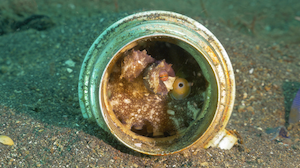
I think that I've found a cheap DIY system that can solve this problem and can be tuned to most underwater ambient light circumstances.
The main component is a 4x4 filter holder made by Lee Filters. It's all plastic and rubber so nothing to rust. $20USD each at BH Photo: http://www.bhphotovideo.com/c/product/162544-REG/LEE_Filters_GS_Gel_Snap_4x4_Filter.html
Here is the holder with an aqua filter (the same filter that I used in the shot further below)
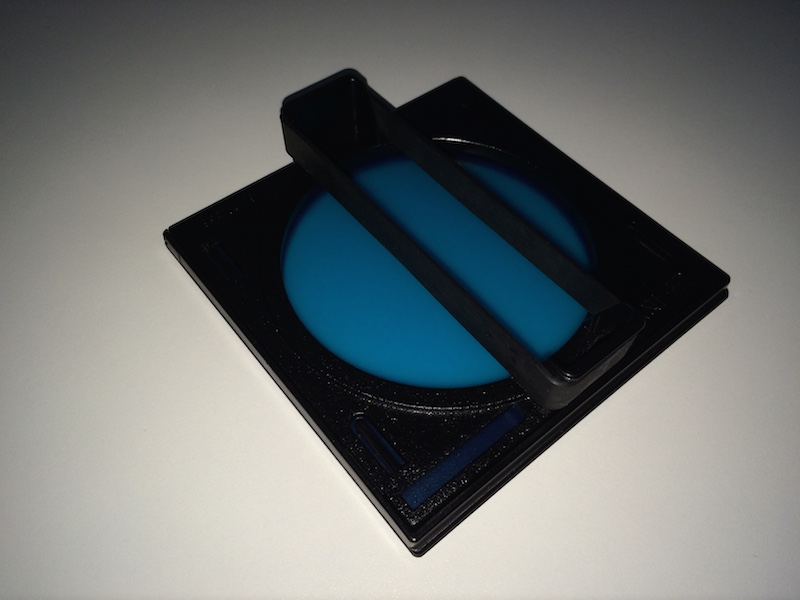
The slip-on rubber-band mounting system enables it to fit on most underwater video lights. I use them on a pair of iTorch 7s but they also fit the Keldan Luma4s.
Here is folder mounted on the iTorch7. It can be "wriggled on" easy enough and will not easily fall off - although I do take them off when getting into and out of the water so that they don't get bumped off.

The filters are pieces of plastic that I cut from document folders that I bought in stationery shops. I wandered around a few shops until I had found a mix of light blue, dark blue, aqua (green-blue) etc. The firmer document folder covers work best. I also cut some uncoloured plastic squares that are a neutral colour but make a nice diffuser for softer macro lighting for night dives.
You can take a few different shades of the colour filters on each dive but I find that I can usually judge from the surface what I will need. The technique is simply to look at the colour of the water and select a filter that is the closest match. If the water looks tropical blue, use a blue filter; if it looks greenish, use an aqua coloured filter.
So, here is the result. This is the same scene as above, shot with the aqua filter on both lights then quickly colour-corrected in FCPX to reduce the green and boost the reds.
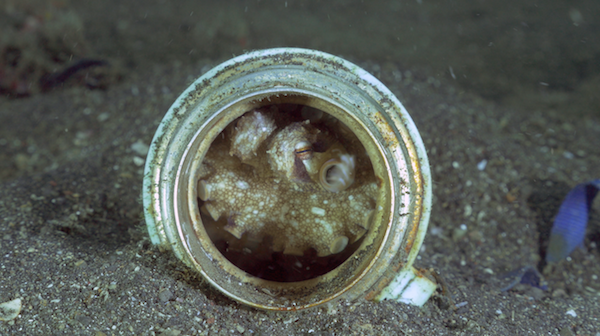
To my eyes, this image is very close to what it looked like underwater last week in Lembeh.
(the coconut octopus inside the drink bottle is guarding eggs and in the last few days of her life).
I have also used the same system in the deep blue waters of North Komodo, where a light blue filter worked best.
So for $40, some time wandering around stationery shops and a little bit of scissor work, you can make a video light filter system that will enable you to balance ambient and artificial light in most situations.
Regards
Peter




