



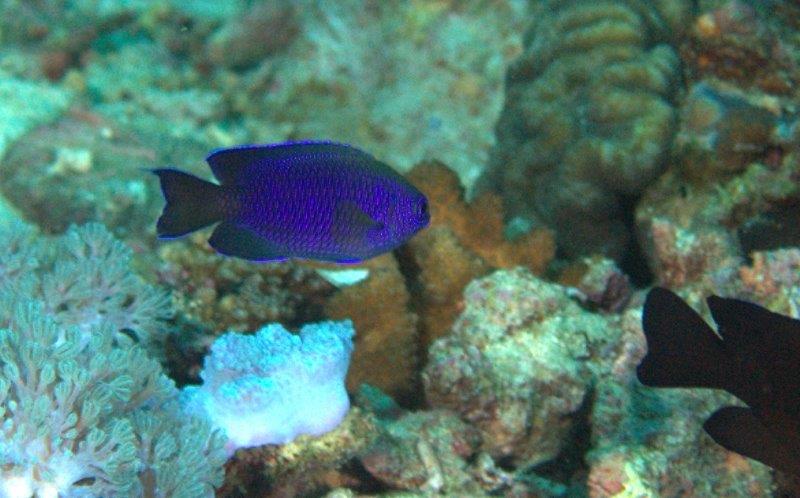
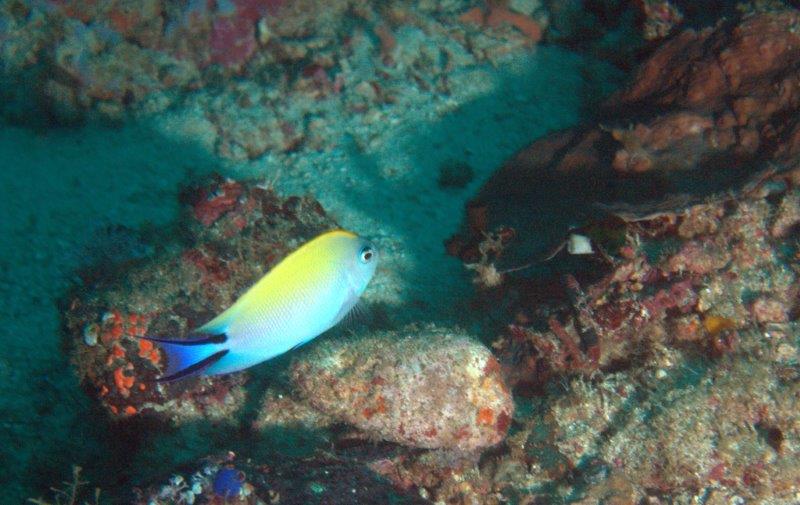
The first one and the last one are from the Philippines
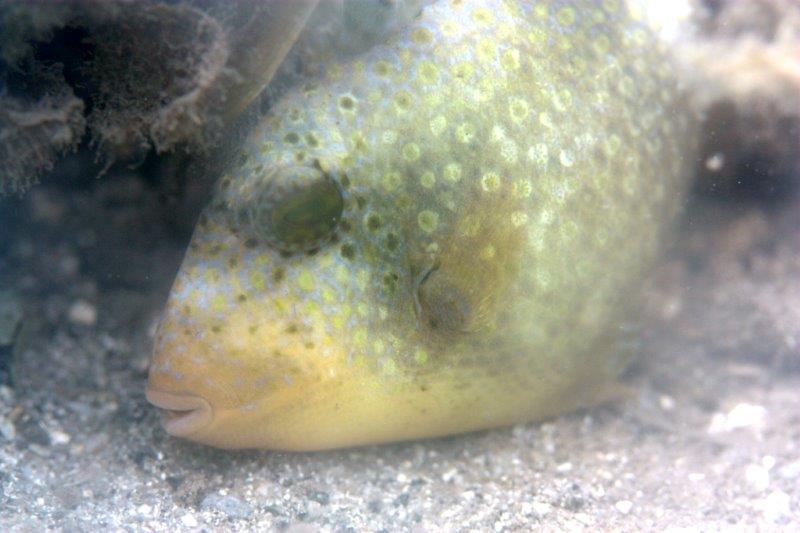
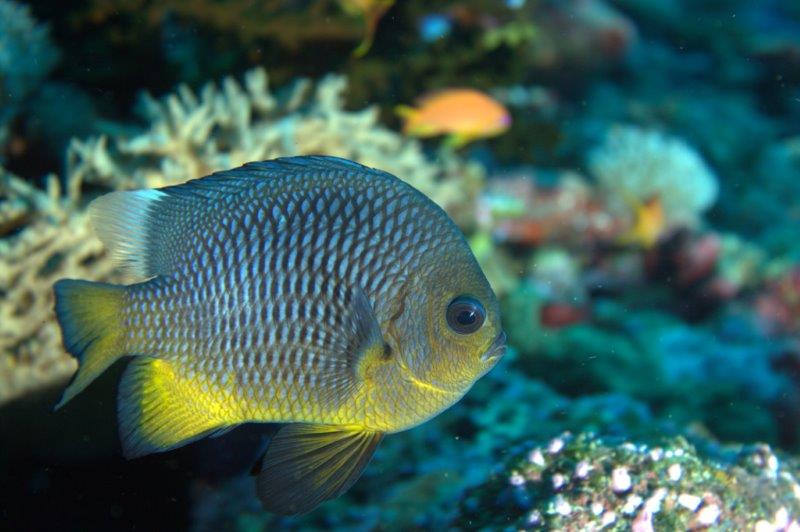
The middle two are from Fiji.
I'm leaving tomorrow and won't have computer access until the 29th.
Read-only discussion
The first one and the last one are from the Philippines
The middle two are from Fiji.
I'm leaving tomorrow and won't have computer access until the 29th.
I don't know the first damsel. To me it looks like a sweetwater demoiselle (Neopomacentrus aquadulcis) but that is only known from Papua and I don't see another Neopomacentrist that could take its place elsewhere.
Assuming Nr. 2 is the "I don't have a clue", it is a young triggerfish. Not sure exactly know which one. My gut feeling says a Pseudobalistes, e.g. yellowmargin triggerfish but they normally have at least some darker dots, not just golden.
Damsel Nr 2 is a orangefin dascyllus (D. auripinnis)
The last one is not a "third damsel" but a female black-spot angelfish (Genicanthus melanospilos). I have always thought that they try to resemble damselfish and you find them away from reef walls in the open hunting for plankton together with damsels. The male is very different with vertical black stripes.
Bart
Thanks Bart,
I looked at sweetwater also and dismissed it also because of location.
Triggerfish hadn't even crossed my mind until you mentioned it. I only got this shot and it was gone, but I have seen many smaller juvenile yellowmargins in this same area.
I looked at orangefin also and dismissed it because my book says it is only known from Line and Phoenix Is. in the Central Pacific. Is this not correct?
I never would have got the Angelfish.
Again, Thanks.
Craig
The visual match is very good and more importantly none of the other known dascyllus look like it. Fishbase indicates that it is also found on the Cook's islands. Given the distance between the Cook and Phoenic islands I would not be surprised if it is also found in Fiji, which is in between the others but a bit futher west.
Bart
Thanks again Bart
I would call the second damsel Dascyllus trimaculatus. In Fiji they usually have orange bellies. Note that most of the ventral & anal fins are dark here, rather than all orange as they should be on D. auripinnis. You can also see a hint of a white spot on the body.
-Mark
Hi Mark,
Thanks for chiming in and it seems you are right on the mark. I dug up the D. auripinnis species description paper (Randall & Randall, 2001). Until that time it was considered a colour form of D. trimaculatus but they now recognize 4 distinct but closely related species as a species complex: D. albisella from Hawaii, D. strasburgi in the Marquesas, D. auripinnis in the Line Islands, Phoenix Islands and Norther Cook's Islands. D. trimaculatus covers everywhere else all the way up to Africa and the Red Sea. They also mention that individuals from Fiji have partly yellow fins, as you pointed out, but apparently that is still considered a colour variant of D. trimaculatus.
Craig - when I get to making a species page for D. trimaculatus perhaps you can consider to donate the Fiji image so I can capture this colour variation with some of the details from the publication.
Bart
Hi Bart,
You are more than welcome to any images I have.
Craig
Sorry, I should have also thanked Mark for his input. A few years ago a friend of mine had a friend who emailed everyone on his mailing list a picture of a fish once a week. He showed me the one he had just got that his friend didn't know the name of. He thought I might know. It was the same fish, also taken in Fiji.
Craig
When I was working on Nai'a in Fiji, Gerry Allen came and did a presentation and noted that Fiji variations of many fishes have extra yellow in their coloration, but that nobody knew why. Worth bearing in mind when you're trying to do visual IDs.
Things are even a bit more complex. Using DNA sequences it became clear that the species D. albisella from Hawaii, D. strasburgi in the Marquesas match the DNA evidence. D. trimaculatus from the Red Sea and Zanzibar, and presumably the entire (Western) Indian Ocean , forms a distinct clade, more different than the Pacific D. trimaculatus is from the other three Eastern relatives. Some of the D. trimaculatus and D. auripinnis from the Pacific mix together on the phylogenetic tree so they really are very similar despite the different colouration.
One of the phylogeny papers also stated "On the other hand, D. auripinnis coloration patterns (yellow lower body and fins) may either be reflective of recent speciation with little genetic divergence (or lineage sorting), or due to ecological adaptation to turbid waters (Randall & Allen 1977)." They don't explain the turbid waters logic but often fish have a light belly to stand out less against the bright surface when seen from below. If the turbid waters are yellowish then perhaps a yellow colouration of the lower body works better. However, I've never seen noticeable yellow water colouration near reefs except for algal blooms in the shallow lagoons behind a fringe reef. I don't find it very convincing but it is my best guess at this point.
Bart
.jpg.857dbbfbdc4d79d9c6ebf7b4ba96ed1b.jpg)
Terms of Use Privacy Policy Guidelines We have placed cookies on your device to help make this website better. You can adjust your cookie settings, otherwise we'll assume you're okay to continue.

A worldwide community for underwater imaging.