Hi, I've seen some pictures of clownfish with tongue parasites.
How do we know if the clownfish is infected by a tongue parasite by just looking at it?? If there any behavior change that we can observe??
Or we can only know if we get an open mouth shot...??
Input are welcome. Thanks in advance.
Tim
Sent from my SM-G935F using Tapatalk
The ones I have seen keep their mouths open far more than normal (wouldn't you!), but they are hard to spot and the only way to be sure is the one open mouth shot out of 50 attempts.
The ones I have seen keep their mouths open far more than normal (wouldn't you!), but they are hard to spot and the only way to be sure is the one open mouth shot out of 50 attempts.
Thanks buddy...
Thanks for the tips... Will try to put more attention to it when I encounter 1 that opens its mouth more...
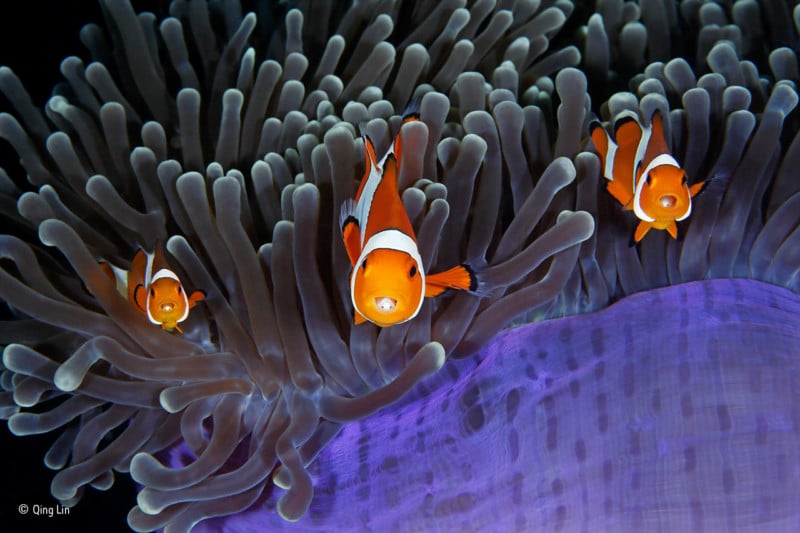
Have a look at this amazing shot. The finalists for the 2017 Wildlife Photographer of the Year at the Natural History Museum include this shot by a photographer named Qing Lin at Lembeh:
I could not find it on the NHS site so here is the link to the article on PetaPixel as well as a link to the WPOTY competition.
What a spectacular achievement to get three of them all with isopods posing identically!
Have a look at this amazing shot. The finalists for the 2017 Wildlife Photographer of the Year at the Natural History Museum include this shot by a photographer named Qing Lin at Lembeh:
I could not find it on the NHS site so here is the link to the article on PetaPixel as well as a link to the WPOTY competition.
What a spectacular achievement to get three of them all with isopods posing identically!
Thanks for sharing... I am aware of this image and the story behind this image... Truely an amazing shot.
But how does the characteristic of the fish changes when it is infected with tongue parasite. What are the first thing we should look at to know that it is infected.