I'm looking for a work around for the limitation of 1/160 shutter speed when using the built in flash, optic cables and two attached strobes with my Sony A6500/Nauticam housing. I've contacted the dealer who sold me my gear and they have said there is no solution for this, that it is a limitation of the Sony camera. Even if I were to use a flash trigger, I've been told that 1/160 is the maximum speed that the camera's shutter can synchronize with any flash. How are others dealing with this limitation? Does the A6400 have the same limitation?
Photography Gear and Technique / Archived topic
Sony A6500 and limited shutter speed (1/160) w/ flash
Started by kellison ·
- 13Posts
- 13Replies
Read-only discussion
Sony A6500 and limited shutter speed (1/160) w/ flash
13 posts
-
-
1/160s is indeed the sync speed limit for A6xxx cameras. Basically, the way it works is that the shutter curtain has two halves - the first half moves down to open the frame, then the second half follows it down to close it, then they both move back upwards to reset for the next shot. However, due to movement speed limitations, in order to produce exposures shorter than 1/160s, the second curtain starts closing the shutter before the first curtain has fully opened it, producing a strip of light that moves across the frame. This works with natural light, because it's 'always on' so to speak, but if a strobe fires with a partially exposed shutter, it will produce a partially exposed image, with a black band on top, bottom, or both.
The only way to overcome this is to use high-speed sync, where the strobe flickers on and off at a very high speed (I've seen 40kHz quoted as a typical number) while the strip of exposure moves across the camera sensor. Unfortunately, besides severely curtailing the strobe's power output, this mode has extremely limited support among underwater equipment manufacturers. To date, the only strobe that I know of that supports it is Olympus UFL-2, which has long since been discontinued, and it only worked with supported Olympus cameras to begin with. The also discontinued Sea & Sea YS-250 Pro has an atypically long pulse length which can function as pseudo-HSS to some extent. Finally, the upcoming Retra Flash Prime and Pro claim support for HSS with a compatible trigger (i.e. you won't be able to make use of that mode when triggering off the camera flash), but these aren't available yet, and neither are compatible triggers.
What problem are you trying to solve by going beyond 1/160s though? Since you're shooting with strobes, and the majority of your light comes from them, the actual effective exposure speed is usually equivalent to the strobe pulse length (about 1/320 at full power on Z-330, for example), not to shutter open time. If too much ambient light is getting through, you can just close the aperture and/or reduce ISO.
-
@Barmaglot - Thank you for the reply. I suspected that was the case. I'm trying to achieve the dark background for macro subjects. I do more macro photography than anything else and typically shoot with smallest aperture available, 1/160 shutter speed, lowest ISO possible and med-full power strobes.
-
Hi,
in macro the sync time is not the problem.
You have a small aperture, and the strobe is the only light source.
So the short strobe burn time is not the problem.
If you do wide angle, and use the natural light in combination of the strobe,
you get a bigger problem.
Regards,
Wolfgang -
@Barmaglot - Thank you for the reply. I suspected that was the case. I'm trying to achieve the dark background for macro subjects. I do more macro photography than anything else and typically shoot with smallest aperture available, 1/160 shutter speed, lowest ISO possible and med-full power strobes.
Snoots? In macro, your background is typically lit by strobes unless you silhouette your subject against water (not a very common occurrence); faster sync speed won't do anything, but snoots will limit strobe illumination to your subject, whereas the background should get only ambient light, which, at 1/160, f/11-16 and ISO100 will get pretty close to black in most circumstances.
-
Snoots? In macro, your background is typically lit by strobes unless you silhouette your subject against water (not a very common occurrence); faster sync speed won't do anything, but snoots will limit strobe illumination to your subject, whereas the background should get only ambient light, which, at 1/160, f/11-16 and ISO100 will get pretty close to black in most circumstances.
Yes, snoots are my next purchase. I haven't used them but decided on this last trip that they would be worth adding to my gear. When you say 'in macro' do you mean the macro setting on the camera? I use the CMC-1 Macro Converter on my 16-50 mm lens. I got out of the habit of setting the macro mode on the camera. Thank you for your help. Much appreciated. Now, I just need to start researching snoots.
-
No, I mean macro photography in general. To be honest, I've never even tried the 'macro' scene mode on the camera (I have an A6300, so pretty similar to yours); underwater I always have it in M mode. What I mean is, most macro subjects are found on or near some sort of surface, which means snoots are needed to isolate the background from the strobe light. If you happen to find a free-swimming one with meters of water behind it - great, although getting the shot becomes exponentially more difficult - but such opportunities are few and far between, aside from blackwater dives which are themselves not too common.
I don't have any snoots myself, but I've read a lot of positive feedback about Retra LSD. Depending on your strobe model though, aiming a snoot can range between annoying and extremely frustrating. As I understand it - again, no personal experience thus far - strobes with a center-mounted modeling light such as Ikelite DS-161 make it easier.
-
No, I mean macro photography in general. To be honest, I've never even tried the 'macro' scene mode on the camera (I have an A6300, so pretty similar to yours); underwater I always have it in M mode. What I mean is, most macro subjects are found on or near some sort of surface, which means snoots are needed to isolate the background from the strobe light. If you happen to find a free-swimming one with meters of water behind it - great, although getting the shot becomes exponentially more difficult - but such opportunities are few and far between, aside from blackwater dives which are themselves not too common.
I don't have any snoots myself, but I've read a lot of positive feedback about Retra LSD. Depending on your strobe model though, aiming a snoot can range between annoying and extremely frustrating. As I understand it - again, no personal experience thus far - strobes with a center-mounted modeling light such as Ikelite DS-161 make it easier.
That's how I use it also, always M mode and never have tried the macro mode. Thank you for the additional information. I'm not sure I need to add another annoying/frustrating thing to the process.

-
Yes unfortunately it is impossible to achieve a higher flash sync even with the S-Turtle TTL Trigger. (but I would still highly suggest on buying the trigger for higher recycle times)
To achieve better black backgrounds in macro photography try using different strobe placement techniques.
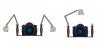
Such as inward lighting. Turning the strobes inwards, facing towards me or the housing in the wrong direction, the background immediately behind a subject can be underexposed achieving the black background you desire. It works by using the very ‘edge’ of the beam angle. Have a look at the diagram below and happy experimenting and shooting!
-
Big shout-out to the guys at TRT Electronics for helping me with this same issue. I had been using a manual trigger the camera didn't recognize (and so it didn't apply the 160 restriction) for wide angle when trying to get sun-rays in the shot. I do not get the black bar using 200 or even 250 (Sony a6600). Anything above 250 does catch the curtain however.
The trick is to enable wireless flash mode (WL) if using a hot shoe trigger.
-
If your trigger will operate without communicating to the camera that it is a flash the camera then allows greater shutter speeds to be set and this may or may not allow achievement of a higher shutter speed - it really depends on your camera model. It looks like the A6600 works up to 1/250 and sometimes you'll just get a narrow shutter band at the bottom which you might get away with depending on the shot. The A6500 may or may not behave the same way - it all depends if the same shutter and timing is used, but quite possibly you'll get a small boost in shutter speed.
But looking at the bigger picture you are chasing 2/3 stop less ambient light. You can achieve the same exposure reduction on the ambient light by stopping your lens down 2/3 stop and raising your flash power the same amount. Similarly minimising ISO and compensating with more flash power will have a similar effect.
-
I had poor results on a recent trip to the Virgin Islands. Probably user error, but the flash was firing late, and using shutter speeds above 160 resulted in just ambient light reaching the sensor. Experimenting around, I ended up doing what Chris suggested and just stopping down more. This last trip, I shot F13 or smaller more than I have ever done in the past. Worked well, getting the "blue" I wanted and increasing corner sharpness. Strobes were operating at a higher power than I have ever used before and as a result, the batteries were draining more than normal, but still got 3 dives on a set of batteries with juice to spare. Not really a big deal...
-
Hi all,
Following up on this topic with a similar issue I encountered few days ago.
I've been shooting macro in very bright conditions: Sunny weather, clear water, bright seafloor in only 3m of water.
Used the Sony A6500/90mm, set to F16 - F22, shutter at 1/160, ISO 100. Even the not-strobe-lit areas are quite bright - to bright to black them out in post processing. As compared: taking shots with the same settings/strobe positioning under a pier in the shade with slighly darker seafloor worked perfectly fine and gave nice shots. So I assume, it really is the ambient light and not my strobe positioning (well, the pros could surley do it better, but at least I tried crossed strobes/inward lighting). Hence, I somehow have to reduce ambient light, which is not feasible with settings only.
Now my idea was to reduce total light by an ND filter (ND4 oder ND8) and crank up my strobes. My port has a M67 thread, so I could add/remove the filter underwater comfortably. Would be cheaper than buying a strobe trigger for the small step to 1/250...
Any thoughts on this approach?
Thanks,
Fabian