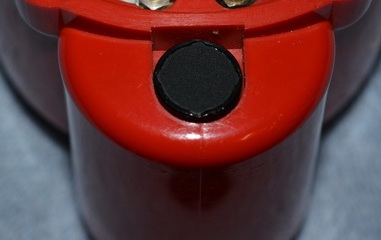
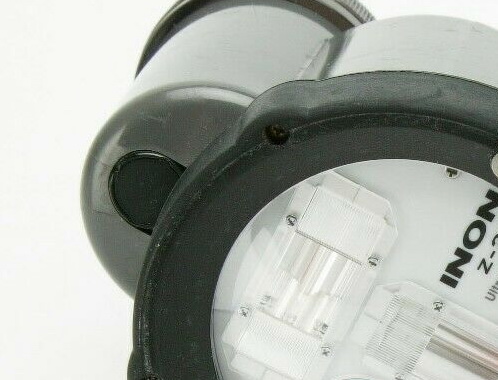
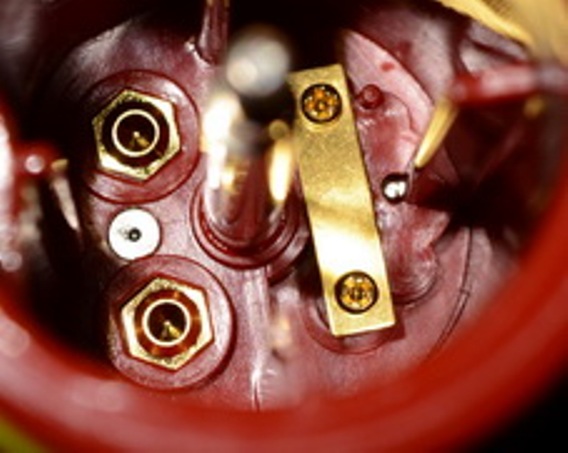
The mystery of the Inon Black Disc is solved, thanks to Tiger Shark, above. If one looks closely into the Inon D2000 strobe battery compartment one finds at the bottom a tiny, about 1 mm, hole with a shiny metal device in it centered on the outer black disc. This is said to be a vent for gas, such as hydrogen, released by a “hyper-electric discharge or short circuit" of Eneelop batteries (1).

There are two shiny steel devices visible in the bottom of the D2000 battery compartment, the one on the right sits inside a small hole, and the one on the left is on the surface. Both may be gas pressure detectors, but are not described in the Inon User Manual.
About this “hyper-electric” (whatever that may be) discharge, here is what Pansasonic recommends: “Please do not use eneloop Ni-MH batteries in underwater lights or other airtight appliances” (1).
Clearly, many underwater photographers neglect to follow this expert hyper-electric advice.
Unfortunately the Inon gas-release device does not prevent water flooding from the battery into the electronic compartment. For this, future, properly engineered water proof seals between the two compartments will be necessary.
Citations:
1. https://www.panasonic.com/global/consumer/battery/eneloop/technologies.html
"Can eneloop be used in underwater lights?
Please do not use eneloop Ni-MH batteries in underwater lights or other airtight appliances. Ni-MH batteries feature a gas vent that allows the release of hydrogen when the battery is misused. Gas will not be released under normal usage conditions, but hyper-electric discharge or short circuit can cause internal gas pressure to rise and gas to be expelled. This gas contains hydrogen and sealed devices can’t diffuse the gas, so any source of ignition may potentially cause fire.”
- -
At Adex 2018 there was more on the Eneloop batteries:
http://wetpixel.com/articles/eneloop-batteries-not-recommended-for-use-in-strobes
followed by a report of the Seacam’s adaptive electronic controller to recharge batteries, and a comment on the Inon off-gas valve:
http://wetpixel.com/articles/show-report-adex-2018-by-drew-wong
--
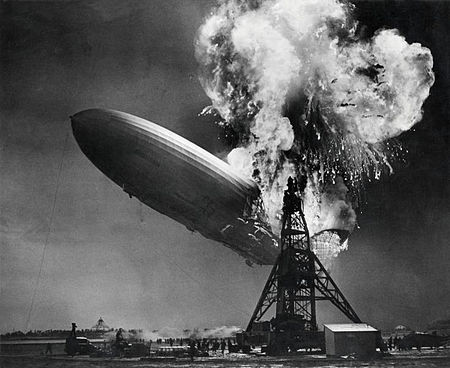
In case you are wondering about Hydrogen, it is the best fuel known, lightest, odorless, colorless, non-corrosive, non-toxic and easy to obtain, except it is explosively flammable and difficult to store as it seeps out of most containers, good reasons why it is rarely used, particularly after the Hindenburg tragedy of 1938. It seems like good practice to open one's strobes away from any fire or person smoking.

Hindenburg dirigible on fire, 1938 newsphoto from Google