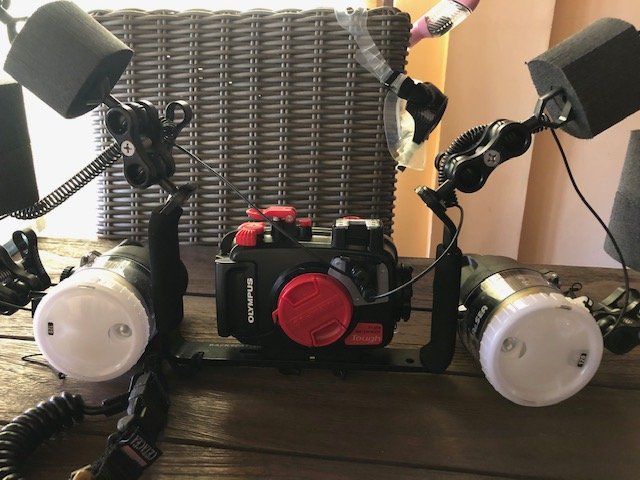
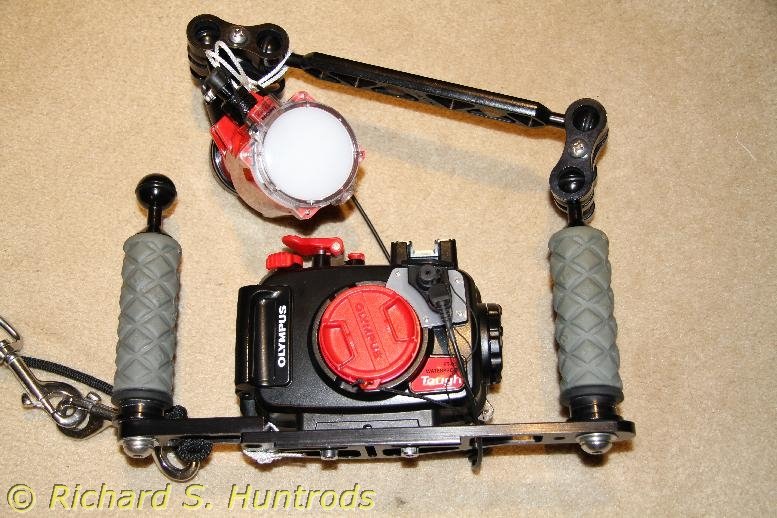
Allow me to suggest that you don’t always want “flat and even” lighting, for macro unless you want to produce straightforward ID images. Light and shadow need to be balanced. Backscatter needs to be managed. Backgrounds often need to be minimized. These objectives are not usually compatible with “flat and even” light.
I had been pursuing the same goal. Most images were OK, some better than that, but few were outstanding. My biggest revelation came on a weekend when I (inexplicably) left my strobe arms at home, and had to jury rig one strobe to the cold shoe on top of the housing, literally strapped to the focus light mount with duct tape with no ability to swivel downward. I figured what the heck, it was worth a try. Somehow, I stumbled on a lighting setup that used the very edge of the light and produced better images than I had been making. Two examples below.


Now I actively try to use just the edge of light when possible, aiming the strobes slightly outward or upward. Remember that strobes produce a cone of light at about 90-100 degrees. You also want the front of the strobe just behind the front of the port. I like them at 10 and 2 o’clock because it seems more natural to my eye to have the light coming from above the subject. I also frequently turn one strobe off, or turn one down to several stops if the shadows are too harsh.
There are other ways to set up that might seem counterintuitive. Martin Edge’s book The Underwater Photographer and Ales Mustard’s book Underwater Photography Master Class both have lots of good material on strobe positioning.
There are many good tutorials on this and other topics available on line:
Good luck, and have fun!