Nice topic Adam, questions about domes are quite common in the forums.
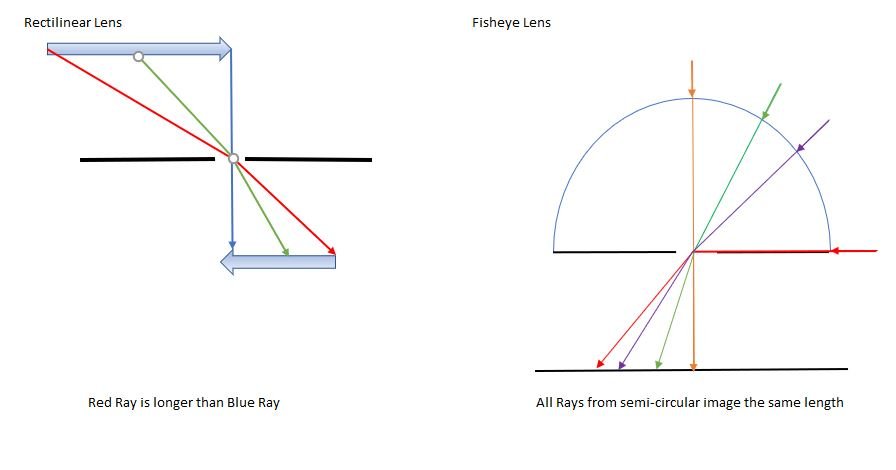
For those with a more technical bent this diagram explains some differences between rectilinear and fisheye lenses:
A rectilinear lens takes a straight line parallel to the sensor and renders it as straight line with both ends in focus/ Note that the red ray is longer than the blue ray. Put the lens in a dome port and suddenly the lens is looking at a curved virtual image and the distance to the red and blue points on the line is now the same and to get the red ray end of the line in focus it needs to fall inside the depth of field for the corner to be sharp.
With the fisheye lens all points falling along the semi circle shown are the same distance from the lens and the lens is effectively designed to get all of these points in focus- you physically can't render a straight line that runs from one corner of the frame to the other with a full frame fisheye as the far ends of the line would have to be at infinity. The lens is instead designed to render a semi-circular arc as a straight line - IF - it runs across the centre of the frame. The corners are also compressed by the barrel distortion so fine details are not magnified as much.
So you can see how a fisheye will deal with a curved virtual image a lot better than a rectilinear lens - the fisheye lens is effectively designed for it and doesn't have to overly rely on stopping down for depth of field to get the corners in focus.
The corners may be not quite perfect wide open (or close to wide) due to other optical issues - the corners won't be as sharp even on land wide open at infinity, add to this potential aberrations in the corners when operating at near minimum focus distance, potential slight misplacement in the dome port and possibly issues with the dome itself at the edges potential for the dome to be de-centred etc- problems that stopping down will likely solve, you can see why fisheyes can be used in small domes only 1-2 stops down from wide open.
Very small domes may get some depth of field issues as distance from subject to sensor may vary a little - the magnification of the fisheye lens is operating near maximum when focusing closer and closer so the available depth of field even on land will reduce as domes get smaller.