



Skip to content

Photography Gear and Technique / Archived topic

Controlling aperture on the TG-5 for macro

Started by demonboy ·

  • 14Posts
  • 14Replies

Read-only discussion

Controlling aperture on the TG-5 for macro

14 posts
  1. Finally I've been using my TG-5 for UW photography and I'm actually impressed with the macro capabilities, even when using my crappy dive torch for light. I've managed to get some great shots, but I've also noticed it's opening up the aperture and giving me really shallow DoF, which I don't want. I understand it is probably doing this to let in more light, even though I stop down by a whole stop.
    What I'm interested to know is, can I shoot macro on aperture-priority mode, or does the TG-5 microscope (macro) setting actually change something physical within the camera to get a closer focusing distance that's not achievable in A mode?
    I normally shoot fully manual on land and in raw, but underwater I appreciate the AF and the macro setting.
    How do I shoot macro, in raw, and have control over the aperture on the TG-5?

    I've attached one of my first efforts which, although nice, sufferers from too shallow DoF.
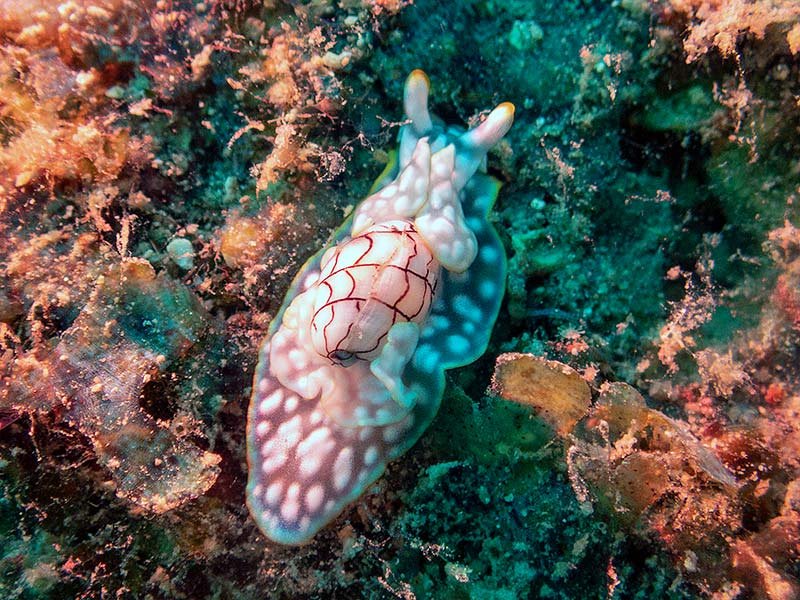


    P4070018-Enhanced.jpg

  2. I’m not 100% sure, but if I remember correctly the TG series cameras don’t have a physical aperture, so you’re stuck with whatever setting it gives you. 

  3. Does that mean Aperture Priority is purely digital then?

    Another thought would be to use a wet macro lens in AP. I wonder how well that would work.

    Edited by demonboy
  4. Just looked it up. Apparently the aperture can physically stop down for 1 stop. There is a further setting for 3 stops achieved by using an internal ND filter, so at the wide setting the apertures possible are f2, f2.8 and f8 (only achieved by ND, so no change to DoF). However on such a small sensor getting more DoF via aperture would often be offset by lost sharpness from diffraction. 

    I think going off the image you posted, I'm not sure it would have profited much more from more DoF. Focusing on the rhinophores is important. If the rest is not all in focus, that is often fine. More important than that is that you should try to avoid shooting down on subjects. Try to get them from the front. That way if you focus on the rhinophores the most important part will be in focus and it will be clear what the subject is.

  5. Thanks for the feedback and the detective work too. Appreciated. Yes, I realise shooting straight down is not ideal. My current tactic is to get a shot looking down first as that is the easiest, and then try for a better angle before I lose sight of the rest of the group! Perhaps my tactic should be to go straight for the money shot.

    I think in my nooby panic to just get a shot I'm concentrating on making sure the shot is generally in focus, but not where it is focusing. In macro mode the focus point is always in the centre so there should be no reason why I can't nail the rhinophores and then recompose.

  6. 58 minutes ago, demonboy said:

    Thanks for the feedback and the detective work too. Appreciated. Yes, I realise shooting straight down is not ideal. My current tactic is to get a shot looking down first as that is the easiest, and then try for a better angle before I lose sight of the rest of the group! Perhaps my tactic should be to go straight for the money shot.

    I think in my nooby panic to just get a shot I'm concentrating on making sure the shot is generally in focus, but not where it is focusing. In macro mode the focus point is always in the centre so there should be no reason why I can't nail the rhinophores and then recompose.

    If you are starting off seems to me perfectly reasonable to be concentrating on getting the shot rather than, perhaps, thinking more about how you might take the shot. That will come though with time and experience. Most important thing is to enjoy the moment!

    Good advice from hyp though. The sooner you can get away from shooting down, the faster your images will get better and be more satisfying. 

  7. 1 hour ago, TimG said:

    Most important thing is to enjoy the moment!

    Exactly that.

  8. The TG does f2/2.8 wide and f4.9/6.3 tele,  any aperture greater than f6.3 involves the ND filter.  Microscope mode is like program mode but allows you to focus closer but doesn't allow you to select your aperture.  If you look at the specs you'll see normal shooting is 100mm to infinity, super macro and microscope mode is 10mm to 300mm.  This is exactly what you would expect to happen if you added a closeup lens to the system.  

    If you wish to choose your aperture you could shoot in A mode and use the super macro AF focus mode.  This will allow you to shoot the same range as microscope mode, but locks out greater distances.  You could switch AF mode back and forth between the two as required by your subject.  For most purposes you probably want f2.8/f6.3 for the most depth of field.

    Microscope mode likely does similar but camera chooses aperture or it might have fixed aperture, it's not clear from the manual, but you could try it out to see how what settings it will use..

  9. 3 hours ago, ChrisRoss said:

    If you wish to choose your aperture you could shoot in A mode and use the super macro AF focus mode.  This will allow you to shoot the same range as microscope mode, but locks out greater distances.  

    That just didn't occur to me! I've been so focused on using 'microscope' while UW that I haven't given myself enough space to play with the other modes. This could be a good work-around. Thanks for the pointer.

  10. 1 hour ago, demonboy said:

    That just didn't occur to me! I've been so focused on using 'microscope' while UW that I haven't given myself enough space to play with the other modes. This could be a good work-around. Thanks for the pointer.

    Suggest you compare shots taken in microscope and Av mode(with super macro enabled) to see if the camera does anything different in microscope, compared to Av with super macro. 

  11. The Backscatter videos are quite comprehensive but they don't mention that f18 is the same aperture as f6.3 with only the addition of a 3 stop ND filter and requires a lot more flash power, I can see using it in clear shallow tropical waters to get a black background, but it may not be necessary if you are deeper and shooting at f6.3 will extend your battery life if you are shooting TTL. 

  12. I've watched the Backscatter videos a few times and they're very useful. They're one reason why I was focused on the microscope setting. They don't, however, discuss aperture in relation to stopping down for macro, unless I missed it.

    I can't comment on flash use yet as so far I've been using a little torch! I do have a strobe on order though, so it will be interesting to see how it affects the auto settings in microscope mode.

  13. There's a one  liner in the TG-6 version of the video where they say f18 is good for depth of field and dark backgrounds.  The focus seems to be on getting a black BG and they mention f18, ISO100 and -2 EV exp compensation all in relation to getting a black background.

Ultralight Control Systems

Account

Navigation

Search

Search

Configure browser push notifications

Chrome (Android)
  1. Tap the lock icon next to the address bar.
  2. Tap Permissions → Notifications.
  3. Adjust your preference.
Chrome (Desktop)
  1. Click the padlock icon in the address bar.
  2. Select Site settings.
  3. Find Notifications and adjust your preference.

