Skip to content

Shooting Technique, Workflow and Editing / Archived topic

Tips on Fish Portraits, Backgrounds and Story telling

Started by Pomacentridae ·

  • 11Posts
  • 11Replies

Read-only discussion

Tips on Fish Portraits, Backgrounds and Story telling

11 posts
  1. Sharing some pictures I took over the weekend in Anilao (here). Would like to start a discussion on portraits so I can learn or get new ideas on what I can do. So happy to hear your critiques.

    Olympus EPL10 + AOI Housing + 60mm Macro + single Z330 strobe; All images 1/250 F8.0 ISO 200

    Some of the things I find hard are:

    • Techniques/style. Thoughts on the black background? would blue backgrounds been better to highlight the subject? Thoughts on the position of the fish? Should I try a different way or style (asking for ideas)?
    • Placing the fish or animal in its habitat. I find most of the time the background to be very cluttered, the only way I get good results is if I shoot with open water as the background. How do you spot good backgrounds? Any tips or personal takes on this?
    • Telling a story. The best photos I think tell a story. Currently I feel my shots are just meh ID pictures that don't engage. Good at show casing how pretty the fish are but have no story/not engaging. How do you see or anticipate those stories, behaviors as they unfold? Most of the time it just feels like a game of chance, but some people seem to have a higher success rate so I feel there is some method to that madness. Any thoughts on this as well?

    EDIT: Also a better way of sharing pictures here, for a photography group it is a nightmare sharing because of the 0.98MB limit. How do you embed an album from Imgur?


    GHOSTS OF THE DEEP

    Pink Tail Trigger Fish (Melichthys vidua)

    C2yrAXP.jpeg


    Orange Striped Triggerfish (Balistapus undulatus)

    lCUGTaz.jpeg


    Redtooth "Vampire" Triggerfish (Odonus niger)7VGMYlc.jpeg


    Edited by Pomacentridae
  2. They are nice portraits though I agree they are ID shots - which can de challenging enough to produce.  Personally I'd prefer blue water background, if it could be achievedwithout too much drama - is one stop brighter enough to get blue?  I was getting reasonable blue BG with 1/250 @ f8 ISO400 when shooting in Indonesia. 

    I do agree placing in habitat helps and it's a matter of taking enough shots till you get one where the BG is good at least in my experience - I mainly shot temperate waters and BG can be untidy,but I often get shots that work, particularly if the BG is a little under exposed so it's visible but recedes from the subject.   You can always practice on fish that sit on the reef taking one degree of difficulty out of the shot.

    As far as stories go, it helps to understand fish behavior, for instance if I see a fish sitting on/above  the reef with all fins raised that's a sure sign it's at a cleaning station and even if I can't see the cleaner I'll make a slow approach to grab some shots and often rewarded to find a small cleaner in the shots.

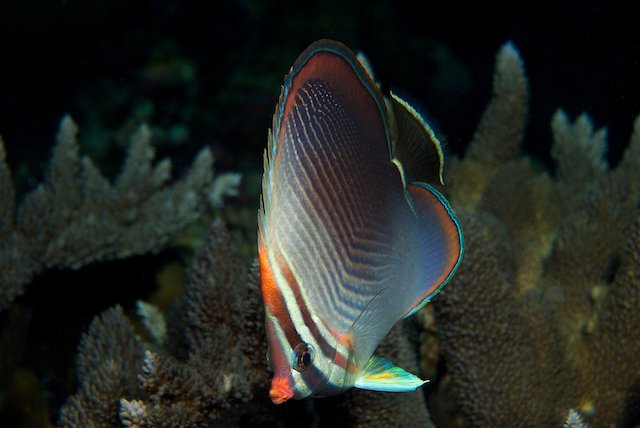
  3. I agree with Chris Ross, the above posting. I  like to photograph the fish in there habitat. It shows the area of the reef they live. And if the background is rather boring the suggestion of underexposing the background ephasizes the fish. Full power on the flash will bring out the foreground and the background goes darker with f13 and up to f22. Basisly close focus wide angle technique. I also like to have the fish swimming towards you and going left to right as it looks more natural. Also using the rule of thirds concept as a centrered photograph is a fish id shot.

    Komodo 429.jpg

    Palau 805.jpg

    Edited by saga7
  4. 17 hours ago, ChrisRoss said:

    They are nice portraits though I agree they are ID shots - which can de challenging enough to produce.  Personally I'd prefer blue water background, if it could be achievedwithout too much drama - is one stop brighter enough to get blue?  I was getting reasonable blue BG with 1/250 @ f8 ISO400 when shooting in Indonesia. 

    You're correct, I can get blue backgrounds at ISO400! I feel a bit stupid, on land my ISO is typically on auto, and just adjust the shutter and aperture. When I was diving I was adjusting the shutter and aperture to get the blue backgrounds -- totally forgot about the ISO. Next time will do that, makes life easier.

    Quote

    I do agree placing in habitat helps and it's a matter of taking enough shots till you get one where the BG is good at least in my experience - I mainly shot temperate waters and BG can be untidy,but I often get shots that work, particularly if the BG is a little under exposed so it's visible but recedes from the subject.   You can always practice on fish that sit on the reef taking one degree of difficulty out of the shot.

    Will take that advice and experiment with trying to underexpose the background. I think that could work in both highlighting the subject but at the same time showing a bit of habitat with it.

    Quote

    As far as stories go, it helps to understand fish behavior, for instance if I see a fish sitting on/above  the reef with all fins raised that's a sure sign it's at a cleaning station and even if I can't see the cleaner I'll make a slow approach to grab some shots and often rewarded to find a small cleaner in the shots.

    Yup, actually those images I shot were near a cleaning station. When it comes to behaviors I think I know a lot about what behaviors that can be seen like spawning, or coconut octopus using coconuts as hiding spots. However, I lack the knowledge of where and when these behaviors occur. I typically don't know what'll happen when I get to a dive site. It would be nice if I could know, for example, when its the full moon, this month, at high tide octopus are mating, that sort of thing. From birding it's sort of like that, we know the months the Shrikes migrate, breed, feed and where they nest. So capturing behavior is much easier. Is there a marine equivalent?

  5. 9 hours ago, saga7 said:

    I agree with Chris Ross, the above posting. I  like to photograph the fish in there habitat. It shows the area of the reef they live. And if the background is rather boring the suggestion of underexposing the background ephasizes the fish. Full power on the flash will bring out the foreground and the background goes darker with f13 and up to f22. Basisly close focus wide angle technique. I also like to have the fish swimming towards you and going left to right as it looks more natural. Also using the rule of thirds concept as a centrered photograph is a fish id shot.

    I like your shot of the Eastern triangle butterflyfish (Chaetodon baronessa) and how the background seems to fade into black but is still there. Is the aperture still the same for M43 at f13 to f22? From my macro background on land, I've been told not to go past f11 as the image starts showing diffraction (M43, Oly 60mm). So I typically don't shoot smaller than f11. I am not sure if how applicable that rule is underwater.

  6. Nice work on those portraits!  I use the same lens but have not managed to get clean shots at that distance.  What was your strobe placement for these?  Knowing the waters around Anilao, you must have needed a lot of patience, and considerable time in editing to remove backscatter.  

  7. The butterflyfish was iso 200, speed 100 and f13

  8. On 10/28/2021 at 11:20 PM, Pomacentridae said:

    Placing the fish or animal in its habitat. I find most of the time the background to be very cluttered, the only way I get good results is if I shoot with open water as the background. How do you spot good backgrounds? Any tips or personal takes on this?

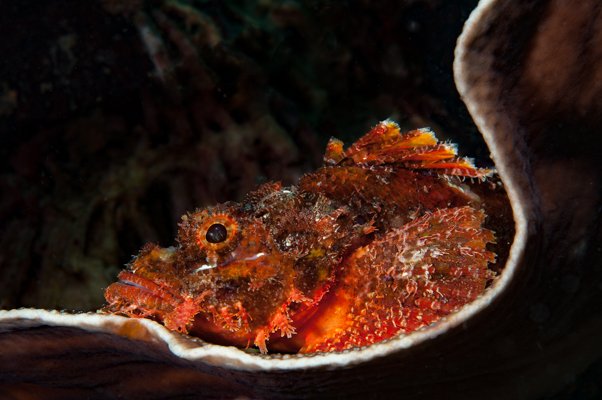
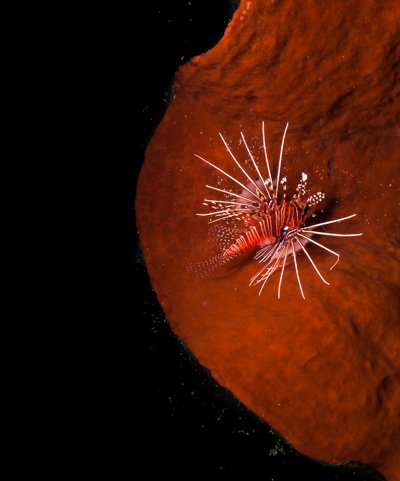
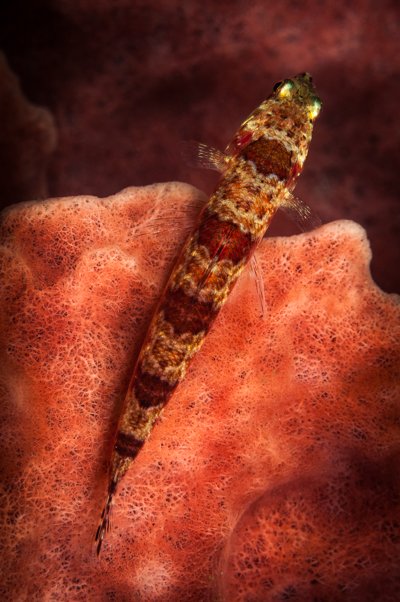
    Some time back I was diving 2-3 days a day for almost a year and photographing all the time. I got to the point where I was bored of shooting "fish portraits" (no surprise!) and was looking for something new.

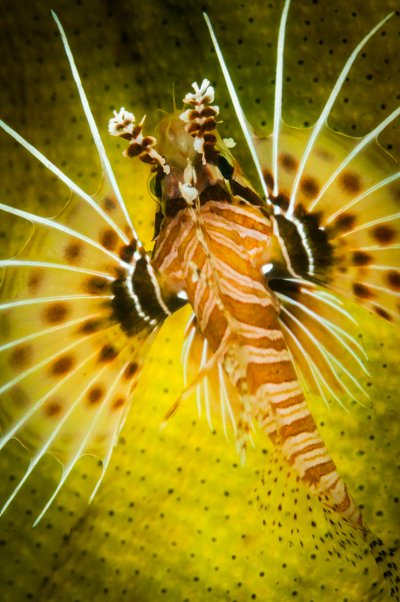
    Someone suggested to me looking for mono-colour backgrounds or interesting graphical coral shapes and then waiting to see what might come along and settle on it. Bingo! I found a whole new direction.

    The advantage of the mono-colour background is that it is not distracting and can, in a neutral space way, enhance the colours or shapes of the subject. Similarly a clearly defined shape can help focus attention. Both help get away from the usual fish portraits!

    A couple of examples: 


    TG18919.jpg

    TG20387.jpg

    TG20974.jpg

    TG21483.jpg

    Edited by TimG
  9. 20 hours ago, Pomacentridae said:

    I like your shot of the Eastern triangle butterflyfish (Chaetodon baronessa) and how the background seems to fade into black but is still there. Is the aperture still the same for M43 at f13 to f22? From my macro background on land, I've been told not to go past f11 as the image starts showing diffraction (M43, Oly 60mm). So I typically don't shoot smaller than f11. I am not sure if how applicable that rule is underwater.

    Depth of field scales with sensor size, so generally you don't stop down as much with m43- f11 on m43 is the same DOF as f22 on full frame.  Diffraction is not talked about much with UW work, but it's still there, perhaps not as noticable as the degradation caused by port optics tends to dominate.

    The effect of the BG fading out to darkness can be achieved perhaps by flash placement or snooting, but the most straight forward way is distance - if the BG is far enough behind the fish it will fade to blackness if the ambient light exposure is in the right range.  If it is at the same distance as the fish then it is going to receive the same light intensity.  So looking for outcrops on the reef or the fish swimming far enough from the reef will help get that effect.

  10. Some time back I was diving 2-3 days a day for almost a year and photographing all the time. I got to the point where I was bored of shooting "fish portraits" (no surprise!) and was looking for something new.
    Someone suggested to me looking for mono-colour backgrounds or interesting graphical coral shapes and then waiting to see what might come along and settle on it. Bingo! I found a whole new direction.
    The advantage of the mono-colour background is that it is not distracting and can, in a neutral space way, enhance the colours or shapes of the subject. Similarly a clearly defined shape can help focus attention. Both help get away from the usual fish portraits!
    A couple of examples: 
     
    TG18919.jpg.7acf0aae19143333c0958e38672d8cdd.jpg
    TG20387.jpg.13e66074ca3edbd1810be27f694a23ee.jpg
    TG20974.jpg.fb35333b1df3070b78dad38b9e55a55e.jpg
    TG21483.jpg.9c71c057c79dbcc61993d94496882cd1.jpg
    @TimG thanks for that tip. That makes a lot of sense and I can definitely see that working. Its a very street photography technique, you set the stage and let your subject walk into it. Might to need to select a high fish traffic area.


    Sent from my iPad using Tapatalk
  11. Nice work on those portraits!  I use the same lens but have not managed to get clean shots at that distance.  What was your strobe placement for these?  Knowing the waters around Anilao, you must have needed a lot of patience, and considerable time in editing to remove backscatter.  

    Thank you! I am using a single strobe, 11 or 1 o'clock position. I actually found a cleaning station and just hang there waiting for the fish to approach me. I know what you mean about the backscatter, most of the time it is an issue. But there are spots where high flushing happen and backscatter isn't that big of an issue. Also timed my visit with no rains the past week, so super clear. If you look at the orange striped triggerfish shot thats pretty much the backscatter there. The other two, not much editing, just selected the fish and increased the blackpoint. Here is the uneditted shots, not much backscatter.
    922fe56e90b95a76f2e122eec4824c10.jpg


    Sent from my iPad using Tapatalk

Account

Navigation

Search

Search

Configure browser push notifications

Chrome (Android)
  1. Tap the lock icon next to the address bar.
  2. Tap Permissions → Notifications.
  3. Adjust your preference.
Chrome (Desktop)
  1. Click the padlock icon in the address bar.
  2. Select Site settings.
  3. Find Notifications and adjust your preference.