Skip to content

Photography Gear and Technique / Archived topic

Do you really need full-frame? The underwater photographer's perspective

Started by turandot ·

  • 11Posts
  • 11Replies

Read-only discussion

Do you really need full-frame? The underwater photographer's perspective

11 posts
  1. Do you really need full-frame? The underwater photographer's perspective. The Great Full-Frame Debate: Underwater Edition
    It’s almost cliche at this point: should I “upgrade to a full-frame camera?” At Mozaik, we hear this over and over. People assume that moving from anything not full-frame to anything full-frame will be an upgrade. This week, we examine this in more detail, from the perspective of the underwater photographer. 

    Read more...

    I open debate! I look forward to your answers

  2. Oh dear, remove pin, open door, throw in grenade. Close door.

    Let me admit at the start that I love shiny new toys. I had a Nikon D300-based system - which was great - but when the D800 arrived, I wanted that. It was full frame. Had to be better, right?

    It was great too. I loved the image that could produce. But also an utter pain to travel requiring a 230 dome for wide-angle images with sharpish (but not perfect) edges; and the depth of field was not as good as the D300 for macro.

    Some years later the D850 arrive. Shiny new toy. But the more I read about it and talked to folks here on WP, the more persuaded I was that that full-frame was not the way to go - and to "down-size" to a D500 instead (thanks, Adam Hanlon!).

    Result: easy to house a wide-angle (the classic Tokina 10-17: which I had on the D300), more depth of field with macro, WAY easier to travel (check that one with my partner!); no mega-domes, cheaper lenses - but not lacking in quality. 

    There is, of course, an element of what does the photographer want to do with the images? Is a, say, 24MB camera image enough? You can argue that FF gives you more crop-ability. But if like many the aim is to look at images on screen, maybe blow-up the occasional print to A3, then it's plenty. I sell lots of u/w images and no-one in 15 years has ever said, hmmm, that's not a full frame camera image..... it's either a nice image or it ain't. 

    Like I say, I love shiny new toys. But just for once, I realised that FF was not an advantage and I would not let my underwater self be seduced by the siren calls of the camera manufacturer marketeers. DX or M4/3 for many users, I would suggest, is the sweet spot.

    And, yes, I have FF for topside..... The Man got me on that one.

  3. Thank you for the link tursiops...

    I have read tons of information on the debate which sensor is optimal for UW-photography and there are many pros and cons. Mostly I see two kind of opinions regarding FF vs. smaller sensors: people using cropped sensor who, from theory, conclude that their system is the best and FF is not worth going for. The FF side comprises almost all professionals and many high-end amateurs and most would not change back to a smaller sensor. There are only few, like Tim or Adam, who can tell from their own experience and have decided to go with the smaller sensor (for most applications).

    Since and before I have acquired a MFT system in 2017, I have read tons of information on the debate which sensor is optimal for UW-photography and there are so many pros and cons. Besides the obvious arguments on luggage, money and the vast discussion on the number and technical properties of the pixels, there is the fact, that due to the wave nature of light (Huygens' principle), more details can be resolved optically on a larger area, compared to a smaller one (unless someone invents a "superresolution camera" according to here: https://www.nobelprize.org/prizes/chemistry/2014/press-release/ :D)...

    As far as I am concerned, I will not know what I prefer, before I have not practical experience with FF (maybe I would switch later back to MFT, maybe not)...


    Wolfgang

    Edited by Architeuthis
  4. Regardless of the image and pixel quality, for me, the determining factor for amateur underwater photography was the price of the set: camera, underwater housing, lenses, ports, etc.

    I think the current prices of any fullframe kit are very high for certain amateur or non-professional underwater photographers.

    Is the SONY α1 good? Yes
    Do I want or can I pay $6,500 just for the body and $4,540.00 for the underwater housing? No

    For many of us the solution goes through MFT.

  5. I think if price is the deciding factor, right now, the D500 is an absolute bargain, and probably no more expensive than a M4/3 system.

    The only downside is that it is bigger and heavier. 

    Super resolution offers the exciting option of producing high resolution imagery with (relatively) low resolution cameras. My experience with it is that it isn’t great with M4/3 files (yet), but is very good with cropped sensor files. 

    So if we remove resolution from the list of full frame advantages, we are left with dynamic range, dealing with noise and the fact that all the manufacturers want us to buy full frame cameras!

  6. I think this discussion will come down to the equipement you're able to use for underwater. DLSR got a wide range of stuff to choose. On the mirrorless side .. you have MFT and Fullframe but for APS-C? Fuji cases are very expansive and Sony seems to let APS-C die.
     

    20 minutes ago, adamhanlon said:

    So if we remove resolution from the list of full frame advantages, we are left with dynamic range, dealing with noise and the fact that all the manufacturers want us to buy full frame cameras!

    Its so true .. Sony will kill the APS-C and Nikon or Canon do not offer anything close to a mirrorless APS-C lineup 

    Its a shame this hobby is so small, that we have to make compromises all the time ... 

    And about the article, why do people still say that smaller pixel produce more noise? This claim is just BS, we're taking pictures from the full sensor area and don't compare pixels to each other. A full frame camera will produce the same kind of noise (with the same level of technology) regardless of the pixel count ... 

    But I agree in most parts with Morgan, underwater I also prefer more depth of field but I also would not get a MFT system because I like to take pictures above the water and there I like to have shallow depth of field (e.g. my APS-C or full frame later).


    Edited by JYk
  7. Won't one of the f1.2 offerings offer enough shallow DoF for you? I have found that I rarely need less than that. To be fair, for most types of Photography I do above water (mostly landscapes/travel) I also prefer to have more DoF rather than less.

  8. @hyp
    As I said, if there was real new Sony APS-C camera and not the old tech in the A6600 I would already build a full system. I also had problems with only 1/4000 shutter speed, which was not good enough in bright light at beaches or taking pictures at the night sky. 

    Some stuff could be fixed with a good APS-C body like the slow max shutter speed. But I just see more options on full frame than on APS-C. If Sony would support the system more, I would stay, but this is not the case ... 

  9. Like most questions in UW photography, the answer starts with "it depends".  I firmly believe for a great many people a m43 system is a great choice, it's got enough sensor area and an excellent array of very capable UW lenses.  the housings and ports are compact and very travel friendly. 

    There's theoretical advantages to bigger sensors mainly in dynamic range.    Dynamic range is not stretched much in  UW photography, except for sunballs and some ambient light work.  Very often contrast is low with not much range in the image. 

    Noise is less of an issue at base ISOs which tend to be the choice for photography with strobes, the bigger sensor has less noise but it's generally only obvious at base ISO.  There's no escaping physics of course a bigger sensor gathers more light(signal)  and overall generates similar noise so signal to noise is better - on a whole of sensor basis which is what really counts.  Smaller pixels have more noise on a per pixel basis but this mainly tends to become apparent when pixel peeping .  Leaving resolution out for the moment a 12 MP full frame sensor and a 61 MP full frame sensor with equivalent technology will display similar noise levels at the same output size. 

    Lens choice is important - the WWL for example is shown to work very well on Sony APS-C, but Canon/Nikon lenses don't seem to work  with it and you are up for $$$$ for a WACP if you want this type of performance on an APS-C DSLR.    m43 has multiple lenses that will work well with the WWL.  14-28mm full frame equivalent class lenses work acceptably well in a 170mm dome and much better in a 200mm dome - no 230mm domes required.  the 24-70/80 full frame equivalent zooms work perfectly in 170mm domes and focus very close.  The adapted Canon 8-15 fisheye is also a unique option. 

    There are specific use cases where full frame has advantages including big prints, low light high ISO imaging and commercial requirements.   I used to entertain producing really big prints, but found I never really printed big - the occasional A3 and mostly A4.  I have had Canon gear on land for many years first file cameras then APS-H and even dabbled in medium format film but found the no real practical advantage for how I use my images.

    Of course if you can afford the equipment and are prepared for the issues associated with transport of the equipment and results bring you joy then why not go full frame - I think it's quite a personal decision.


  10. Thank you for your answers and your wisdom in underwater photography. It is a pleasure to read your comments. Especially ChrisRoss's comments, its summary is very good.

    I stick with this phrase:

    Quote

    Like most questions in UW photography, the answer starts with "it depends".

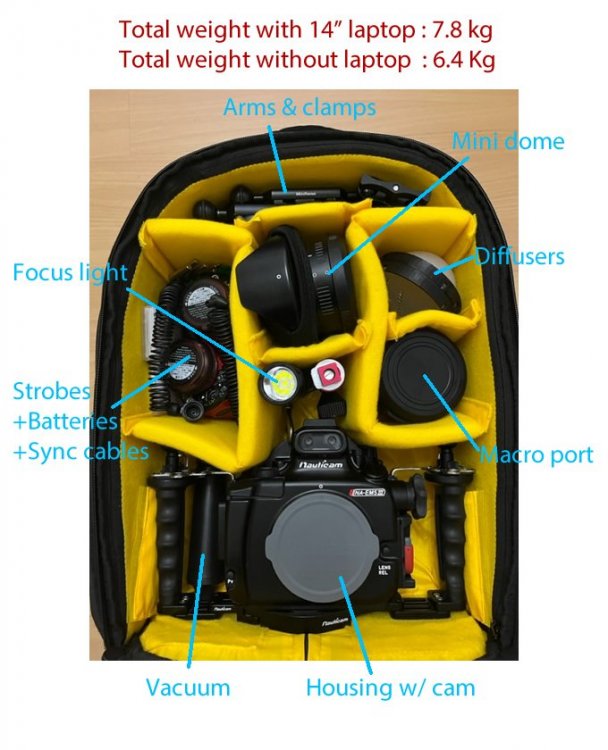
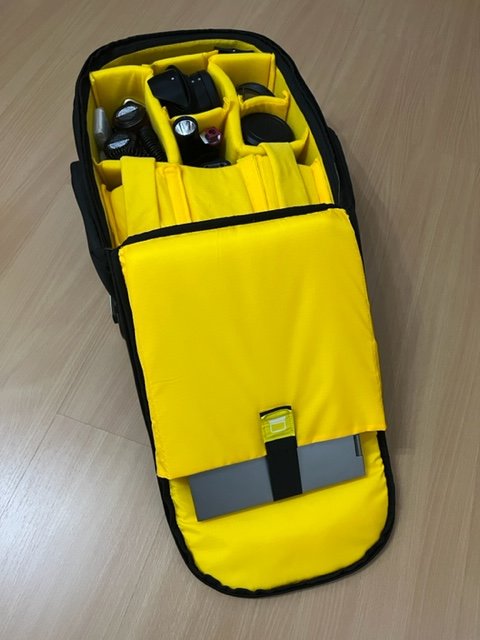
    I think another important question is... Where are you going to post your photos: IG, FB, 500px, flickr? Do you want to print photos? And for me one of the most important is weight. Carrying all the equipment in a single backpack is priceless.

    Contents of my backpack for an MFT system: Olympus OMD EM5 Mark III + Nauticam

    • Housing w/ cam
    • Vacuum
    • 2x Strobes (Inon S2000) + Batteries + Sync cables
    • Diffusers
    • Mini dome
    • Macro port
    • Arms & clamps
    • Focus light
    • Other accesories
    • 14" Laptop

    The total weight is 7.8 kg with 14" Laptop and 6.4 Kg without 14" laptop. Camera and Lenses I carry separately in another small bag.IMG_0781.jpg

    IMG_0788.JPG

  11. FF can result in worse corner quality too! Only advantage to me is to have less noise / better ISO performance.

Account

Navigation

Search

Search

Configure browser push notifications

Chrome (Android)
  1. Tap the lock icon next to the address bar.
  2. Tap Permissions → Notifications.
  3. Adjust your preference.
Chrome (Desktop)
  1. Click the padlock icon in the address bar.
  2. Select Site settings.
  3. Find Notifications and adjust your preference.