4 hours ago, ChrisRoss said:
the dominating factor seems to be filling the frame with subject- the cameras seem to struggle to know what to do if there is a lot of water in frame
This depends on the metering mode that you've set. For example, my A6300's manual says this:
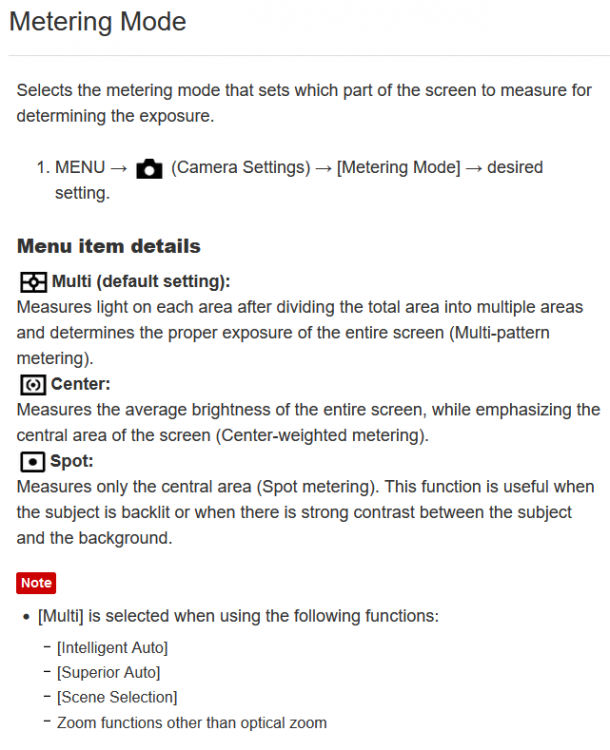
So, when 'Multi' is selected, whether manually or automatically, such as in when shooting in auto mode, water in the frame has a high potential of confusing the camera, but 'Spot' is generally accurate so long as you place your subject in the middle of the frame. For static scenes, you can also use AEL function to meter with pre-flash, then recompose and shoot, but I've found this to be too much hassle to use operationally.
7 hours ago, dhaas said:
Both Barmaglot and TimG who I respect shed insights for various ILC cameras if they have a built in flash. Hot sho flash triggers obviously solve a lot of those problems.
I was mainly referring to small compact camera's built in flash for triggering.
It doesn't matter if a camera is ILC or fixed-lens - the salient point is that without an LED flash trigger, using TTL mode will limit the output of underwater strobes. Yes, small-sensor cameras are more tolerant of lower flash power, but the issue is still there. You can kinda-sorta get the best of both worlds if you use a compact camera with a hot shoe and a flash trigger instead of pop-up flash, but these are quite rare - Canon G1X series is not really a compact, Panasonic LX100 uses an M43 sensor, leaving Sony ZV-1 as the sole entry. Interestingly, there are two housings out there for ZV-1 - Ikelite and SeaFrogs - which makes it an interesting alternative to RX100V.
7 hours ago, dhaas said:
Basically the Sony was all TTL but you could dial in some minus flash (dial it waaaayyyyyy down) and experiment depending on what flashguns you have. Then you could tell if it would just trip a strobe in Manual.
I'm not sure what this is meant to accomplish - are you trying to make the pre-flash weak enough so that the strobe wouldn't detect it? I don't know whether or not modifying flash compensation setting would affect the pre-flash duration; it stands to reason that it wouldn't - the sensible thing, from the camera's perspective, would be to meter with a fixed-duration pulse, and then apply flash compensation setting to the final calculation. Regardless, if you want to shoot in manual mode when triggering off a Sony camera, just enable pre-flash cancellation on your strobes... although, I suppose, with the really annoying magnet in/out thing on Inon strobes, this is not something you'd want to do mid-dive either.
Another issue that I ran into when shooting TTL is the pre-flash delay - it takes about maybe half a second between trigger press and the main pulse, which is usually not an issue, but can be annoying when you're trying to catch a subject exhibiting some dynamic behavior, such as a fish yawning - if you don't anticipate the action and press the trigger ahead of time, then by the time the flash fires, that precise moment you're after may be gone.