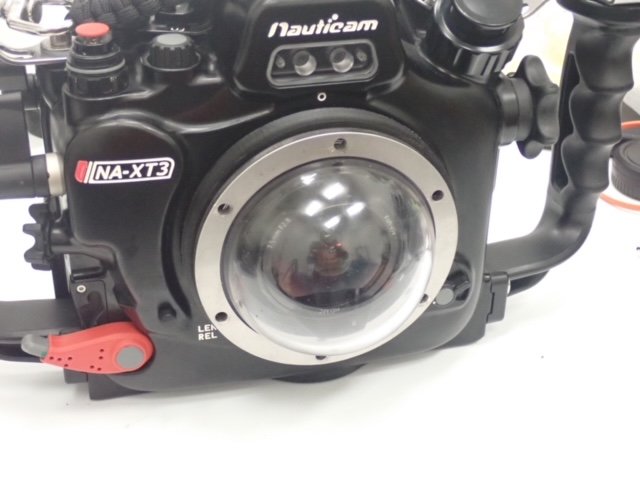
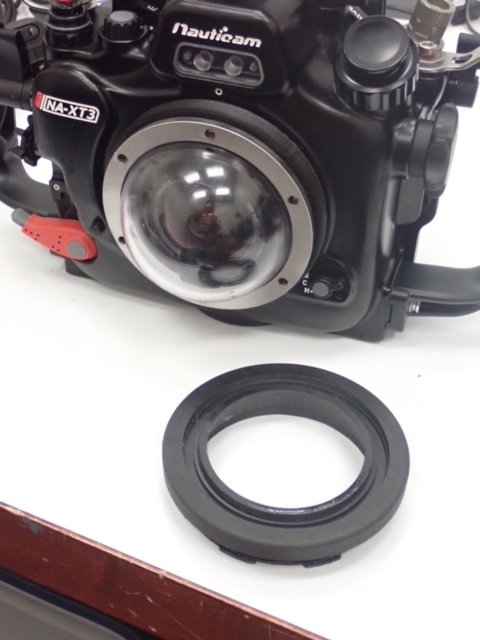
I have been working on a 3 inch dome set up for fisheye lens on my Fuji Nauticam housing. Can use with Pergear full frame fisheye or Opteka circular fisheye. Just tested under vacuum for one hour, and the seal held. This opens up a lot of possibilities for 3D printing adapters. Material is PETG printed on a Creality cr-10 V2
Photography Gear and Technique / Archived topic
3D printed port adapter for N100 Nauticam
Started by tobyone ·
- 10Posts
- 10Replies
Read-only discussion
3D printed port adapter for N100 Nauticam
-
-
Very nice! Looks good. I've been 3D printing all my ports for several years so I can confirm that it is a viable option. However, I haven't explored the depth/pressure limits of 3D printed ports since I snorkel in shallow streams, but it's something I'm planning to test soon.
If you're willing to share I'd be interested in seeing more of the details of your design or hearing about how you handle printing the o-ring groove and other overhangs.
-
This is the second underwater 3D project. The first was a add on to an aluminum housing for a Osmo pocket.
Link to video :https://youtu.be/yNkCzbgGqOY
This project was to get a port setup for fisheye lens. I printed with matte black petg from California Filament. Designed in FreeCAd, and sliced in Cura. I printed with 100% infill and wall and Botton thickness of 9 layers. I think it will stand at least rec diving depths. I will test without camera in a Florida freshwater spring. The dome I used is a 3 inch Ritchie compass dome. I have ordered a 4.5 dome for which I will print another adapter. Will keep your posted. I have two versions, one with the retaining taps printed and the other the Nauticam n100 retainer need to be bolted. I can send you some sty files, but I do not want to put them out on the web just yet.
-
-
Wow I am impressed how good can 3d printed stuff be! Just starting my underwater photography journey now and as everything is so expensice I am really considering to print stuff myself too, at least starting with zoom gear for which is a steal prices out there....
I assume as you guys are 3d printing ports and domes you also get affordable lenses..any suggestions? -
3D printing is a great for stuff like zoom gears. Ports are more advanced but possible with experience.
To follow up on my previous comment, I have now tested some 3D printed ports in a pressure chamber and can confirm that it is a viable option for scuba depths.
-
1 hour ago, Isaac Szabo said:
3D printing is a great for stuff like zoom gears. Ports are more advanced but possible with experience.
To follow up on my previous comment, I have now tested some 3D printed ports in a pressure chamber and can confirm that it is a viable option for scuba depths.
I would think one of the keys would be achieving a smooth enough surface to make a seal with the o-ring?
-
9 hours ago, Isaac Szabo said:
3D printing is a great for stuff like zoom gears. Ports are more advanced but possible with experience.
To follow up on my previous comment, I have now tested some 3D printed ports in a pressure chamber and can confirm that it is a viable option for scuba depths.
Can you share your experience and explain the way you are doing it and which kind of lenses/glass are you using to keep cost cheap?
-
15 hours ago, ChrisRoss said:
I would think one of the keys would be achieving a smooth enough surface to make a seal with the o-ring?
Yes, this was one of my main concerns early on since FDM 3D prints are built up layer by layer which results in tiny ridges on vertical surfaces. So I started out coating the o-ring groove in a layer of epoxy to achieve a smooth surface. That worked but required extra work and had some precision/repeatability issues. Later on I moved to cutting the o-ring groove on a lathe. That also worked and was more precise but still required more work than I would like. So more recently I decided to try getting an o-ring seal on raw 3D prints, and it has actually worked just fine. Each printed layer is only around 0.10-0.15mm thick, so the compressed o-ring seals against 10 or more layers, negating any inconsistencies in any single layer. So now I am able to print out ports that don’t require any additional work.
-
7 hours ago, Aikoon said:
Can you share your experience and explain the way you are doing it and which kind of lenses/glass are you using to keep cost cheap?
3D printing is a huge topic, and it would be impossible for me to try to explain it all here. But if you familiarize yourself with 3D printing in general (there are plenty of resources on the web) and then have some specific questions about making ports, I would be happy to help. I’m using PETG as my material. The main differences from normal 3D prints are 100% solid prints comprised entirely of walls/perimeters, small layer height (0.10-0.15mm), random seam position, slightly higher nozzle temperature (250-260C), and slight overextrusion (15-20%).
I’m not using cheap lenses as I’m going for the best image quality possible. Currently my main lenses are the Nikonos 13mm and the Nauticam EMWL and Canon 60mm, Sony 90mm, Sigma 105mm macros. I purchased the glass for the macro ports from Edmund Optics. Here is one example.