



Skip to content

Photography Gear and Technique / Archived topic

Water Contact Optics Field of view

Started by Interceptor121 ·

  • 7Posts
  • 7Replies

Read-only discussion

Water Contact Optics Field of view

7 posts
  1. I am testing a number of lenses with the WWL-DRY or WACP prototype and my objective is to find something that gives outstanding IQ in the 28-40mm zoom range. For video I will use the WWL-1 with the Sony 28-60mm

    The following table gives the field of view on the 3 coordinates for the WACP like lenses

    While the marketing message focusses on 130 degrees those optics are fisheye like with a very stretched aspect ratio that goes from 1.9 to 1.6 as you zoom in.

    Looking at the horizontal axis you see that in effect the field of view is same as a 13.5mm lens while the vertical is a 17mm lens 
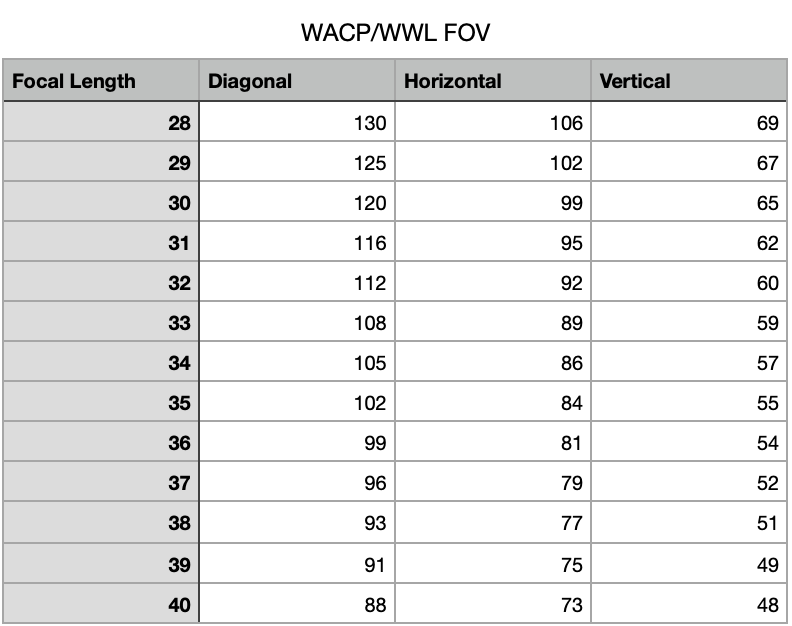
    image.png.4519dd3dde144ece25df90488da7d5f1.png

    The range between 28 and 40 mm is the most important because once you hit 40mm the lens has an horizonal field of view similar to a 24mm lens. At that point a 24mm high quality rectilinear lens will generally produce better IQ behind a dome. 

    While for video it is important to be able to do all sort of shooting with one lens and eventually to be able to remove the lens underwater (though with the WWL-1 this is easier said than done) for photos shooting for most with strobes once you are far away there is not much point having a superwide lens. I have analysed my past WWL-1 shots and pretty much all of them were in the 28-35mm range.

    In summary view take is that if you spent the whole dive with the lens past 40mm you probably had the wrong lens or you were too far away

    I would be interested to know what other people think and if anyone is really shooting photos at 50mm + with their water contact optic


     

  2. My lens-maximum is 42mm and I occasionally use it when I see a macro subject I can't resist. If I had 50+ I would use that, I guess.

  3. My lens-maximum is 42mm and I occasionally use it when I see a macro subject I can't resist. If I had 50+ I would use that, I guess.

    For video where you can remove the wet lens no problem and in fact you switch to flat port
    A macro subject wont something you capture with that lens
    Normally you are looking at field of view around 20-30 degrees over a flat port


    Sent from my iPhone using Tapatalk
  4. For supermacro not, for postcard size macro, no problem.

    Verstuurd vanaf mijn SM-A536B met Tapatalk

  5. On 4/20/2023 at 6:43 AM, Interceptor121 said:


    The range between 28 and 40 mm is the most important because once you hit 40mm the lens has an horizontal field of view similar to a 24mm lens. At that point a 24mm high quality rectilinear lens will generally produce better IQ behind a dome. 


    This is all true, however if you don't have a high quality 24mm , or if you are on a dive and find appropriate subjects you certainly wouldn't exclude using the longer focal lengths.  The other consideration is that the 24mm might not focus right on the dome like a WACP will and the longer focal lengths will enable you to choose to shoot smaller CFWA subjects larger in the frame.  A case of convenience trumping ultimate image quality.

    A question - are the fields of view measured or calculated?  I've done the calculations myself assuming some type of fisheye projection and I get a 13-14mm full frame equivalent rectilinear field of view on the horizontal axis - which seems to me the best basis for comparing these optics to other lens types.

  6. Just now, ChrisRoss said:

    This is all true, however if you don't have a high quality 24mm , or if you are on a dive and find appropriate subjects you certainly wouldn't exclude using the longer focal lengths.  The other consideration is that the 24mm might not focus right on the dome like a WACP will and the longer focal lengths will enable you to choose to shoot smaller CFWA subjects larger in the frame.  A case of convenience trumping ultimate image quality.

    A question - are the fields of view measured or calculated?  I've done the calculations myself assuming some type of fisheye projection and I get a 13-14mm full frame equivalent rectilinear field of view on the horizontal axis - which seems to me the best basis for comparing these optics to other lens types.

    First I calculate them then I take a rectilinear lens to check them against. I use the rectilinear lens as reference

    The other point that rectilinear lenses give you a taller frame a 17mm lens is already as high as the water optic at 28mm

    With regards to if you find something you woild shoot of course but the point is if there are subjects at distance and you are zooming like mad your strobes are not reaching out and things will look colorless. At a certain point you get the same field of view and better from a rectilinear lens

    We are not talking super close here, 130 degrees diagonal and 100 horizontal is for subjects beyond half meter more like 0.75 to 1.5 meters like sharks etc

    With regards to getting close my 24-70 focuses right on the dome now the port itself may be a bit bullky but if I zoom at 70mm rectilinear i have a much smaller captiure area than this type of lens

    I think this kind of optics especially when paired with a 28-70 type of lens are interesting because they are versatile but the bulk is the wide end. A video user may be ok with the entire range covered by one lens shooting in ambient light but a photo users that has to fire strobes will not be in the same use case

  7. 1 minute ago, Interceptor121 said:

    With regards to getting close my 24-70 focuses right on the dome now the port itself may be a bit bullky but if I zoom at 70mm rectilinear i have a much smaller captiure area than this type of lens


    Yes I use an Olympus 12-40 a fair bit in the 170mm dome it's a nice option, but I mostly use it on temperate (non-coral) reefs around Sydney.  I've only occasionally used in tropical diving.

Account

Navigation

Search

Search

Configure browser push notifications

Chrome (Android)
  1. Tap the lock icon next to the address bar.
  2. Tap Permissions → Notifications.
  3. Adjust your preference.
Chrome (Desktop)
  1. Click the padlock icon in the address bar.
  2. Select Site settings.
  3. Find Notifications and adjust your preference.