Skip to content

Photography Gear and Technique / Archived topic

I bought a full frame camera and I want to produce pictures of a compact?

Started by Interceptor121 ·

  • 14Posts
  • 14Replies

Read-only discussion

I bought a full frame camera and I want to produce pictures of a compact?

14 posts
  1. I have to admit I am rather puzzled by the anxiety of sharpness across the frame that seems to be the motto with underwater shooters

    Topside sharp images throughout as usually architecture, landscape, studio work withour distracting elements. There needs to be sufficient depth of field for the subject or part of the subject if that is more interesting.

    If you were taking a picture of a flower or a bird you would not want the rest of the image to be sharp throughout the opposite you want whatever is not subject to the blurred to emulate how your eyes see.

    Recently there has been an influx of wide angle macro lenses for topside Laowa is a prominent example of it and this is all about close up and subject and the rest is just an idea of the background leaving the rest to imagination

    Close focus wide angle instead is all about sharpness if possible throughout. This is of course difficult if not impossible without stopping down the aperture

    Mirrorless camera lenses frequently can't be stopped down more than f/22 and stacking is not really an option underwater

    On the same coin new cameras are optimised to shoot at f/4 f/5.6 no longer f/8 f/11 and by f/11 resolution starts to drop by f/16 normally halves f/22 is mostly a garble

    Even if dome ports increase depth of field there is a limit to where you can go so with a real tridimensional target you won't have the entire frame in focus

    I have normally shot my MFT camera at aperture which had good peak sharpness and were not affected by diffraction generally anything more than f/11 was forbidden unless required by a specific situation. This still gave me plenty of depth of field

    Now with a full frame camera shooting at f/8 f/11 to get the lens peak performance the drop in sharpness due to depth of field (nothing to do with domes etc etx) is very strong and I did not buy a 50 megapixel camera to shoot it at f/16 and produce at best 20 megapixels on the other hand I find annoying that there is such a drop between the areas in focus and those out of focus as my eye is trained to get a certain type of shot

    As a paradox I am finding full frame much more rewarding for video where the larger sensor means being able to shoot ISO 4000 and no noise

    I am not sure if this is time to reeducate myself or just shoot at f/16 and forego the extra 30 megapixels I just gained

    This post is an hyperbole but I am interested in view points from fellow shooters

  2. The sharp across the image issue really depends on the subject and its position in the frame.

    As we often discuss, if the edges of the image are in the blue, then, sure, sharpness is not that critical. But if the edges contain significant bits of e.g. reef, then edge sharpness is way more important.

    Agreed on macro which is broadly similar to shooting portraits topside. Often/usually only the main subject of the  photo needs to be sharp. Worth maybe remembering though that if you are using a rule-of-thirds type framing, you sure need sharp focus around those third intersections.

  3. 12 hours ago, Interceptor121 said:

    I am not sure if this is time to reeducate myself or just shoot at f/16 and forego the extra 30 megapixels I just gained

    This post is an hyperbole but I am interested in view points from fellow shooters

    The question is do you actually get 50MP underwater, sure you might have the best available water contact optics and a nice sharp image but you are still shooting through water.

    The next question is do you need 50MP of resolution?  For many purposes (and ignoring cropping) I would suggest probably not - the exceptions being printing very large - the A1 produces a non interpolated print file 730mm by 490mm at 300 dpi, but a print that large could arguably be made from an interpolated 150 dpi file that would be hard to differentiate.  The other need for MP might be for stock library specs, but they generally mainly care about having the actual pixels and you picture is unlikely to be rejected for being shot at f16.

    I still shoot m43 and don't feel like I am missing out except perhaps for high ISO situations, but that only comes up for me when I'm on dry land.

    On the other handeh question of corner sharpness there are degrees involved a slightly soft corner in a large frame where there is some detail, an image like this one taken with a 17mm lens in a 170mm dome at f8 is another :  Sea&Sea Internal Correction lens: the best solution… to date! | Jordi Chias: Underwater photography (uwaterphoto.com)      scroll down to the shark picture.

    Edited by ChrisRoss
  4. The question is do you actually get 50MP underwater, sure you might have the best available water contact optics and a nice sharp image but you are still shooting through water.
    The next question is do you need 50MP of resolution?  For many purposes (and ignoring cropping) I would suggest probably not - the exceptions being printing very large - the A1 produces a non interpolated print file 730mm by 490mm at 300 dpi, but a print that large could arguably be made from an interpolated 150 dpi file that would be hard to differentiate.  The other need for MP might be for stock library specs, but they generally mainly care about having the actual pixels and you picture is unlikely to be rejected for being shot at f16.
    I still shoot m43 and don't feel like I am missing out except perhaps for high ISO situations, but that only comes up for me when I'm on dry land.
    On the other handeh question of corner sharpness there are degrees involved a slightly soft corner in a large frame where there is some detail, an image like this one taken with a 17mm lens in a 170mm dome at f8 is another :  Sea&Sea Internal Correction lens: the best solution… to date! | Jordi Chias: Underwater photography (uwaterphoto.com)      scroll down to the shark picture.

    I am sorry but most of the conclusions of this pseudo science are flawed
    Shooting a flat target has to do with field of curvature however shooting a 3d target is predominantly affected by depth of field
    The whole corner sharpness topic is vastly overrated and exploited
    I ran two months of tests with flat targets topside and in the pool with a test set up and then taken shots
    When you get close no matter what adapter you have if your edges are on a different focal plane they will blur especially the ones closer to you
    This is absolutely nothing to do with corner sharpness of the lens
    The picture of that sharp is a typical manipulation
    The reef is way closer than the shark that is the subject in focus if you had put your hand in the frame in the center sideways it would have been blurred too
    Cropped sensor having more depth of field will give you a more homogeneous result although in the center or the subject the resolution will be less
    Furthermore if I use the same lens system with a 24 megapixel camera and then with a 48 megapixel camera the results differ
    The 48 mp will not resolve everything due to the lens but say it resolves 24 this means the 24 megapixels will resolve 12 not 24. It doesn’t work exactly like that but you can follow the reasoning.


    Sent from my iPhone using Tapatalk
  5. 33 minutes ago, Interceptor121 said:


    I am sorry but most of the conclusions of this pseudo science are flawed
    Shooting a flat target has to do with field of curvature however shooting a 3d target is predominantly affected by depth of field
    The whole corner sharpness topic is vastly overrated and exploited
    I ran two months of tests with flat targets topside and in the pool with a test set up and then taken shots
    When you get close no matter what adapter you have if your edges are on a different focal plane they will blur especially the ones closer to you
    This is absolutely nothing to do with corner sharpness of the lens
    The picture of that sharp is a typical manipulation
    The reef is way closer than the shark that is the subject in focus if you had put your hand in the frame in the center sideways it would have been blurred too
    Cropped sensor having more depth of field will give you a more homogeneous result although in the center or the subject the resolution will be less
    Furthermore if I use the same lens system with a 24 megapixel camera and then with a 48 megapixel camera the results differ
    The 48 mp will not resolve everything due to the lens but say it resolves 24 this means the 24 megapixels will resolve 12 not 24. It doesn’t work exactly like that but you can follow the reasoning.


    Sent from my iPhone using Tapatalk

    Look Massimo, you ask an opinion and when one is given you belittle it calling it pseudo science, I don't know why I bother sometimes.

    on the shark pic if you take time to examine it closely, while the reef might be closer if you look at the pale sponge in front of the red sponge it is clearly closer to the camera than the blurred brain coral to it's left.    It however is sharper as it's closer to the centre.  I agree there is some depth of field effect there, but the blurring clearly gets worse as you head into the corner.  But that's not really the point - it's an example of an image where corner sharpness is a problem and some steps need to be taken to correct it.

  6. @ChrisRoss

    It was obvious to a some of us that read your post (clear example of corner sharpness issues).

    121 must be "great" at parties.

  7. 48 minutes ago, ChrisRoss said:

    Look Massimo, you ask an opinion and when one is given you belittle it calling it pseudo science, I don't know why I bother sometimes.

    on the shark pic if you take time to examine it closely, while the reef might be closer if you look at the pale sponge in front of the red sponge it is clearly closer to the camera than the blurred brain coral to it's left.    It however is sharper as it's closer to the centre.  I agree there is some depth of field effect there, but the blurring clearly gets worse as you head into the corner.  But that's not really the point - it's an example of an image where corner sharpness is a problem and some steps need to be taken to correct it.

    The image has the diagonal ideally positioned to exploit the argument the bottom corner is closer, the subject is on the upper third left

    The pale sponge goes up vertical and behind the edge of the reef goes sideways and closer

    The proof is that the reef on the left hand side which is further away and more in line with the shark is not blurred and the little corals coming up are also sufficiently sharp consider that is an extreme edge

    This is not about edges is mostly about how the image is taken. Take the same shot with that framing and perspective on land focus on something deep in the frame and you will get a similar result

    For sure that lens has also a field of curvature issue but the idea that this correction lens works should be demonstrated with a 3d target with similar framing not with a flat resolution chart

    Field of curvature is an issue where a lens does not manage the edges on a FLAT target however most targets are not flat anyway and dome ports tend to favour depth of field behind the focus point

    Demonstration with the same lens and same aperture on the same dive

    First shot right side reasonably sharp top to bottom

    20230507_mf204947_gattuccio-egg.jpg

    Second shot subject is deep in the frame edges of the reef comes forward blur increases for part of the reef that is close, top left alga in the edge is sharp however alga on the right and coral not in the edge are soft

    20230507_mf205035_cucu.jpg

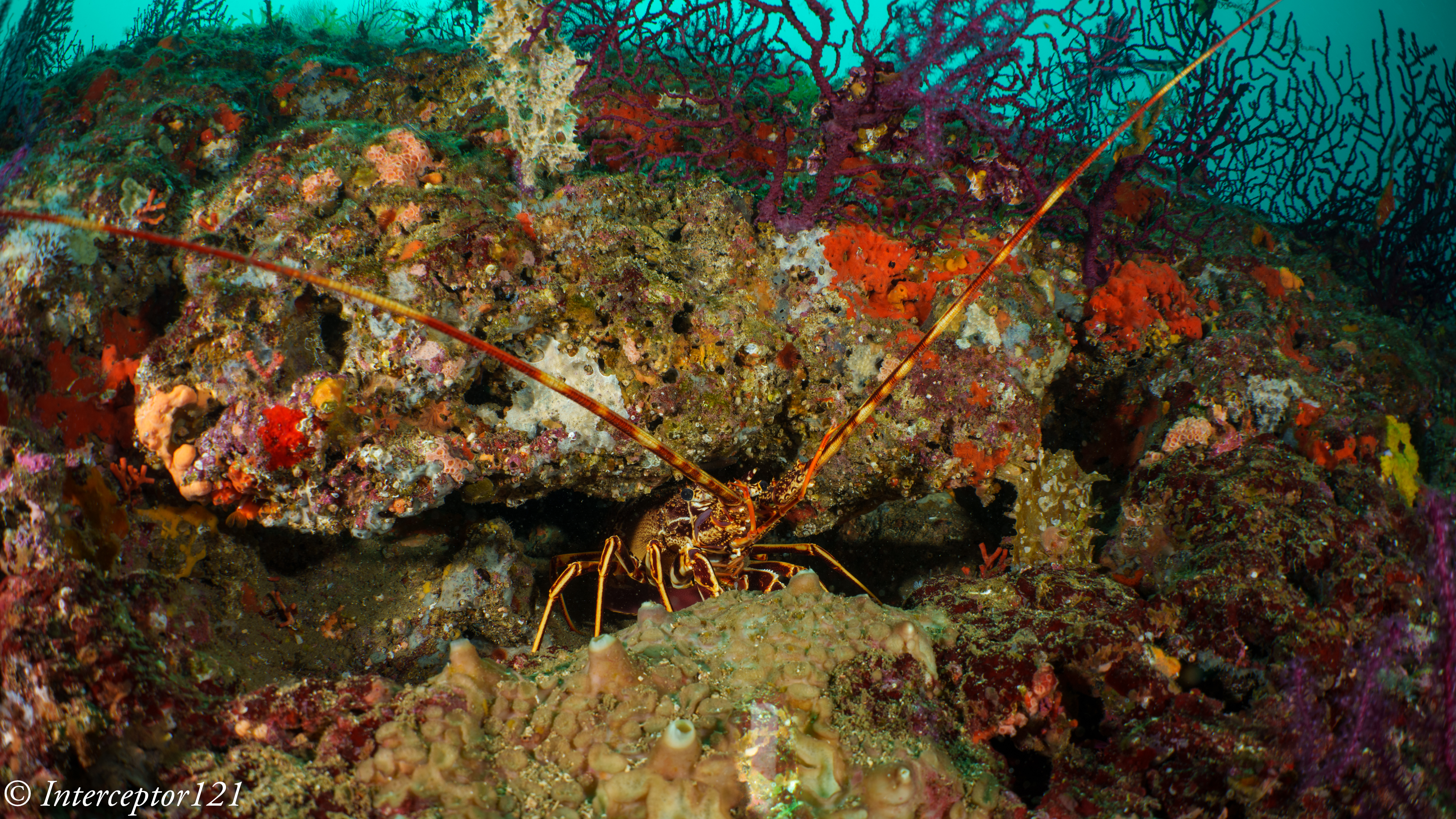
    Third shot the lobster is almost forward this is a 16:9 crop so the bottom is not the lens edge either

    20230507_mf204956_aragosta.jpg

    Reef on the top sharp including the coral edges, right of the image reasonably sharp as aligned with the focal point left quarter not at the edge soft and this was a crop

    All shots at f/8 28mm WWL-1

    No lens is immune by issues of depth of field. I have similar scenarios with a fisheye

    I wanted to prove myself the idea that a wet lens would achieve better corners are relatively wide aperture, this might be true for far subject (where any lens works better) but it is generally not true as you get close is exactly the same issue

    If you focus on something 2 meters in the frame and you have something at half a meter not matter where it will be soft unless you stop down the lens a lot or focus differently


  8. From my point of view, the approach of wanting to get a 50MP pixel sharp image even underwater is wrong. The conditions are not given for all typical dives (maybe apart from macro photography perhaps) anyway. The optical properties of the water we dive in are far too inhomogeneous.
    99% of all divers will never have a higher requirement than a good 20MP image. The human eye has blurred edges through the area of sharpest vision anyway. Only the distortions in the corners strongly disturb the image impression, and this is avoided by large domes or water contact lenses.
    So what is the advantage of an A1 over an RX100? Above water, with the appropriate lenses, it has the potential for free framing, under water it has advantages in low-light situations, better autofocus, and with a relatively open aperture, floating matter is less noticeable due to the narrower focus range.

    You should be happy to use such a reliable, fast and easy to use camera

  9. 1 minute ago, fruehaufsteher2 said:

    From my point of view, the approach of wanting to get a 50MP pixel sharp image even underwater is wrong. The conditions are not given for all typical dives (maybe apart from macro photography perhaps) anyway. The optical properties of the water we dive in are far too inhomogeneous.
    99% of all divers will never have a higher requirement than a good 20MP image. The human eye has blurred edges through the area of sharpest vision anyway. Only the distortions in the corners strongly disturb the image impression, and this is avoided by large domes or water contact lenses.
    So what is the advantage of an A1 over an RX100? Above water, with the appropriate lenses, it has the potential for free framing, under water it has advantages in low-light situations, better autofocus, and with a relatively open aperture, floating matter is less noticeable due to the narrower focus range.

    You should be happy to use such a reliable, fast and easy to use camera

    The idea that you should not get a 50 megapixel camera underwater because it can't resolve the full resolution is flawed and the number of Nikon D850 Sony A7R and other high res cameras around is a demonstration that nobody is really aligned to your thinking

    You think about the overal spatial resolution of an image this is a mix of 

    Sensor resolution x lens resolution x underwater optics deterioration x conditions deterioaration

    Keeping the 2,3,4 factors fixed and halving sensor resolution will produce half the spatial resolution

    In addition at close range YOU WILL resolve the sensor resolution see macro

    Even if the maximum spatial resolution was say 20 megapixels the lower sensor resolution will resolve 10

    The other point you got wrong is the distortion. Water contact lenses create distortion this is an aberration there is nothing positive about it. The reason why wet lenses are distorted is because they focus close and distortion can't be easily corrected so it is left there

    Large domes or small domes do not induce any distortion of their own if correctly positioned. Domes increase depth of field improving matters but are affected by other aberrations

    As underwater shooters we are used to distorted images but that does not make them pretty or correct

    This was not a post about not getting an A1 but about the fact that going up in sensor size brings depth of field issues that can only be cured by stopping down the aperture and this does reduce performance.

    Now lets look at what this means. I am shooting a fisheye 8mm on MFT at f/5.6 it gives me a spatial resolution of 70 lpmm in the centre and 40 at the edges

    I then shoot a canon 8-15mm at f/11 to get the same depth of field I now have 40 lpmm in the center and 30 at the edges

    The benefit of the higher resolution is being defeated partially by the fact i need to stop down the aperture more for a larger system

    So the problem is not so much that I had too many megapixels but that as I am shooting smaller apertures and lenses and systems are optimised all for the range 2.8 - 5.6 not for f/11 or f/16 which is where I will need to shoot

    In other words due to how cameras are designed smaller sensors are more efficient to have a frame full sharp top to bottom than larger ones. 

    The dynamic range point and low light are really more important for ambient light shots and video than it is for photos where you shoot with strobes. For video comparing 4K which is 8 megapixel the difference is obvious and not due to number of pixels

    One benefit of a larger sensor size unrelated to the resolution is that you have more latitude if you had the exposure wrong so you can save more photos but this does not take away the issue of the additional depth of field reducing the resolution

    My initial thought was that for underwater we give a lot of importance at what is at the edges etc etc and this is not conducive to extract the maximum performance from the camera because closing down the aperture goes against image quality


  10. Why are you stopping down so much? Every lens has a lower resolution with higher f-stop numbers due to diffraction.

    An image sharp everywhere looks mostly flat.

  11. 1 minute ago, fruehaufsteher2 said:

    Why are you stopping down so much? Every lens has a lower resolution with higher f-stop numbers due to diffraction.

    An image sharp everywhere looks mostly flat.

    Because if you don't stop down you get blurred parts in the frame see example with the grouper. I shot it at f/8 I know the lens has no edge issues at f/8 but it has depth of field issues

  12. 8 hours ago, Interceptor121 said:

    The idea that you should not get a 50 megapixel camera underwater because it can't resolve the full resolution is flawed and the number of Nikon D850 Sony A7R and other high res cameras around is a demonstration that nobody is really aligned to your thinking

    I am very much aligned with @fruehaufsteher2 thinking, and I shoot a high resolution camera underwater too.  The camera is chosen for its capabilities and the A1, R5, A7rV all have abilities that other cameras do not have.  The issues with the images posted are not the camera but the framing and lighting driven in part by depth of field and too much in the foreground that leads to no separation of the subject and clutered images where one notices the corners and the oof areas.  There is a lot going for 4/3 or aps-c for underwater however, full frame provides light capturing that is unrivaled and bodies that do magic, but at the cost of complication in getting corner to corner sharpness without working for it and framing as such.  

  13. I am very much aligned with @fruehaufsteher2 thinking, and I shoot a high resolution camera underwater too.  The camera is chosen for its capabilities and the A1, R5, A7rV all have abilities that other cameras do not have.  The issues with the images posted are not the camera but the framing and lighting driven in part by depth of field and too much in the foreground that leads to no separation of the subject and clutered images where one notices the corners and the oof areas.  There is a lot going for 4/3 or aps-c for underwater however, full frame provides light capturing that is unrivaled and bodies that do magic, but at the cost of complication in getting corner to corner sharpness without working for it and framing as such.  

    Next time I will pick up the lobster and move it outside the crack where it stands to get an uncluttered frame?

    Is that a joke?

    Those were examples to make the point about depth of field


    Sent from my iPhone using Tapatalk

  14. Quote

    I have to admit I am rather puzzled by the anxiety of sharpness across the frame that seems to be the motto with underwater shooters

    Totally agree with you, and it reminds me of a quote "There is nothing worse than a sharp photo of a fuzzy concept" Ansel Adams


Account

Navigation

Search

Search

Configure browser push notifications

Chrome (Android)
  1. Tap the lock icon next to the address bar.
  2. Tap Permissions → Notifications.
  3. Adjust your preference.
Chrome (Desktop)
  1. Click the padlock icon in the address bar.
  2. Select Site settings.
  3. Find Notifications and adjust your preference.