



Skip to content

Photography Gear and Technique / Archived topic

Natural light camera settings for whalesharks?

Started by MTH ·

  • 18Posts
  • 18Replies

Read-only discussion

Natural light camera settings for whalesharks?

18 posts
  1. Hi All

    My wife and I are off to Cenderawasih Bay in August on a liveaboard. I'm hoping to take as many photos as I can of the famous whalesharks there, but I've never really shot anything like this in natural light. To be honest, my preference is macro as most of my diving is in the UK and macro is far easier when the vis is 1-3m at our most common dive sites. I dabble with wide angle photography when the conditions allow or went on a holiday, but I'd say my technique is ropey at best; however, even then it is all with strobes, and I'm assuming no strobes will be the order of the day with the whale sharks. I'm a self taught photographer - digital really opened up the photographic world to me. I understand all the basics though as I'm an engineer so I like to understand the physics of everything.

    Does anyone have any recommendations? I'm assuming a fast enough shutter to stop any motion blur, say 1/100th of a second; aperture of say f8 or f10 to give some depth of field, auto ISO or adjusted ISO to correctly expose the brightest part of the shark or surface.  Does this sound reasonable? I plan to use my Tokina 10-17 on my D500. Is there a better lens combination, ie none fisheye or more zoom. Will this be just too dark and I'll need to push the ISO to high ending with noisy photos.

    My concern is I'll have snapped away and then on the laptop all the pictures will look blurred, or no depth of field (blurring again) or too noisy to be of any use. Its a long way to go and end up with a camera full of nearly good shots. So I thought I'd ask.
     

  2. Whale sharks are normally at the surface or near the surface and swim faster than you think

    i got best results snorkelling with a small rig with no lights or strobes

    As the animal is large you need sufficient depth of field, they do not move fast but 1/100 is rather slow

    At the surface you will not lack light but it can be murky

    Obviously having a DSLR is a major disadvantage as you will need to check your shots in the LCD after framing and this means the shark would have moved. So make sure you got all correct and then fire away in burst continous autofocus with a slow rate

  3. 17 minutes ago, Interceptor121 said:

    Obviously having a DSLR is a major disadvantage as you will need to check your shots in the LCD after framing a

    Not sure why this would be the case. I shot whale sharks with a D300 and had no problem at all framing the image and taking continuous shots without taking my eye from the viewfinder.

    There’s really no need to check each shot once you have the exposure dialed in. 

    But as Interceptor121 says, whale sharks move deceptively fast and you have to fin like crazy. So totally agree that you don’t want lights/strobes on your system or megadomes which increase drag. 

  4. Not sure why this would be the case. I shot whale sharks with a D300 and had no problem at all framing the image and taking continuous shots without taking my eye from the viewfinder.
    There’s really no need to check each shot once you have the exposure dialed in. 
    But as Interceptor121 says, whale sharks move deceptively fast and you have to fin like crazy. So totally agree that you don’t want lights/strobes on your system or megadomes which increase drag. 

    Unless you have live view you don’t know how the shot is exposed
    You can of course use the LCD but autofocus may work differently


    Sent from my iPhone using Tapatalk
  5. I hardly ever use Liveview. Check the first couple of shots are about right and you’re pretty much good to go. Minor adjustments can be made in LR. 

    (Thinking about it, I never use Liveview,)

    Edited by TimG
  6. 1 hour ago, TimG said:

    I hardly ever use Liveview. Check the first couple of shots are about right and you’re pretty much good to go. Minor adjustments can be made in LR. 

    (Thinking about it, I never use Liveview,)

    You don't know until you know I guess

    The luminance histogram that is present in most live view and finders is useless however with a mirrorless you can have a quick review of 0.5 seconds with the RGB histogram which is more useful and then from there move to burst and forget about it

    Obviously if you go around the shark and it is a sunny day the exposure may change dramatically so being on the sunny side and not in the shadow is key

    Edited by TimG
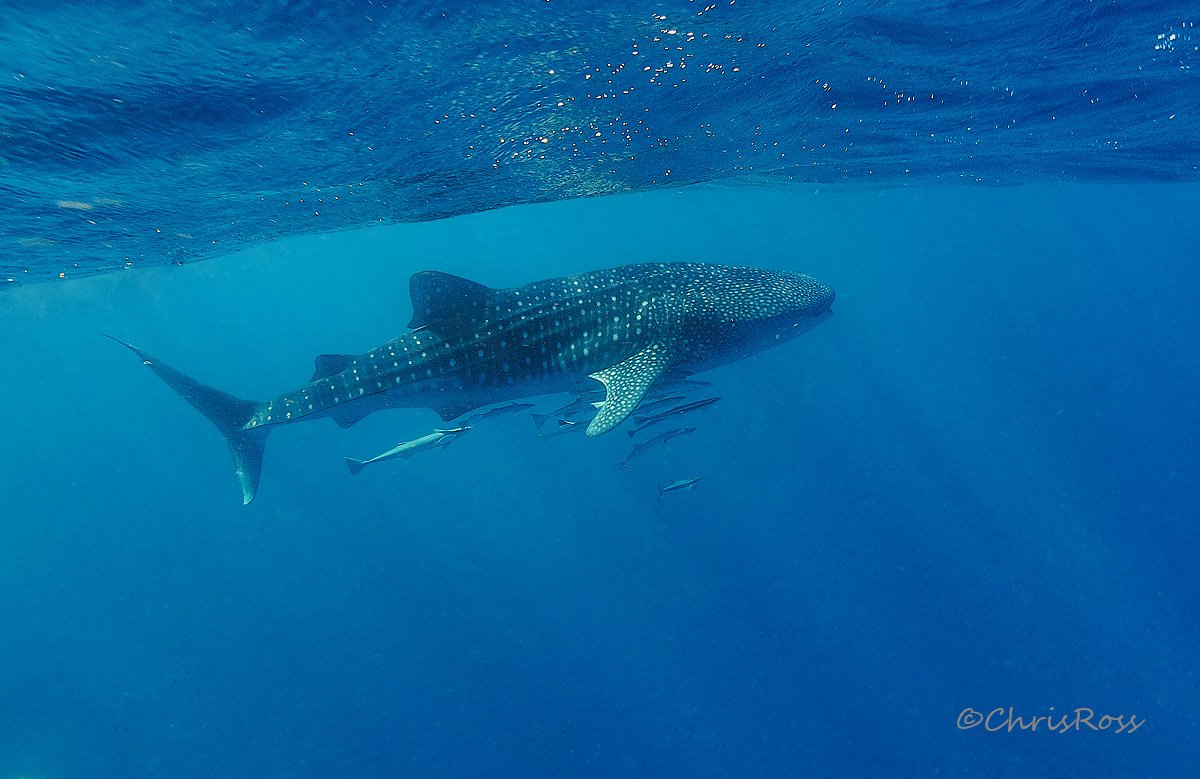
  7. I swam with the whale sharks in Ningaloo way back in 2017 when I was shooting an EM-5 II,  My exposure was 1/100 @ f8 ISO400, I stayed at 7 -8mm (14-16mm FF equivalent)  and got acceptably sharp photos of the sharks while finning along furiously.. I just set it aperture priority and shot away and exposure was pretty right out of camera.  You could always shoot a nearby swimmer to dial in some compensation.  When swimming with a moving whaleshark there's really no time to do anything but fin and shoot.

    Having said all that at Cenderwash Bay the sharks hang around the bagans of fishermen and the fishermen believe they bring good luck so feed them - so possibly a lot less finning involved for these particular sharks and you'll have time to move in and frame shots.  See this article for example:  https://www.uwphotographyguide.com/whale-sharks-west-papua

  8. 4 minutes ago, ChrisRoss said:

    When swimming with a moving whaleshark there's really no time to do anything but fin and shoot.

    Well said, Chris!

    I did Ningaloo in 2008 and have never finned so hard in my life. The idea that you might shoot “around” the whale is a non-starter unless the whale turns around!

    Edited by TimG
  9. @ChrisRoss

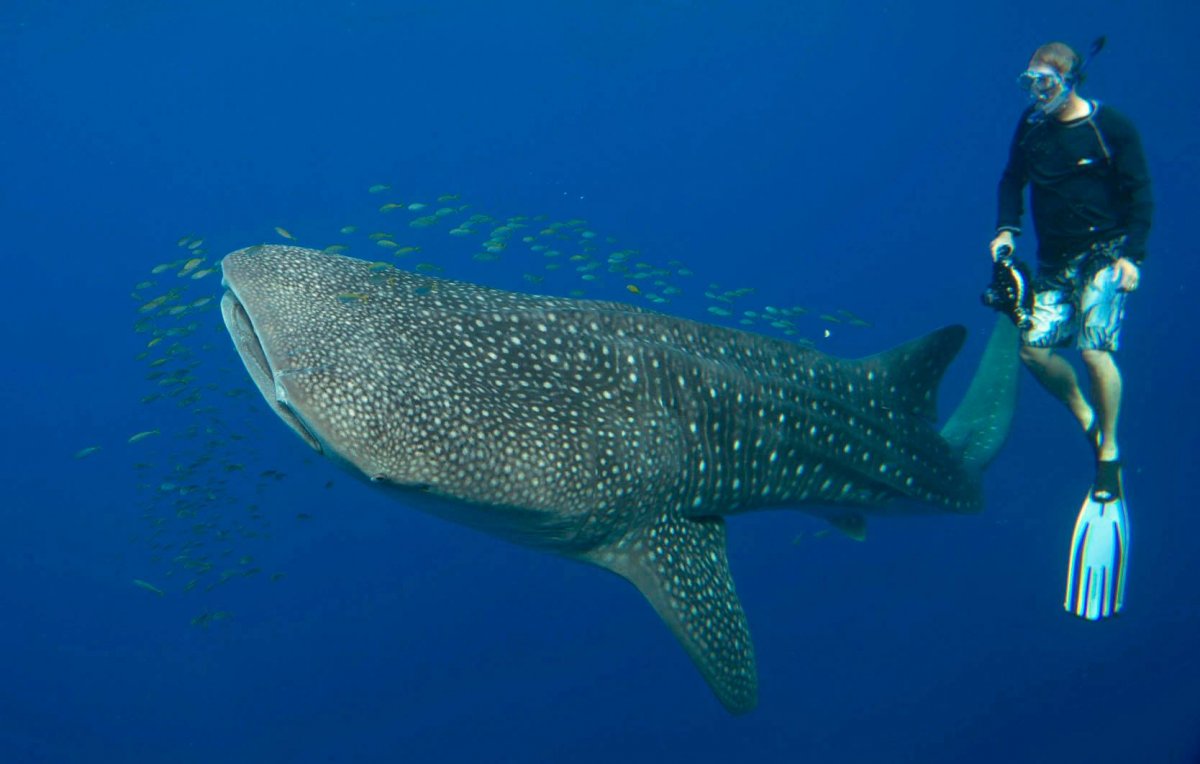
    Having done Cenderwash Bay several years ago, it was a much better way of taking images of whalesharks. Instead of trying to keep up with them I spent most of the time in the water with them trying to stay out of their way as they circled aroung the bagans. This allowed you to both get close and choose the angle in which you could get images.

    [not my image, but an image of me with a new friend]


    WSnMe.thumb.jpg.40aa6f77fd8d2abfe15f248c88cf7b36.jpg

  10. I recently came back from an all-wide-angle trip to Truk Lagoon.   I think I finally got used to shooting wide angle and finally started to enjoy it.  Of course it helped a lot that there were big wide-angle subjects there!   But there wasn't a lot of light there.  Here are some random tips.

    1. If you get deep enough that light is a problem, switch to B&W (in post).   Sounds like you won't be that deep.

    2. 1/100th is too slow for anything moving.   I use 1/160th as much as possible, but I'll drop to 1/125 if needed.

    3. If shooting wide angle, your aperture should be much wider than macro - say F8 instead of F16 as a starting point.  F8 may or may not give you sharp-enough corners.  Depends on your gear.

    4. If light is poor, consider video.   With video, you actually want a bit of motion blur, and it's certainly common to shoot at 1/60th and F8 - that can really lower your ISO values.

    5. When shooting wide-angle, even if I'm using strobes I almost always have some ambient to deal with.   But in this case I don't think you want strobes at all.  First, for the reasons already pointed out, like perhaps needing to fin quickly.  But strobes can cause a bunch of issues, including spotty reflections on the dome port if you didn't position them behind the glass somewhat.  At least without strobes you don't have to deal with mixed lighting!

    6. Depending on equipment and settings, your corners could end up as lousy mush.  Until I got the Sea and Sea Internal Corrections Lens for my (Nikon 16-35) wide zoom, I routinely cropped all the corners and edges of my wide shots.   Which made me careful to frame the subject to allow for cropping to occur.

    7. I shot a fair amount of video on my D850 on dive trip.  Learned a lot.  But the autofocus was almost unusable in Live View.  I learned that shooting at 14-16mm at F8 focused several feet in front of me would pretty much have almost everything in focus.  I focused before starting a video and generally just left it alone after that.  Worked fine.

    8. Unlike macro where you can control the lighting and select base ISO, you need auto-ISO at some higher level for ambient lighting.   At higher ISO's, even as low as 500, you lose enough dynamic range to not have enough latitude in post to rescue some shots.  Be careful to get the exposure right in camera so as not to blow highlights or overly increase shadow noise.

  11. 2 hours ago, phxazcraig said:

    2. 1/100th is too slow for anything moving.   I use 1/160th as much as possible, but I'll drop to 1/125 if needed.

    Disagree with this, the required shutter speed is related to the focal length and I found it adequate shooting the whale sharks at Ningaloo.  I was shooting Olympus and their in-body stabilisation is very good which is going to help in this type of shooting.  Settings on this image 1/100 @ f8 ISO400 with Panasonic 7-14mm @ 7mm

    Cenderwash Bay is different of course, much more relaxed by all reports.


    Whale_Shark_6b.jpg

    Edited by ChrisRoss
  12. To shoot whale sharks I would consider the following:

    • Use a very wide lens, like a Fisheye. Maybe in the 8-16mm FF range.
    • If you can't fill the frame, you are not close enough.
    • You will likely need a fast shutter (1/100th or faster) as you may be very shallow with a lot of ambient light.
    • Consider shooting with Shutter Priority mode. The greater depth of field from a small aperture may not add any value to these images.
    • Turn on Auto-ISO. Allow up to ISO 1000-2000 as needed. However, that won't happen if you have sunny shallow conditions.
  13. 1 hour ago, davehicks said:

    To shoot whale sharks I would consider the following:

    • Use a very wide lens, like a Fisheye. Maybe in the 8-16mm FF range.
    • If you can't fill the frame, you are not close enough.
    • You will likely need a fast shutter (1/100th or faster) as you may be very shallow with a lot of ambient light.
    • Consider shooting with Shutter Priority mode. The greater depth of field from a small aperture may not add any value to these images.
    • Turn on Auto-ISO. Allow up to ISO 1000-2000 as needed. However, that won't happen if you have sunny shallow conditions.

    Depending where you are there are regulations for how close you can approach whale sharks, for Ningaloo it's 3m which means a 14-16mm full frame equivalent lens can be a bit short, particularly so at Ningaloo as the sharks are mostly  in the 3-6m length range.  You also don't want to get whacked by the tail!

  14. Going back to basics. Shooting just below the surface in topic conditions will mean plenty of light! So its just a matter of determining what aperture to provide sufficient depth of field and then adjusting the ISO to provide a sufficiently high shutter speed. Personally I would aim for f/8 and 1/250s with ISO adjusted to produce these, but then I prefer higher shutter speeds even handholding above water.

    Oddly enough my wife worked for WWF on Cenderawasih Bay back in the 1980s ........

  15. 9 hours ago, Paul Kay said:

    Going back to basics. Shooting just below the surface in topic conditions will mean plenty of light! So its just a matter of determining what aperture to provide sufficient depth of field and then adjusting the ISO to provide a sufficiently high shutter speed. Personally I would aim for f/8 and 1/250s with ISO adjusted to produce these, but then I prefer higher shutter speeds even handholding above water.

    Oddly enough my wife worked for WWF on Cenderawasih Bay back in the 1980s ........

    I would also add have the sun behind you.  On my shot you can see the horizontal fin is very bright and the sides of the shark are quite dark.  The sun is coming from behind the shark and a little to the sharks left in that one I think.

  16. @MTH

    The image I posted higher in the thread was taken at Cenderawasih from a few years ago.

    If your boat is the only liveaboard in the area you will likely have plenty of time to swim with the whale sharks. 


    Some things to consider that are somewhat specific to Cenderawasih.
    - There is not (was not?) a limitation in how close you swam to the sharks, although (obviously) no touching.
    This means you should be able to get close for shooting, which also implies you are going to want to shoot really wide (10-17 was fine).

    - Even if they allow strobes (unllikely), I highly recommend shooting with ambient light. The sharks are big, and you will be shooting fairly shallow, so light isn't that big an issue.

    - We found that the sharks follow a pattern in returning to the bagans to suck on the nets (with the fish bits in them). If you watch closely you can place yourself near or in the path of a shark as it swims towards a bagan - getting a chance to shoot the shark as it is heading towards you.

    This has the benefit that you don't have to hang out right next to a bagan (where several other divers may be hanging out). It's very possible to get shots of just a shark against an empty, blue water background vs. other fins & people. As for swimming along side for any amount of time - this was a non-starter... they move effortlessly through the water at a speed that would be much too fast to keep up with (while pushing your rig through the water).

    - On our first day we had 2 sharks hanging out, on the 2nd day we had 4-5 (one disappeared and another showed up). The sharks come together at the bagans, but otherwise will be swimming on their own as they leave the platforms, circle around, and then return.

    - Interestingly, they actually didn't swim on the surface very much here. We found they tend to circle around at about 5m-10m of depth, and then approach the bagans from below. This meant that many on our trip were trying to shoot the sharks from the surface, which led to some great shots down (and usually from the side), however I found it useful to free drive down about 5m, in the path of where I thought a shark was headed, and then wait a few seconds while a shark approached. This (to me) provided a much more interesting perspective for images. I spent most of my time 15-20 meters away from a bagan while doing this, so no other people around.

    - settings (D500): I did not shoot with auto-ISO (that might be interesting). I knew I would be shooting very close to these sharks, at fairly shallow depths, so I had mine set at ISO 400, and never lacked for light (we had a couple of fairly sunny days). I did try several different shutter speeds mostly around 1/125. I optimized for the blue I was looking for as a background. For an f stop I shot between 5.6 (mostly as a test) and f/13, depending on the scene, subject depth, positioning.

    Three things I wish I had thought through ahead of time:
    1. I was too concerned with getting really good shots, so I missed out on opportunities for a bunch of good/decent shots. In hindsight I should have probably shot continuous for the first 25+ opportunities, just to get it out of my system -> overwhelming feeling of FOMO, re getting decent shots.

    2. Keep your fins, others' fins, and other people out of the shots, unless you are looking to provide perspective (esp. true shooting at the surface). This seems so obvious, but the lens you are going to use is wide, and you will be focused on the subject, not others around you.

    3. I did review my images after day 1, made adjustments for day 2, which helped tremendously. I should have been even more critical after Day 1. This is one of those rare times where these large subjects (at least for us) were present and not going anywhere, so I could have planned specific shots better. Of the ~400 images taken across 3 sessions with the sharks (one on day 1, two on day 2), maybe 15-20 I really like, with another ~15 that help tell the story... with a little more forethought I think this % could have been significantly higher.


    Edited by oneyellowtang
  17. Thank you all for your thoughts and suggestions.

    I was lucky enough to swim with whalesharks in Mexico and know for me finning to keep up while trying to take pictures is really a none starter.

    It sounds like my D500 with the Tokina 10 - 17mm is going to be about right.

    From the helpful comments people have made it sounds like I should probably have a faster shutter speed and I can try 1/200s maybe going down to 1/100s as a minimum as required. I do like to keep the ISO as low as possible.

    @oneyellowtang thanks so much for the positioning suggestions and the alternative of snorkeling down to the sharks approaching level. That will be really useful.

Account

Navigation

Search

Search

Configure browser push notifications

Chrome (Android)
  1. Tap the lock icon next to the address bar.
  2. Tap Permissions → Notifications.
  3. Adjust your preference.
Chrome (Desktop)
  1. Click the padlock icon in the address bar.
  2. Select Site settings.
  3. Find Notifications and adjust your preference.

