



I see many people getting obsessed with strobe field of view and coverage and I thought this post may be useful to relax some of them.
Frame coverage with two strobes with each 90 degrees is generally sufficient for wide angle.
A fisheye like lens behind a dome will not cover 180 degrees due to the proximity of the focus point. Lens field of view is specified at infinity but when your target is close the field of view can drop significantly.
Even at specification level a diagonal fisheye is at best 92 degrees on the vertical axis in the centre of the frame and 142 on the horizontal.
A good check is to see shooting a pool wall how good is the cover of the vertical line in the middle of the frame

If this test is passed you know that the sides will be covered too.
When it comes to the edges of the frame most mirrorless lenses have significant vignetting that is potentially corrected in post processing.
This is a diagram from lenstip
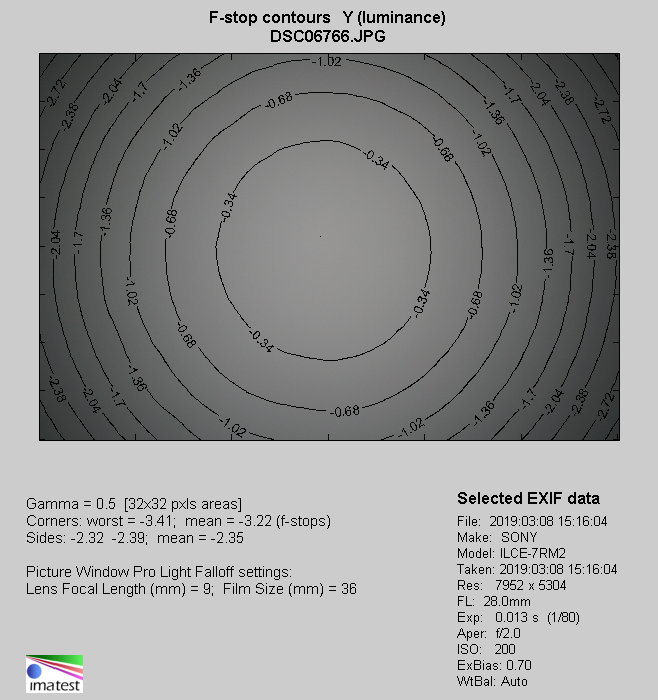
In the corners the lens is 3 stops less than in the center. That means only 12.5% light intensity makes it there
Even after correction you do not get back the full 3 stops because otherwise the image will present severe artefacts and banding.
I generally disable vignetting correction underwater anyway as seldom there is something of interest in the edges.
It follows that no matter your strobe coverage even at short range your frame will not be lit homoegenously it does not matter how perfect is your strobe.
Obviously if your strobe is terrible this will degrade even further however the point is that the strobe is not necessarily to blame for dark corners if you have a mirrorless camera.
Vignetting diagrams for fisheye lenses are generally not available on full frame however the vignetting at the edges is of course 100% as it hits the lens border.
Some older DSLR lenses like the Nikon 28-70 f3.5-4.5 only have 0.5 Ev vignetting so with those and a water contact optic you generally would see brighter corners however the adapters have light fall off themselves and this is not measured as of today.
Strobe power instead is an issue at long range. When you move further away from the target to the point where the light source becomes a point regardless of shape of the tube only power matters. If you are interested in big wide angle scenes you are better off with a strobe that has a lot of power than one that is very smooth and wide but can't cover distance and will dissipate all the light without penetrating in the frame. Of course illumination will not be homogenous across the frame that is indeed impossible due to inverse square law but at least some of the fish in the middle of the frame will have color.
Here an example of a significantly large school of snapper shots at more than 2 meters with a pair of sea and sea YS-D2 at full power you can see the red dropping as you go deeper in the frame but still for a decent effect




