




Posts posted by TimG
-
-
-
 1
1
-
 2
2
-
-
-
-
-
-
Like Chris, I'm using I'm using the Panasonic version of the 8mm with the Zen100. Actually the Zen100 was Chris' and I bought it off him.
I've only used it for one dive trip so far but was very happy with it. It's a very compact combination too, good for travelling.
-
 1
1
-
-
Hello Anonymnous Rob!
Great to have you with us - a warm welcome to Waterpixels.
We hope you really enjoy the forum.
Best wishes
-
1
-
-
-
-
-
-
-
Hi Giorgio!
Great to have you with us. A warm welcome to Waterpixels.
Your design work sounds fascinating and we look foreard to hearing more!
Best wishes
-
1
-
-
6 minutes ago, Michiel said: I have a zen dp-100 for my sony a6700. Would that work with the new sony fisheye lens? I really like the dome because of the small size.
And maybe a dumb question maybe, why do people want a teleconverter to us with it? For closeup whalesharks for exemble, isn't the wide angle fisheye lens a benefit? Or is it already to wide?
Hi Michiel
There are no dumb questions. Sometimes the answers can be…..
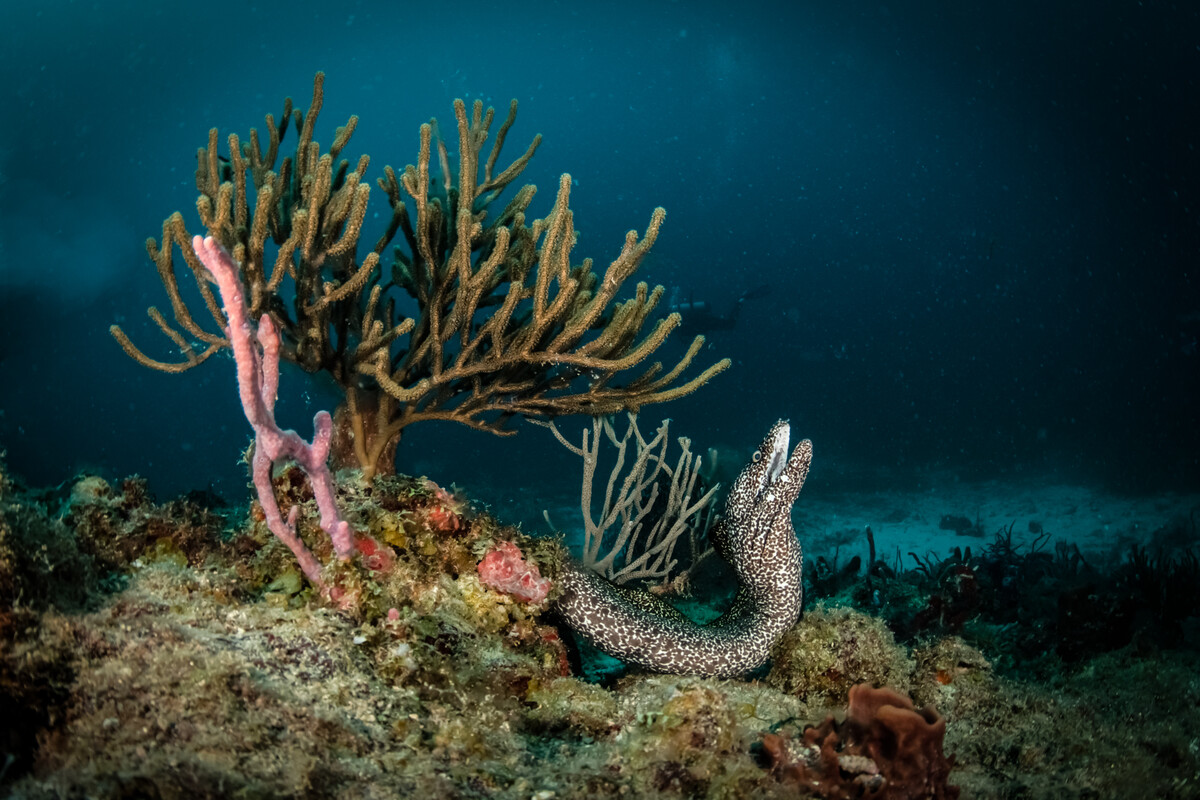
A TC works well with an FE lens to give a photographer the Close Focus Wide-Angle option, CFWA. This allows you to get very close to the critter and produces a larger image of the subject than just FE - but provides a wide-angle to show the subject in its environment.
It’s a neat technique and can be very effective. A small dome port is ideal
as the size doesn’t get in the way as much as a larger dome port allowing strobes to be tucked in very tightly which is key to CFWA lighting.
Not an especially good example below which gives the idea - shot with the classic Tokina 10-17mm DX lens (on an APS-C sensor D500) with a Kenko 1.4TC. If I'd just used the Tokina, the moray would have appeared very small.
-
3
-
-
26 minutes ago, Dave_Hicks said: Only it does. The import module of Lightroom is very flexible and powerful. It also does exactly what you say it does not.
I import every days photos into distinct folders with my the Folder name of the Event, files renamed to that event + date info, and placed in sub-folders named by date.
Photos
+++ 2026
+++ Gods Pocket Sept 2026
+++ Sept 6 2026
+++ Gp-Sept26_Photo1
I have 20 years of photo organized this way using lightroom and it is very simple to parse and discover using just the file system. LR goes beyond that with a system of tags and metadata in the library but i don't really use that.
Snap
-
2
-
-
2 hours ago, Architeuthis said: I use LRc and PS with Macbook Pro M1...
Great software and no need for an alternative, but what makes me outrageous is the "Library" system: Instead of having the option to define the folders/subfolders from where to take the photos and where to place the Adobe specific files by oneself and just use the "Develop" module, one has to use the entire Adobe Libraray-system that I find complicated and confusing...
I wrote them several times, but still they do not offer this simple and easy to implement option...
Haha, funny old world. Me, I find the Library brilliant! I can search all 60k photos and find exactly what I'm looking for (yeah, you have to Keyword of course). The ability to then drop files into a Collection is terrific.
Each to his own, eh?!
-
1
-
-
2 hours ago, Jurgen said: Hi Dave,
Absolutely, you’re right!
Our editing skills and the tools available to us are constantly evolving. Images we were more than happy with five years ago might offer even more potential today with new techniques and a fresh perspective. That’s exactly why keeping the RAW files is so valuable!Totally agree!
-
1
-
-
Lightroom since 1.0. And, maybe minority view, I think the subscription is actually good value. 😝
I honestly struggle to think of anything I can’t do or that could be significantly better. I guess a lot of that is just that I’ve been using it so long!
-
3
-
-
-
Hi Stefan!
Very good to have you with us. A warm welcome to Waterpixels. We hope you enjoy the forum.
Best wishes
-
1
-
-
-
There's a lot of interest in the OM system cameras, especially the OM-1ii model which is used by a good number of long-term Waterpixels' members.
As a result I thought it worth starting an seperate thread for OM Systems. So by all means post here issues, questions, thoughts, ideas, knowledge on how to get the best out of these cameras underwater. God knows I need some help..... 😝
-
1
-
-
One thing I didn’t mention, which although relatively obvious is important: I’m comparing a D500/60mm (90mm FF equivalent) combination with a OM-1ii/60mm - a 120mm FF equivalent. Perhaps a fairer comparison would be the OM/60 combination and a D500/105 combination (150mm equivalent). That was also pretty difficult to capture a mid-water swimming subject! I don’t think the D500/105mm combination hunted as much as the OM.
-
3
-
-
Subjectively, yes.
Bear in mid that I have never used these OM camera or lenses before and, despite very helpful pre-match advice, I was not entirely sure what settings were available or which to use. The OM-1ii is capable of all sorts of tech bells and whistles way beyond (for me) a 2017 D500. I just tried to keep it simple.
Not surprisingly the Panasonic 8mm was fine. No problem at all. Easy to focus.
The Zuiko 60mm was more problematic and very prone to hunting in turbid water - much more so, I thought, than the D500/Nikkor 60mm. I've never used any kind of focus tracking on my old system and continued to use C-AF for focussing. Subject Detection was set to Off.
I did miss a lot of shots initially. Switching to the 0.19-0.4m setting helped a bit. Yes, I started on 0.19m to infinity. Trying to catch a subject swimming in mid-water was something I could do easily with the D500/60mm. Not so with the settings I was using with the OM/60mm. The AF could be distracted by stuff in the water with AF/ Release combined on the shutter release control. Separating out AF and Release will be something I try next time set up on its own Custom group. So, say, C1 for AF/Release combined; C2 for AF/Release separated out to different controls.
The other features I want to try out is reducing the C-AF Auto Sensitivity. The Default is 0 but, I read -2 should help distractions. But then, I'm assuming, so should separating out focussing and release buttons.
So, bottom line, subjectively, the D500 with a Nikkor 60mm was easier and seemed more reliable for focussing. But, as I say, very early days and it was an accumulation of using the OM for 19 dives as compared to almost a 1000 with the D500. The OM-1ii is clearly highly capable, flexible and customisable. It will take time to fine-tune and get the best of it. As I wrote, I came away happy I was not frustrated to death with a new system. But I did miss shots I would have taken with the D500 so it is a work in progress.
-
3
-
.jpg.857dbbfbdc4d79d9c6ebf7b4ba96ed1b.jpg)


Hello everyone
in Member Introductions
Hey Magicknipser!
A warm welcome Waterpixels. Great to have you with us. We hope you enjoy the forum.
Best wishes