



Chris Ross
-
Joined
-
Last visited
-
Currently
Viewing Topic: New Retra Maxi -
Country
Australia
Posts posted by Chris Ross
-
-
10 hours ago, Dave_Hicks said: Export and resize in Lightroom as sRGB color space, 100% quality, and 300dpi. So for a 30" print you resize to 30*300 or 9000 pixels on the longest side.
I have found the greater range of blues/greens in Adobe RGB gives me nicer looking water - this is quite obvious when converting to sRGB for web posting. I firmly believe there is a benefit of using Adobe RGB in UW images. This of course depends on the printing service and whether the printing method and your monitor can accommodate the Adobe RGB colour space. This needs to be confirmed as if you try to print colours that are out of gamut then the results can be unpredictable. sRGB is a safe but somewhat limiting option.
-
 1
1
-
Printing is whole other universe, there's lots of options these days and the quality can be exceptional. I'll describe what is done for inkjet printing. In general terms you size the image to required dimensions at the native resolution of the printer being used. Printing with archival inks is what I would recommend, a good printer can match the gamut of Adobe RGB but not the brightness range of a quality monitor. I print my own prints on an Epson P880 printer which can do up to A2 size.
The choices of printing medium is quite subjective and personal, I tend to favour archival fibre based papers with a lustre finish. If you want to display prints you need to consider reflections from the print - I tend to not like the ultra reflective media that much. You could have a whole chapter on the choice of media available. I generally print with Ilford gold fibre gloss these days.
The ideal inkjet workflow outline is as follows:
work on a calibrated monitor - the correct brightness is important, if the monitor is too bright the print will look dark.
Obtain the profile for the paper of choice from whoever does your printing and soft proof it in photoshop to review any colour changes
Generally work in Adobe RGB, it has a wider range of colours and modern inkjets can reproduce 90-100% of that colour space.
Make any adjustments needed while viewing in soft proofing.
Flatten file, re-size to the required size at the recommended dpi setting
Re-size in PS or program you use to the linear dimensions (mm, cm, inches etc), generally I would leave a 10mm border around the image, some printers can do borderless but it is more of a problem to deal with.
Sharpen file and preview it at around 50%
For practical purposes find a quality printing firm that uses inkjets with archival inks and follow their recommendations for file preparation. Pay attention to requirements such as flattening and no alpha channels that may be specified, i generally work with tiff files. You could also buy a printer - but they have specific requirements, large format printers are big! they also need to be used regularly. Your choice of medium will be restricted to what they have on offer. Possibly get some A4 prints done to test out a vendor and to see how the colours look and the general look of the paper you are thinking about
As for format I generally crop to suit the subject to whatever dimensions look pleasing.
-
1
-
 2
2
-
-
1
-
-
1 hour ago, Muellema said: Hi Chris & Tim,
thanks for reply. Yes, the lightning bolt symbol on the camera screen on position 7 UWT board appears on the D850 for few seconds. Then disappears. You assume correct, no light at all.
Br Markus
This likely indicates the problem if this doesn't show up then it is not communicating with the camera. By the description when in manual mode on the trigger the camera doesn't detect it as a flash and it is triggered by the centre contact of hotshoe and the earth of the hotshoe frame. To be recognized by the camera it communicates using the other smaller contacts of the hotshoe. I could be a fault with the hotshoe cable perhaps, you said you checked hotshoe did you try cleaning the contacts perhaps with a pencil eraser? This might be a good first step.
Also try looking into the fibre optic connectors to see if you can see the LEDs illuminate, try it at position 0 so you can see how bright they are to be sure you can recognise the LED lighting up then try at position 7 If no light comes in position 7 this ocnfirms trigger is not talking to the camera.
Again suggest you PM Pavel to ask advice, he may have additional things you can try.
-
Believe @Alex_Mustard uses the 0.8:1 unit and prefers it. see this video:
I''m sure other Sony users will chime in.
-
1 hour ago, Nemrod said: That housing was sent for service at three years as I stated. It looked much better but was not anything like new. That photo was prior to service.
Have you sent a housing to Nauticam, not to a repair facility authorized by Nauticam but actually to Nauticam?
I do use a wet towel when nothing is available, wet with fresh water. I also will carry a bottle of water to rinse the housing best I can before placing in the wet towel. I also often use a cooler bag and will pour freshwater in it or the wet towel if no water is available. All of that is easier said than done in a tossing boat or a rented Jeep at a place known for theft (of even wet towels) or a beach entry that needs a half mile walk or a pickup truck ride through desert heat to and from. My FIX housing has had the same use for many years and has little discoloration, Nauticam seem particularly good at turning white.
If you want to defend Nauticam or place the blame on operator error I understand that POV but it is my opinion based upon ownership of several aluminum housings that Nauticam could improve their coatings for the cost of their housings.
I don't doubt that Nauticam seems prone to this, just sharing my experience. I notice now that my latest housing has a different finish to my previous housings, more of a satin or lustre finish rather than a smooth glossy finish, I would describe it, don't know if it will be an improvement or not, time will tell. There are varying grades of anodising and it is quite possible there are better coatings.
If you have a cooler bag, sitting the housing in salt water till you can get it to fresh rinse tank is better than letting it dry out, it's just like more dive time. Don't know what you could do in the shore dive situation sounds like you have to live with it.
-
12 hours ago, Nemrod said: I hope I am not breaking a rule, fuss at me if I am, here is a link to a gentleman and his business that repairs UW camera housings and equipment. Scroll down to the video of a recent repair of a Nauticam.
Here is my NA-6400. Purchased around January of 2020 and has about 500-600 dives on it. I had it serviced in 2023 prior to a Red Sea trip just to make sure I had no issues on the trip, peace of mind. You can see the white-ish discoloration compared to the less used 4.33 dome.
This housing has not been abused. I am OCD. But what RIB has a tank of freshwater? What beach on Bonaire has a freshwater soak tank and water hose to fill it of which would not be stolen out of your rented vehicle? The complaint here is that these housings cost $$$$$$$ and Nauticam could provide an improved coating that does not turn white in normal, real world use. The good is that there appears to be no degradation of functionality, just aesthetics, at least for mine. It is nonetheless quite annoying. When I go all OCD and clean it up it does not look so bad. And, again, I do a Balistol wipe down and it looks pretty from 10 feet. So I just do not get closer than 10 feet so as not to trip into a nervous breakdown 🤣.
Notice that my (2009) FIX/Canon S90 housing is clean and shows little white discoloration and has tons of dives on it. It clearly has a better anodize process.
I wonder if Cerakote could be applied as an additional protection at considerable expense?
I've seen pics of worse Nauticam housings than that. With my housings, it's less dives than yours, but I generally have a damp towel available to cover the housings on dive boats. Presumably the RIB is taking you out from the mother ship, so you shouldn't be in it long?? I don't know. I shore dive a lot at home and have my own car, so the housing only walks from the exit to the car and gets covered with a damp towel.
It appears the link you had that the guy has a process to clean up the housing? Perhaps he polishes it? Apparently if you send your housing to Nauticam it comes back like new.
As for ceramcote, i'm sure it could work but you would need to strip all the buttons etc I think, remove the rear window, strobe trigger window etc and work out how to mask off all of the o-ring sealing surfaces, in the button holes , the housing back etc. i'm not sure I'd want to have an O-ring trying seal against the coating?? It would need proper research to prepare the surface properly, mask as required etc. and a good applicator to apply it. There would probably be procedures around the protective anodes as well to follow.
-
you just need to watch which domes you refer to, some of them the bayonet is machined into the metal part of the dome, others use a bolt on lug ring and extension rings typically use a machined bayonet. For example the Zen DP 170 N120 dome does not use a lug ring it appears, while many of the Nauticam domes do. This is the only way to change between S&S and Nauticam mounts without adding extension.
For example this S&S dome does not seem to use an interchangeable lug ring so would not be readily adaptable:
This is the lug ring for converting Nauticam ports to S&S:
Note it is discontinued but I think available through other vendors??
Also this small S&S dome port appears not to have removable lug ring:
while this larger port does:
Regarding the Tokina - yes the adapter is expensive but you can use the one dome setup for all wide angle applications and it's all available to you during the dive, all you miss out on is the long end of the 14-42 behind the WWL.
-
1
-
-
3 hours ago, Grantmac said: I realize I could use Nauticam or Zen domes, however on the used market S&S are far less expensive.
The 60mm extension on that adapter seems to line up with the required extensions on the S&S and Nauticam port charts.
My WWL-1 does cover most of my use cases except it makes the camera significantly larger and heavier.
Some sort of zoom in a dome would be far more convenient on a lot of dives. Either a native MFT or adapted lens.
There's lots of choices possible there, though I would venture the Canon 8-15 option is not lighter than a WWL setup. and the size is very close. Unless you go with a 4"dome most of the dome options will be lighter but a little larger than a WWL setup. Rectilinears need bigger domes, you might get away with a 5-6"dome with 12mm though if you are not fussy about corner sharpness.
I'm not sure what your budget is however the 6"acrylic Nauticam dome is $690 new at Backscatter which seems somewhat reasonable for UW gear and you don't need the $350 Nauticam - S&S adapter. You can also use the Panasonic 7-14 in that dome if you want something wider and I expect the 12-45 lens would also fit, it's not on the port chart but given the size of the lens it would be close to the same positioning in the dome. The dome is a little small for lenses that wide but it will work OK, the corners might be a touch soft.
It strikes me though that the Nauticam to S&S adapter might be a cheap path to adapting Canon-8-15 or Tokina 10-17 to a m43 camera, it appears to have 60mm of extension and is half the price of the no longer available it seems 34.7mm N85-N120 adapter. It doesn't have a knob but you could use the 3D printed gear I use to mate with the main knob on the housing. Only problem is you would need a 10mm extension ring to get the same extension as used with the Nauticam setup, but S&S doesn't make one. The DP-100ST for S&S might be a solution as it has extension built in. These are excellent solutions for m43 and cover the range from 180° diagonal fisheye through to 28mm FF equivalent in terms of field of view so replace an 8mm fisheye, a 7-14 wide (in terms of horizontal field of view) and will cover about 2/3 of the horizontal field coverage of a WWL.
-
22 hours ago, Muellema said: Hi,
problem is that the flash is only firing in position 0. If I set UWT- Board position 7 the flash doesn't fire. Doesn't matter on which position the Retra dial (M, TTL, HSS) is.
Br Markus
I would PM Pavel, Have you checked to see if the LEDs on the trigger illuminate when you fire off a shot? Do you get the lightning bolt symbol on the camera screen as mentioned in the manual(on position 7) ? These would be good first steps to check the camera recognises the trigger and that the LEDs fire or not. I ask as this may point to the problem.
Also just to confirm, you say the strobe does not fire - I assume you mean the strobe emits no light at all, not that the the strobe fires but the frame is dark?
-
6 hours ago, Marc Furth said: I can't be leave how much the housings have gone up in price. Ikelite looks like the best deal around.
I would suggest looking into what lenses are supported and how they are before deciding, for example ikelite only sell 6 or 8 inch domes for fisheyes, no 4"offered and only have one flat port for all the macro lenses offered, which reduces working distance on the shorter lenses. Also check how you would go about attaching a WWL if you were interested in that option.
-
My closeup vision has gone by the wayside, but I can still dive without any sort of closeup lens, but I certainly couldn't use a monitor for my shooting, for me it's a Nauticam 45° viewfinder all the way, the view through it with the diopter adjustment that I can use UW is perfect - easy to see sharpness, setting, no issues with sun or glare and I can use it with the housing sitting on the sea bed.
-
1
-
-
7 hours ago, Grantmac said: I am currently shooting M4/3 cameras in Nauticam housings with N85 flat ports plus water contact optics (WWL-1 and diopters) with the 12-50ez kit lens.
Although I'm happy enough with the WWL-1 I do wish it wasn't such a massive piece of glass to deal with. Also I find myself never removing it although I've just gotten the bayonet mount so that may change. I find myself frequently diving with the 12-50 just behind a flat port and wishing it was a touch wider. When I'm using the WWL-1 I wish it was wider still.
Which brings me to the question. I'm tempted by a dome and I see that Zen offers an adapter for Sea&Sea domes which seem to be available at less than painful prices. Does anyone have experience with adapting either the NX Compact dome 150 or one of the larger domes on a M4/3 in a Nauticam housing?
The use case would be wreck and CFWA plus occasional freediving.
Thanks,
Grant
The adapter you mention has quite a bit of extension and is designed to use with a couple of specific lenses and the Zen S&S DP170. If you want to use a dome with your 12-50 then there are a number of options.
First is to use the Zen 170mm dome, it's available in N85 in two versions, and no adapter needed. I expect you could use the 12-50 with the N85-DP-170II. It's about the same size as the WWL though, just lighter.
The S&S dome would also work, but possibly a bit small for the 12mm end and you may have to add extension? Also it's acrylic versus the glass in the Zen dome.
You could also try and work out if the Nauticam 6"dome port would work, its cheaper than the adapter plus S&S 150 dome.
The advantage of using the adapter would be to use it with DP170SS for larger lenses like the 7-14 and 8-25mm lenses which require an N120 size dome as the front element lens won't fit through the N85 port opening. They are installed from the front - camera in housing, add the adapter, install the lens and zoom gear then fit the port. This future proofs you if you want to use those lenses in future.
I would also suggest looking into the 12-40 or 12-45 lens, it will be sharper than the 12-50 and will give you more magnification as it focuses closer. You can get more magnification with the 12-50 but you need to be able to operate the macro switch and it won't be possible in the dome. Should be possible to use the same port with all of those lenses.
I'm not sure the 12-50 would be that great for CFWA as it doesn't focus that closely unless you throw the macro switch - I think it's 50cm at the long end which is long enough that you would need to closely consider whether of not it would focus behind a dome. Might be OK at the short end though?
-
2
-
-
54 minutes ago, Marc Furth said: Looking to buy a housing for the OM-5 Mark II who sells AOI housings. The AOI website does not sell ?
Backscatter seems to be the retailer selling the most of them but don't list it. The OM-5 II is listed as new on the AOI website. Maybe give Backscatter a call and see if they will be stocking it?
I also see on Backscatter that the Isotta housing is less than $300 more than the AOI, might be worth considering?
-
I'm having trouble following. Is the issue only in HSS that the flash is not firing? Also to be clear are you saying the flash is not firing or is it not syncing? From what I can see the sequence is:
Set the UWT dial to position 7
in camera menu set to Auto FP in the flash sync speed menu
Set the retra strobe to the HSS setting.
The manual doesn't mention using dial position zero in conjunction with HSS sync mode on the Retra. The Retra is in manual mode with when it receives HSS signals, there's no TTL with HSS. You can adjust flash intensity with the power knob on the strobe.
-
4 hours ago, foetusmachine said: This is just a prototype in PETG. It's a simple U shape with one hole sleeve for the mounting. I'm intending to print in ASA/ABS and surface smoothed to try and ensure it remains sealed. Time will tell how long it lasts.
This post might be helpful, talks about how to make 3D printed parts waterproof:
-
1
-
1
-
-
My old EM-1 MkII Nauticam housing was 6 years old and did around 290 dives, it's treatment was a long soak after each diving session, drained and blown dry in crvices etc and wiped down to dry with microfibre towel. It's got wear marks from shore dive entries but it's still black, just some slight discolouration - like a gloss differential more so than a colour change. Probably helps that Sydney Tap water is quite soft?
My new OM-1 housing has a different sort of Satin finish compared to the older OM-1, be interesting to see how it lasts.. One thing I see though is the white paint used for labelling the controls disappears quite quickly.
Not sure I'd want to be playing with mineral oils around plastics though.
-
1
-
-
On 10/15/2025 at 10:47 PM, DPT Scuba said: Thanks Chip,
I was hoping not to spend that much more money if I'm honest! There are some good deals on the A7RIV and V at the moment so I was hoping to take advantage of one of those deals.
I'll see if I can get my hands on one and actually put it in the housing and see.
this site allows side by side comparisons so you can compare models:
https://cameradecision.com/compare/Sony-Alpha-A7S-III-vs-Sony-Alpha-A7R-V
They have to be very close not only in layout but items like body depth from front to back so the buttons can engage with housing controls and dial grips will work. There have been posts where people have modified the camera plates to allow similar models to work.
If you take the pice from camera comparison you can cut and paste one on top of the other to get something like this:
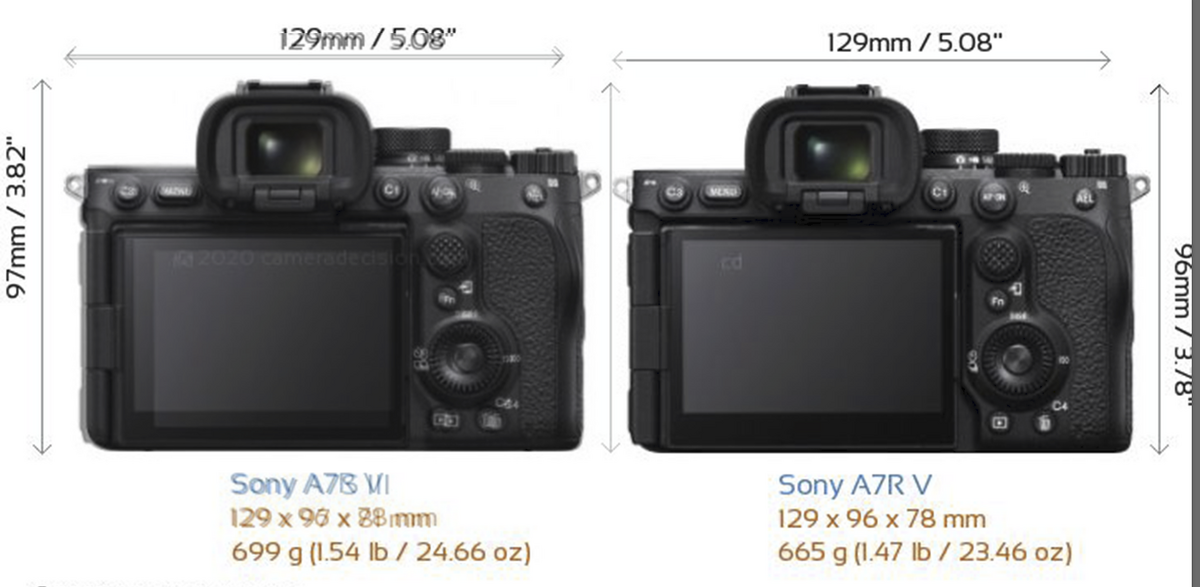
You can see the controls are out a little while the Sony A1 vs A7SIII are a perfect match apart from the top panel dials to left of the viewfinder on the A1:
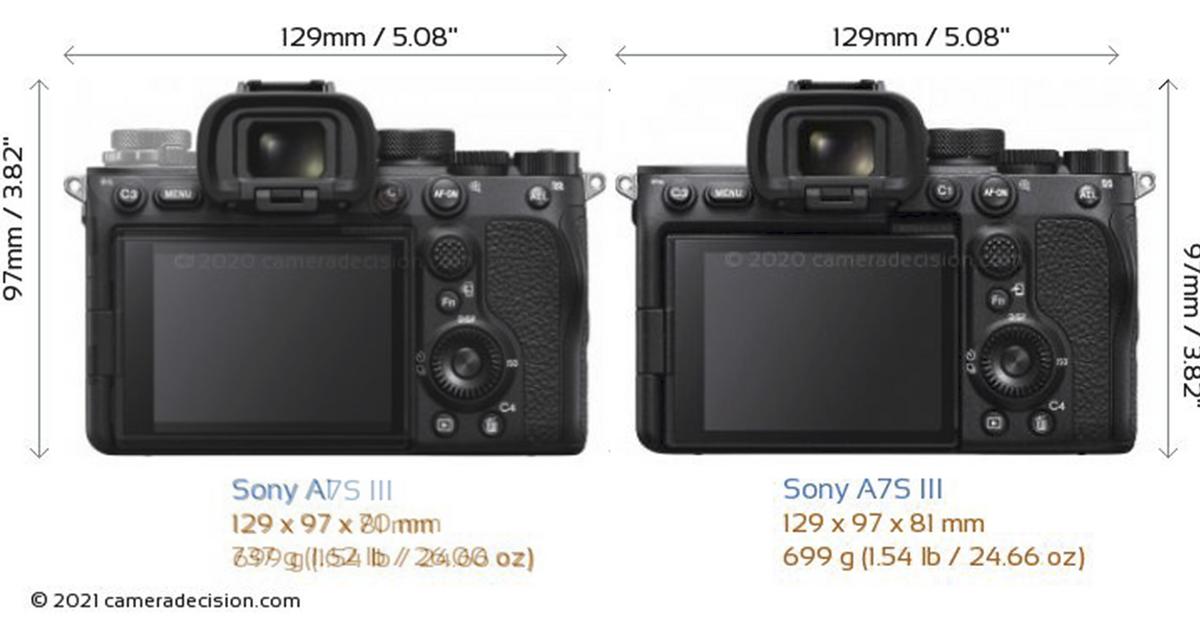
The camera plate change is needed to deal with the change in camera depth front to back with these models.
-
1
-
-
2 hours ago, flowdesign said: Thanks Chris,
As my typical shooting objects are all tiny critters no larger than 5cm on daylight diving. I have tried full range focus but it took me more time to find and foucs on the certain object, especially for the fast moving ones.
So maybe I can still use my previous setup on daylight diving, use SMC-1 instead of MFO-3, but keep MFO-3 attached all the way during the blackwater, and set focus range as infinity?
it's up to you, the main point is you need full range for the MFO3 to work properly. I typically set my macro lens for full range and mount the MFO3 whenever I want to shoot something larger. I'm not sure how the SMC-1 would be used instead of the MFO3 as they have completely different purposes. Have you tried pre-setting the lens for close operation before approaching your subjects? I'm not familiar with the 90mm/A7RIV combination, I've heard the new bodies have better AF with the 90mm lens.
As you generally don't have access to macro range switches during a dive it needs to be set to allow infinity focus, I don't see much point in setting the switch to 0.5m to infinity on a dive where you are wanting to do macro and use the MFO3 - you lose the ability to get close for small things and potentially limit what you can do with the MFO3.
As for blackwater, max magnification with MFO3 is 0.8x and the subject would be touching the front element So I think you'll need the full range to shoot small things? For subjects as greater distances the macro lens is operating at 2m to infinity range where most macro lenses will AF better.
-
You want the full focus range on the lens in all circumstances with the MFO3. Infinity focus on the lens corresponds with an object about 1.5m away so if you engage the focus limiter you will be restricted to a few cm from the lens. You could use 0.5 to infinity quite likely but you can't get 1:1 if you take the MFO3 off.
If you are diving and taking the MFO3 on and off you want to be in full range (unless you are able to change focus limiter while UW ) .
-
On 10/13/2025 at 3:04 AM, TimG said: I’ve noticed many times that Nauticam housings seem to show discolouration much more than Subal. All the Subal housings I’ve had still look good as new even after hundreds of dives.
I can’t imagine Subal owners by default are more careful with post-dive care. Quality of the anodising?
Subal housings are powder coated I believe, so I expect the paint is not subject to etching like anodizing is.
On 10/13/2025 at 7:23 AM, Dave_Hicks said: That is probably from hard water deposits. I don't have hard water where i do most of my diving and my housings don't seem to accumulate those deposits or discoloration.
I believe Rome has hard water, however I don't believe the white look is a deposit, if it was it could be removed. Salt and hard water are both alkaline and become more so as the water evaporates and this etches the coating. But deposit or etching the prevention is the same, don't let water evaporate to dryness on the housing, even after rinsing. Aluminium is somewhat soluble in alkaline solutions and also acidic solutions. A coating of aluminium oxide forms on the surface however this can be porous and subject to attack eventually. Anodizing improves resistance but is not perfect and with strong enough alkali it is soluble as well.
-
2
-
-
4 hours ago, Pavel Kolpakov said: If you set M mode by the strobe knob, the flash starts only when the optical input signal edge appears, and nothing else. After this trigger point, the strobe operates automatically and cannot be controlled externally. Flash intensity can only be adjusted using the strobe itself, using its knob.
In this case, the discrepancy between the knob's adjustment range and the flash intensity range can only be explained by the strobe's operating algorithm.
To omit the details, please confirm the problem with your Sea&Sea strobes in classic manual mode (both strobe and camera are in M mode): The strobe knob rotation range is some more wide than flash adjustment range?
Is this a fact that bothers you?
Pavel the issue as far as I can tell is that the at higher powers on the YS-D3 flash the frame is black, the strobes go off but there is no flash exposure. To me this indicates that the pre-flash is firing and draining the capacitor enough that it won't fire on the main signal. Setting to double lightning bolt on the strobe fixes this as the strobe ignores the pre-flash. It is working with the camera set to ETTL as the strobe ignores the pre-flash in double bolt manual.
-
1
-
-
A further update, looking at these images back on my desktop, where I have EXIF reading apps, the focus distance is an easy way to pick that you used the MFO3. Recorded distance on the lens was between 2.5m and infinty, for example the trumpetfish above had focal distance recorded as infinty. The Rhinopias - 3.9m, the clownfish 5.8m. Easy to distinguish between the MFO3 and the bare 60mm.
-
2
-
-

Help with Printing some of my shots printed for artwork
in Photography Gear and Technique
I think it depends on what they are printing with and the medium. Any service printing with an Epson or Canon large format printer using their pigment inks can accept Adobe RGB as these printers cover the 100% of the Adobe RGB colour space. For example in your area this service specifies you should use Adobe RGB : https://www.nwfineartprinting.com/file-preparation.html
If the service has a file preparation page it's generally a good sign. It's even better if they have printer profiles you can download for soft proofing.
It's really important to use a calibrated monitor and also to ensure monitor brightness is set to the correct value of around 100 cD/m2.