



Skip to content

Shooting Technique, Workflow and Editing / Archived topic

60mm Micro Nikkor on Digital SLR

Started by Trevor Rees ·

  • 22Posts
  • 22Replies

Read-only discussion

60mm Micro Nikkor on Digital SLR

22 posts
  1. My early efforts with a 60 mm macro lens have left me struggling with shallow depth of field. Whilst this is great for some subjects there are others where I want as much as possible in focus. I'm sure my Canon A95 had more DOF.


    This Brittlestar was shot on F22 and too much of it looks out of focus to me. The subject is about 4 inches across and is hardly what I would call that small.


    I know I could try and use F32 to eek out a little more DOF but my question is this : Does anyone deliberately move further back and then just crop the picture in order to get better depth of field?


    Am I too preocupied with filling the frame and would I be better off settling for a crop from further back?

     

    post-4145-1158170801_thumb.jpg

  2. Go to F32. You'll end up with a higher resolution image than moving back and croping. Only crop when you've reached minimum aperture or maximum magnifcation of your optics.


    My early efforts with a 60 mm macro lens have left me struggling with shallow depth of field. Whilst this is great for some subjects there are others where I want as much as possible in focus. I'm sure my Canon A95 had more DOF.


    This Brittlestar was shot on F22 and too much of it looks out of focus to me. The subject is about 4 inches across and is hardly what I would call that small.


    I know I could try and use F32 to eek out a little more DOF but my question is this : Does anyone deliberately move further back and then just crop the picture in order to get better depth of field?


    Am I too preocupied with filling the frame and would I be better off settling for a crop from further back?


    post-4145-1158170801_thumb.jpg

  3. I think that given the choice, I would go for sharpness first even if it is necessary to crop. Generally speaking your lens performance will be better with an aperture around f16 or so, rather than f32.


    My early efforts with a 60 mm macro lens have left me struggling with shallow depth of field. Whilst this is great for some subjects there are others where I want as much as possible in focus. I'm sure my Canon A95 had more DOF.


    This Brittlestar was shot on F22 and too much of it looks out of focus to me. The subject is about 4 inches across and is hardly what I would call that small.


    I know I could try and use F32 to eek out a little more DOF but my question is this : Does anyone deliberately move further back and then just crop the picture in order to get better depth of field?


    Am I too preocupied with filling the frame and would I be better off settling for a crop from further back?


    post-4145-1158170801_thumb.jpg


    I think sharpness is much more difficult to recover; if resolution becomes an issue for larger blow-ups etc then interpolation can be used. Just my 2 cents.

  4. I think that given the choice, I would go for sharpness first even if it is necessary to crop. Generally speaking your lens performance will be better with an aperture around f16 or so, rather than f32.


    It's true that at F/32 you'll loose resolution due to diffraction, but using as much of the sensor as possible will still give you more details for a given depth of field. The cropped image looks sharper if you look at a 100% crop, but that's not a good measure since the uncropped image is at higher resolution.

  5. My only point is that once you have lost focus sharpness in any part of an image that you may want it, it is difficult or impossible to recover at any viewing size or distance. On the other hand resolution is more flexible, and may not even be an issue for smaller prints, the web etc.

  6. It's also important to note that when your camera locks on a subject (at f22 or 32) there is a range of DOF. The closest range is not represented when the camera locks on the subject. You can experiment and use manual focus...I do it all the time. Focus on the subject then I bracket with "slightly pulling back" on the housing or even "slightly moving in forward a bit" with the housing (depending on what I want in focus). It takes a little trust from experimentation, but at F22 you might still be able to get in nfocus what you want by using this technique.

  7. This particular subject I've found a bit tricky. I think camera has focussed well enough on the central body and that is nicely in focus. However the central area is a soft shape & pattern that I think it needs the spines on the arms to be sharper.

    The image just says to me - 'Nice subject, badly executed'

  8. Trevor


    Your Compact digital is effectively a smaller format camera than you Nikon(?) dSLR as far as I am aware. As such it will have a greater depth-of-field than the dSLR (in just the same way that 35mm has greater depth-of-field than 6x6cm format).


    Add to this the fact that your dSLR is using the 60mm lens (and it operates as a 90mm lens on 35mm FF format) and that the focal length is again effectively changed to 90x1.5 = 135mm by using a flat port, and you can see why your depth-of-field appears to be much shallower. On the dSLR I use (Canon FF) depth-of-field decreases more but I can use macro lenses with an effective shorter focal length.


    Optimim apertures for macro photography vary with format too - the larger the format, the larger the optimum aperture f/16~22 on the Nikon dSLR and f/11~16 on FF dSLR.


    All of which might help explain things BUT the bottom line is that you need to experiment until you achieve the results you want. If its any consolation, I find brittlestars to be a tricky subject and am very careful to try to choose ones that have vivid clours so that this are draws the eye away from less sharp areas in the image!

  9. Paul,


    I can't fault anything you've said there. I remeber for a BSoUP talk I gave a while back I did some web research and found that at F8 on my Canon A95 with it's tiny 1/1.8'' sensor had better depth of field than F32 on film for an equivalent subject. This theory now seems true in practice.


    I probably have 4 options here -

    Use F32 to gain a tiny bit extra DOF,

    Move further back and crop a bit,

    Move the central point of focus to a different area

    Shoot the subject in a different way where limited DOF is not so distracting.

  10. Optimim apertures for macro photography vary with format too - the larger the format, the larger the optimum aperture f/16~22 on the Nikon dSLR and f/11~16 on FF dSLR.


    I think the opposite is true. To achieve a given resolution, a smaller sensor requires a larger aperture when we're up against the diffraction limit. An easy way to think about this is to consider two different size sensors with the same number of photosites. The photosites on the larger sensor will be spaced further apart and the image from it will show less diffraction blurring at a given aperture simply because it is sampling the image at larger intervals.

  11. The DOF is a property of the image created by the optics and has NOTHING AT ALL to do with the sensor. The sensor can determine how much of the detail in the optical image actually ends up in your digital data but that is another story. I would need to do some checking but I believe the -stop numbers for compact cameras don't use the same definition and SLRs. At least in Martin Edge's book he continuously mentions use F22 on dSLR or an equivalent F8 on a compact cameras (the actual numbers he mentions may be different but the point is that compact camera "equivalent F values" tend to be a lot higher.


    Herbko is in principle right about a smaller sensor needing a larger aperture or, more accurately, a sensor with smaller pixels will need a wider aperture. The reason is that the maximum resolution that can be captured is about twice the size of the pixel. Smaller pixels means you can capture higher resolution. However, that resolution has to be present in the optical image in the first place. To increase the optical resolution you have to open the aperture or get closer. Unfortunately, those two options both also reduce the DOF. Because DOF and optical resolution both depend on the "angle of diffraction" (think about the angular width of a cone of light emanating from a point in your subject that still fits through your aperture) it is physically impossible to increase resolution without losing DOF. It's in the laws of nature, no amount of trickery or expensive technologies is going to fix it.


    Bart

  12. The DOF is a property of the image created by the optics and has NOTHING AT ALL to do with the sensor.
    Hey Bart - Not quite so.


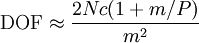
    03c06867e117c2af4ff8cd7be670d1c4.png (Source: wikipedia - DOF)


    Where f is the focal length, N is the f/stop, P is the pupil magnification, m is the magnification, and c is the circle of confusion.


    The circle of confusion is different for various sensor sizes - for example, the CoC of 35mm film is ~0.029mm, CoC of the 20D is 0.019mm, of the D70 is 0.020mm.


    Changing the camera sensor size, in turn, changes the DOF for a given focal length, aperture, and lens.

    Edited by segal3
  13. Hi Matt,


    Thanks for the great link to Wikipedia. It will take some head-scratching to work my way through but it looks very interesting. I wouldn't be surprized if in the end what I was saying (or intending to say) ends up being the same as wikipedia. The idea being that the DOF is independent of the sensor, but that the sensor size has an impact on the CoC that can be tolerated. For now it is safest to assume that I'm plain wrong and there really is no point in playing semantics, just if the sensor characteristics make life easier or harder to get a macro shot with a larger region in focus.


    Bart

  14. I may be totally off the mark here, but I have a different but simple explanation to this.


    Wide-angle lenses have a very large depth of field as compared to telephoto lenses. We all know that. It happens that the lenses on compact digicams are very wide (say 6mm to 21mm, for example). I'm talking about the real (physical) focal length , not the equivalent angle of view.


    What this means is that if you're taking a macro shot without zooming, your depth of field will be incredibly large (that of a 6mm lens). I think this simple explanation accounts for the very large difference (several orders of magnitude) in DOF between a compact camera and an SLR with an "equivalent" focal length. In this particular case, the DOF of the 60mm lens (a few millimeters at close range) on a dSLR is being compared to that of say a 12mm on a compact (a few centimeters or even meters, at the same distance). There's just no comparison possible...


    Now... if I'm totally wrong, feel free to correct me :lol:

  15. Wide-angle lenses have a very large depth of field as compared to telephoto lenses.
    This is actually a common misconception :lol: - they can have the same DOF under certain conditions.


    An excellent article that ties all of this together is Understanding Depth of Field on Reichmann's Luminous Landscape website. Be sure to look at some of the linked pages in the article as well - if you try to work out the math once or twice it should come together. Just plug-in all the numbers and see what you get for a few real-world examples.


    The focal length is a function of the lens alone - no other part of the camera. The short of it is, is that as sensor size decreases, DOF increases (assuming constant field-of-view and f/stop). Note that, as mentioned, you must use the f/stop number in the equation, not the aperture diameter for each lens.


    Herb can jump in here :lol:

    Edited by segal3
  16. Thanks for the correction, Matt.


    Notwithstanding this, the last paragraph of that page does corroborate what I state in my previous post. The real issue is related to how wide lenses on compact digicams are... :lol:

  17. Just to be awkward let me comment that lenses also have an optimum aperture - and for faster lenses this is usually wider than for slower lenses. As an example, when I shoot on my FF Canon on my 100/2.8 macro the images are sharper at f/11 than f/22 but have of course less depth of field. Like many things in life the interaction of different problems produce a more complex result than each problem on its own would. So simply stopping down doesn't always improve things! And yes, compact digitals do tend to have wider minimum apertures than dSLRs mostly I suspect to diffraction limitation and the small pixel size. Whilst I accept that generalisations are not always a good thing, they can sometimes be effective as they mimic the practicality of the situation.

  18. Matt -


    Does that equation help explain why the DOF is less for my 105mm vs. 60mm lens? Given all other parameters (fstop, CoC, pupil mag.) are the same while shooting?


    M.

  19. A good primer for all the is M J Langford's "Basic Photography" (Focal Press). Although written for film users most of its base photo theory remains useful.


    This said, given the relatively few lenses used underwater, it really doesn't take that long to become familiar with the effects of small apertures and specific cameras. Since few of us have a variety of cameras its unlikely that we need to chop and change our techniques too often. In the 'real' photographic world the practicality of use limits the amount of theory which is usable - macro depth of field, diffraction limitation and sensor size/pixel size will affect your results but it won't take much experimenting to find optimum settings.

  20. Matt -


    Does that equation help explain why the DOF is less for my 105mm vs. 60mm lens? Given all other parameters (fstop, CoC, pupil mag.) are the same while shooting?


    M.


    Easiest way to think of it is that as your lens gets longer your DOF gets smaller... university was waaaaaaay too long ago so i won't get into the scientific stuff like the others.... :lol:

Retra

Account

Navigation

Search

Search

Configure browser push notifications

Chrome (Android)
  1. Tap the lock icon next to the address bar.
  2. Tap Permissions → Notifications.
  3. Adjust your preference.
Chrome (Desktop)
  1. Click the padlock icon in the address bar.
  2. Select Site settings.
  3. Find Notifications and adjust your preference.

