Skip to content

Classifieds / Archived topic

WTB: Lembeh Muck Stick

Started by diver21 ·

  • 29Posts
  • 29Replies

Read-only discussion

WTB: Lembeh Muck Stick

29 posts
  1. Hello,


    I'm looking to find another muck stick like the one I picked up at LBR. It's basically a metal rod that has a second metal clamp section (nice for attaching to a D-ring).


    Short of going back to Lembeh, has anyone seen these available for purchase online?


    Thanks.


    David

  2. What is a muck stick really used for? The only time I dived with someone with a muck stick was in Bali when the dive guide was using it to force the poor frog fish out of a hole and lift the spanish dancer to show us it can swim which I found rather annoying. I'm assuming there must be a proper purpose for a muck stick?


    Jing

  3. I use knitting needles. They're aluminum, very light, and a good length. You can get them in several diameters and they fit nicely in the sync cord coils. They aren't as durable as a solid rod but they hold up fine, they're cheap and it's easy to carry extras.

  4. Try Ryan at Reef Photo.

  5. get a car radio antenna at the local wrecker.


    Then use a dremel to make a hole and insert a key ring into it....

  6. What is a muck stick really used for? The only time I dived with someone with a muck stick was in Bali when the dive guide was using it to force the poor frog fish out of a hole and lift the spanish dancer to show us it can swim which I found rather annoying. I'm assuming there must be a proper purpose for a muck stick


    A stick isn't necessary to abuse wildlife, but there are uses I consider legitimate. Perhaps the most important is to help a diver position and move him/herself in difficult places with lots of live corals, sponges, etc. There are reefs so alive that it's difficult for a gloved hand to touch anything without the risk of damage, but there are usually at least a few small areas of rock or dead coral - big enough for the end of the stick to be be placed to stabilize the diver or assist with movements. I've also used mine to anchor myself in sand in a strong current.


    Turning over rocks and rubble (searching for boxer crabs and other crustaceans), etc. falls within the pale as far as I'm concerned. I don't wear gloves except in very cold water, so a stick is good for this. I've also used my stick to gently reposition a crinoid out of the way so I can shoot something behind it. (It goes back again), to softly stroke crinoids on their feet to induce them to open their arms for a quick glance or shot of a clingfish, squat lobster or commensal shrimp living inside. To attract octopus and stomatopods to come out of their holes, which sometimes works. On abyssal walls infested with crown-of-thorns, to stab cots and then carry them out over the deep and let them go. And once to encourage a stone fish to move to deeper water. (It had been resting in the sand in very shallow water near where local kids were swimming and wading barefoot.)


    Sturdy, decent-sized stainless steel rods are better than radio antennas for use in stabilizing or epositioning oneself, though a sturdy chopstick (which was always Larry Smith's favorite) will do.


    Frogfish (Robert Delfs)

  7. Try Radio Shack. That's where Larry Smith used to get his.

  8. Thanks Robert. It seems pretty much what I use my dive hook for, which is primarily to avoid damage to coral. I do use it to stroke crinoids. Think I will change my hook to a stick, since it is not always easy to find a bed rock to put the hook.


    Love your photos!


    Jing

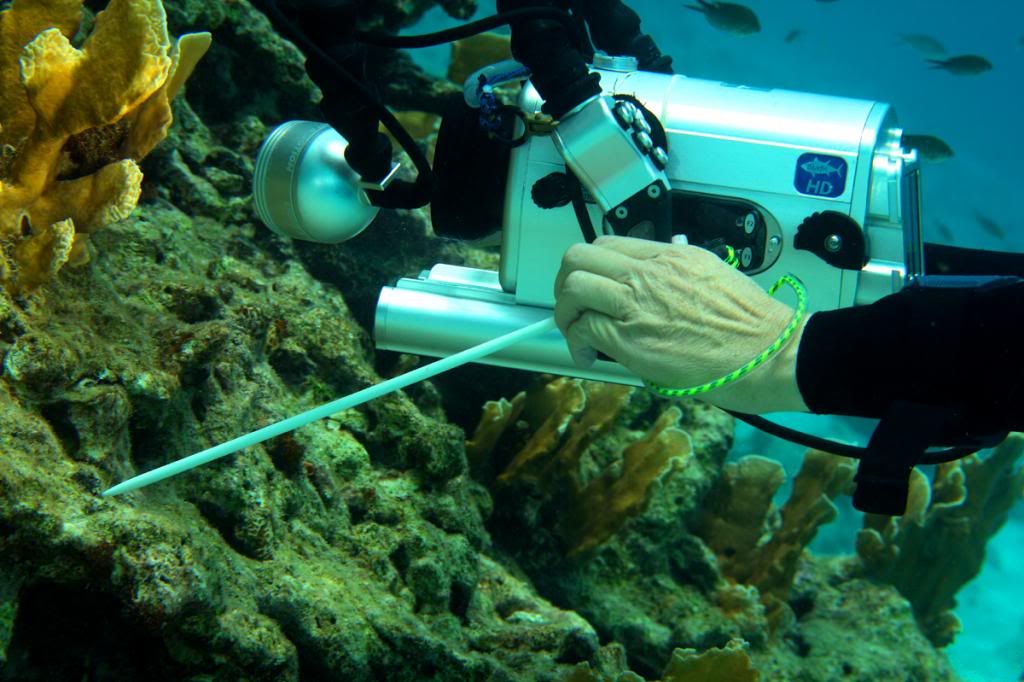
  9. I learned to use a muck stick in Lembeh and will not dive without it again. It is so helpful in positioning yourself on a non hard bottom. Simply carefully push it into the sand and pull yourself around to change your position. For those difficult shots, I used it to steady the camera. It will help keep you off the bottom, reducing any stirring up of the substrate.


    Any expanding stick will be too flimsy to push into the sand and will collapse. An aluminun rod with and eye loop bent into one end is best. I use a lanyard to hold it onto the wrist of the hand using it. I am able to single hand my rig, using the hand with the stick to hold my position. It really helps with current situations.

  10. I bought some aluminum tent stakes at the sporting good store. $2 for a set of six. Bent the open loop end to close it, then attached a clip to it. Use a bungie on other end of clip to wrap around my left wrist. Filed the ends down so to be not as pointy.


    Sometimes you can rest your arm on it to hold camera steady.

  11. I bought a really nice set of chopsticks from our favorite local Chinese food restaurant. They're nice solid plastic with the end being thick enough to put a hole through for a ring/lanyard, but still lightweight. I'm going to use a trick I saw on my last trip to Lembeh and put a neoprene sleeve for it on my strobe arms.


    I found the sticks to be very handy in strong current situations and for holding steady for a shot without stirring up the bottom.


    Kathy

  12. how long should a muck stick be? heading to Lembeh in a few months time and want to get one. Although I will still need to figure out how I can hold my camera set and the stick together.......... such a pity I am not an octopus :)

  13. how long should a muck stick be? heading to Lembeh in a few months time and want to get one. Although I will still need to figure out how I can hold my camera set and the stick together.......... such a pity I am not an octopus :lol:


    This works well for us: A stainless steel rod, 3/16 " in dia, over all length of 16". Using a high precision hammer, form a ring at one end large enough to get your thumb through. Add a short wrist lanyard. To use, put your left thumb through the hole, make a fist and the stick projects across your palm and out the bottom. You can push the stick into the bottom and still hold the camera in your left hand and stay off the bottom all at the same time


    Now see what you can do with 30 years of diving and 3 degrees :):):D

  14. Go To www.xit404.com Mike And Jody have Great Muck Sticks :-))

  15. look at: http://www.ebay.com/...=item416d88866a


    I have purchased these and they are well made.


    I have bought from this guy as well and he will make them to order if you want a different length.

  16. Hmmm... a thread that is nearly 6 years old resurrected for the purpose of advertising in the used classified section ... maybe post in the COMMERCIAL classifieds? Just a thought.

  17. please, please, please be careful with those... They can be a great tool but are often used for all the wrong reasons.


    If used for positioning, maybe this diver could follow a technical dive course to learn new finning techniques. Finning backwards and helicopter turns are a good alternative to poking the bottom and damaging corals or lifeforms hiding in the sand.

    If used for banging on your tank, consider this: divers who are interested in what you show them will look if you merely point. Making noise makes the fish flee and (di)stresses other divers.

    If used to reposition fish, then you should really consider not diving since you have 0 respect for the wildlife underwater.


    Some sticks can be used to measure fish and objects underwater, which is useful and causes no damage.

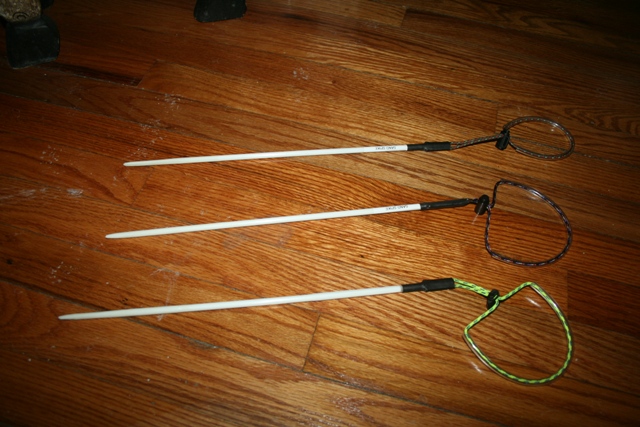
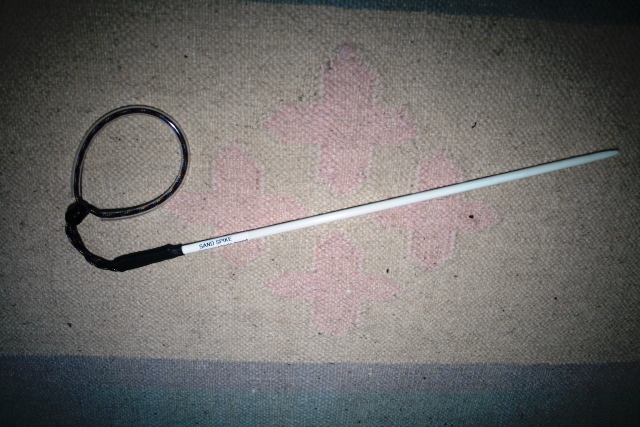
  18. I make sand spikes out of fiberglass. They are virtually unbendable/unbreakable. They are also ultralight for travel. Metal rods are just too heavy and the knitting needles bend too easily. I've tried them both.


    I ship within the USA.


    2114262030_8b13dab674_o.jpg


    2114262034_c642ca3a1a_o.jpg


    add2_zps69d771d6.jpg


    They sell for 20.00 each with 5.00 shipping and handling. You can put quite a few in one mailing tube and it will still be 5.00.

  19. I have a LBR muck stick I would sell. Going back next month, so I could replace mine.

Backscatter

Account

Navigation

Search

Search

Configure browser push notifications

Chrome (Android)
  1. Tap the lock icon next to the address bar.
  2. Tap Permissions → Notifications.
  3. Adjust your preference.
Chrome (Desktop)
  1. Click the padlock icon in the address bar.
  2. Select Site settings.
  3. Find Notifications and adjust your preference.