Skip to content

Shooting Technique, Workflow and Editing / Archived topic

Underwater Cave Photography

Started by breals ·

  • 38Posts
  • 38Replies

Read-only discussion

Underwater Cave Photography

38 posts
  1. I did an underwater photo course with Gavin Newman about ten years ago.

    On the course Gav told me about a 10 point technique he uses in total darkness to paint caves with light.


    1: find a cavern with areas you can conceal yourself.

    2: get to know the area really, really well.

    3: housed camera with 12-24mm on a tripod weighted down with a couple of kilos of clip-on lead

    4: use a strobe with a test firing facility the old Sea & Sea YS120 is perfect.

    5: cover the stobe ready light with tape so it cant be seen. (wont show as a trail of light in final image)

    6: place tripod in your desired position set f8 as a starting point set camera on 'bulb' (shutter locked open)

    7: switch off all your lights press shutter release

    8; in total darkness swim to an area where you can conceal yourself (out of shot) fire strobe full power pointing to the wall, stalectites, roof, floor etc and paint them with light.

    9: change positions and repeat the process painting the whole area. last shot fire the stobe blindside to the camera with you visible mid water to create a diver sillouette

    10: swim back to the camera close the shutter, check your image and if need be adjust the f stop to increase / decrease exposure and go again.


    Clever old Gav eh? :glare:


    Check out Gavins "room of tears" http://www.action-photo.u-net.com/roomoftears.htm the image was taken using the above


    Good luck.
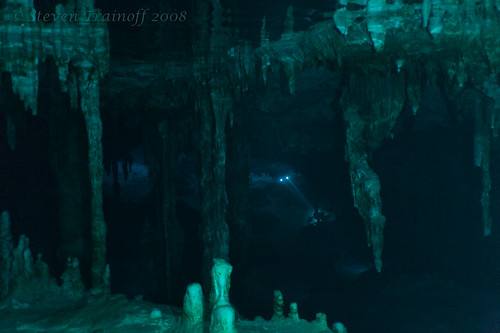
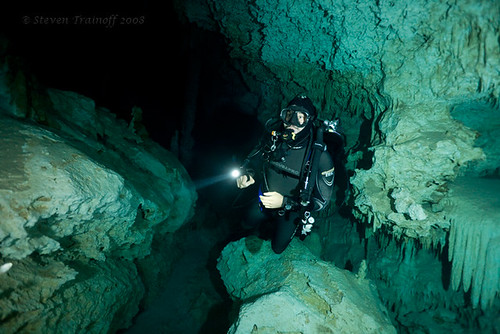
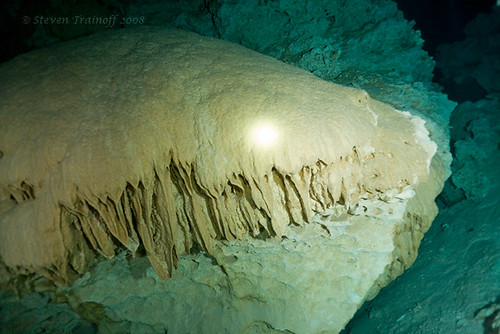
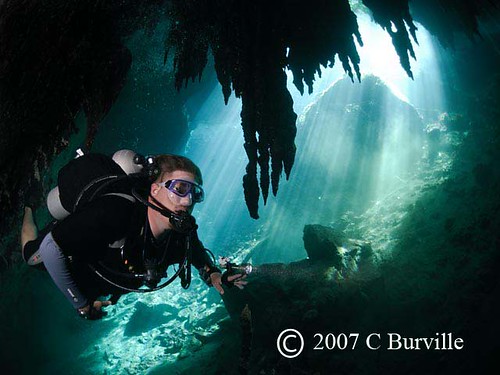
  2. I wish I had read this thread before I dove Dos Ojos a few weeks ago. Here are my humble efforts. They were taken with an EOS 5D, ISO 1600, Canon 17-40, Inon Z240+Z220 strobes. The first image really needs to be viewed large. Click on the image and select "All Sizes"


    2412892524_657339df66.jpg


    2430567934_e68d29b951.jpg


    2436007656_f21d4dd613.jpg


    This last one is a bit silly. To me it looks like a face with the "eye" begin the hotspot from my light.


    2433153328_4d21d03e45.jpg

  3. 8; in total darkness swim to an area where you can conceal yourself (out of shot) fire strobe full power pointing to the wall, stalectites, roof, floor etc and paint them with light.

    Yikes! That sounds like a way to smash into cave formations! Not good.


    Besides, this sounds like the old school film method of doing multiple exposures. Presumably the "digital" equivalent is taking real multiple exposures and making a pano out of them.

  4. I did an underwater photo course with Gavin Newman about ten years ago.

    On the course Gav told me about a 10 point technique he uses in total darkness to paint caves with light.


    1: find a cavern with areas you can conceal yourself.

    2: get to know the area really, really well.

    3: housed camera with 12-24mm on a tripod weighted down with a couple of kilos of clip-on lead

    4: use a strobe with a test firing facility the old Sea & Sea YS120 is perfect.

    5: cover the stobe ready light with tape so it cant be seen. (wont show as a trail of light in final image)

    6: place tripod in your desired position set f8 as a starting point set camera on 'bulb' (shutter locked open)

    7: switch off all your lights press shutter release

    8; in total darkness swim to an area where you can conceal yourself (out of shot) fire strobe full power pointing to the wall, stalectites, roof, floor etc and paint them with light.

    9: change positions and repeat the process painting the whole area. last shot fire the stobe blindside to the camera with you visible mid water to create a diver sillouette

    10: swim back to the camera close the shutter, check your image and if need be adjust the f stop to increase / decrease exposure and go again.


    Clever old Gav eh? :glare:


    Check out Gavins "room of tears" http://www.action-photo.u-net.com/roomoftears.htm the image was taken using the above


    Good luck.

    Impressive. Even if my camera had a bulb setting, I'm not sure I could pull that off on my first cavern dive - but maybe someday! That's not an image I'll soon forget.


    I wish I had read this thread before I dove Dos Ojos a few weeks ago. Here are my humble efforts. They were taken with an EOS 5D, ISO 1600, Canon 17-40, Inon Z240+Z220 strobes. The first image really needs to be viewed large. Click on the image and select "All Sizes"


    2412892524_657339df66.jpg


    2430567934_e68d29b951.jpg


    2436007656_f21d4dd613.jpg


    This last one is a bit silly. To me it looks like a face with the "eye" begin the hotspot from my light.


    2433153328_4d21d03e45.jpg

    Did you shot any close-up or macro shots? Are the formations interesting close-up?

  5. Jeremy. No. I didn't bring my macro lens since I only had time for two dives and I didn't want to fiddle with the housing between dives. Besides, although there are interesting macro formations, no one will know that they are underwater! To get the feel of the place you need wide angle and something to give a sense of scale.

  6. Jeremy. No. I didn't bring my macro lens since I only had time for two dives and I didn't want to fiddle with the housing between dives. Besides, although there are interesting macro formations, no one will know that they are underwater! To get the feel of the place you need wide angle and something to give a sense of scale.

    I hear you ... I will have a w/a adapter with me - but it is wet-mountable and comes off underwater ... one of the few advantages the G9 has over an SLR setup.


    As you've just been down that way ... what do you think ... I'm going in June and I'll be staying near Playa Del Carmen in Mayakoba.


    Should I:


    >>> Dive two days in the cenotes and one on the reef (I hear I should go near Puerto Aventuras)


    >>> Dive two days on the reef and one in a cenote


    Are the caverns worth two days?

  7. Should I:


    >>> Dive two days in the cenotes and one on the reef (I hear I should go near Puerto Aventuras)


    >>> Dive two days on the reef and one in a cenote


    Are the caverns worth two days?

    It depends on what kind of diving you want. We dove 4 days in Cozumel and one in Dos Ojos. The Cenotes have very little life in them. I was a little surprised that there were small fish in Dos Ojos. If you want to see pretty fish, dive the reefs. If you want to see interesting topography dive the Cenotes.


    One nice thing about our schedule was that we dove the Cenote on our last dive day. The advantage is that it was shallow and our gear was thoroughly "rinsed" for the return trip.

  8. It depends on what kind of diving you want. We dove 4 days in Cozumel and one in Dos Ojos. The Cenotes have very little life in them. I was a little surprised that there were small fish in Dos Ojos. If you want to see pretty fish, dive the reefs. If you want to see interesting topography dive the Cenotes.

    Makes sense. I'm inclined to think as interesting as they may be, the cenotes are a one day thing.


    One nice thing about our schedule was that we dove the Cenote on our last dive day. The advantage is that it was shallow and our gear was thoroughly "rinsed" for the return trip.

    Makes double sense!!

  9. It depends on what kind of diving you want. We dove 4 days in Cozumel and one in Dos Ojos. The Cenotes have very little life in them. I was a little surprised that there were small fish in Dos Ojos. If you want to see pretty fish, dive the reefs. If you want to see interesting topography dive the Cenotes.


    One nice thing about our schedule was that we dove the Cenote on our last dive day. The advantage is that it was shallow and our gear was thoroughly "rinsed" for the return trip.


    The cavern dive at Dos Ojos is amazing, we usually take that route on our way into the cave. Once you are past the stops signs, cave diving begins and it's all about scale and structure.


    I bought a Ikelite 225w strobe and slave sensor for this years' trip, I hope to get better pictures.

  10. http://www.ikelite.com/web_two/uarmatray.html - whichever size matches your strobe arms... these are your friends for cave photos.


    Mount one to the lower set of tank bands (works best if the bands are assembled w/threaded rod, so you have a 'stub' on the back side to attach the 9577.1 to)


    then attach your strobe arm to it (6-8" arms are good), and mount your strobe to the arm. If the strobe is pointing down, it's really streamlined, and nothing sticks up higher than the tanks themselves, restrictions are not a problem.


    When you get to where you want to take the photo, flip up the strobe, point where you want it, and shoot away. (3 foot extensions for strobe cord cables are a good idea also, allowing the diver to handhold the slave sensor).


    don't forget to turn the modeling light off when you're done though, anybody behind the diver with a tank mounted strobe will really appreciate not having to look at that light for the rest of the dive.


    IMG_2236.jpg

  11. http://www.ikelite.com/web_two/uarmatray.html - whichever size matches your strobe arms... these are your friends for cave photos.


    Mount one to the lower set of tank bands (works best if the bands are assembled w/threaded rod, so you have a 'stub' on the back side to attach the 9577.1 to)


    then attach your strobe arm to it (6-8" arms are good), and mount your strobe to the arm. If the strobe is pointing down, it's really streamlined, and nothing sticks up higher than the tanks themselves, restrictions are not a problem.


    You have a picture of how you did this? I was planning on having the diver hand hold the strobe and pointing it in the right direction or I was going to mount the strobe flat along one of the tanks with an argon strap. I never thought about mounting a ball and arm so that I could point it up and then back down for the tighter section.


    I'm just unclear how I would mount it. Are you screwing this ball joint into the portion of the extended screw on the tank band?


    I did buy the 3' extension cord based on your recommendation. :)

    Edited by breals
  12. ok here you go. -tanks are LP 85's, arm lenth is 6" (in between the balls)


    from above

    P1020648.JPG


    profile

    P1020647.JPG


    attachment closeup

    P1020649.JPG


    if the stub is too long, you could use a thumbwheel on both sides of the adapter, to stand it away from the tanks a bit. (i use Deep sea thumbwheels for this, works great)

    P1020650.JPG


    This shows the 2 ways I've attached them.. top has the advantage of a little shorter, so no gap between strobe & bottom of tanks (not a big deal either way), and it can be eaisly removed/attached once you're in the water.


    the lower setup has the added flexability of the 2nd ball, making it easier to rotate the strobe to fine tune what it's pointed at.

    P1020656.JPG


    I turn the modeling light on, so the model can see that the strobe is pointed at what I want it at (if it's to the side - this makes it easier for them to know if they're in position or not - for that type of shot.


    here's an exploded veiw of the components for each - I like the 1.25" ball arms, better grip for the heavy strobes (and they're what i've had for years, since before the 1" ones came out)

    P1020657.JPG


    this one illustrates pointing the strobe at 45° or so to the diver, you're not limited to straight behind etc.

    bosh-chen-03.JPG


    when stowed, we coil the sync cord/slave strobe, and place in the model's pocket so it's out of the way, take it out to shoot photos, then re-stow it.


    just remember to take the strobes off while you're still in the water... models HATE standing around waiting for you to do it on land, before they can set the tanks down on a bench/tailgate etc :)


    Art

  13. Very cool and inspirational.


    No way I can pull any of that off on my one day, first-time cavern dive in june, but maybe someday!

  14. Very cool and inspirational.


    No way I can pull any of that off on my one day, first-time cavern dive in june, but maybe someday!


    the setup also works in wrecks :) .. nothing stopping you from practicing it anywhere (I do at a local lake, also a good place to practice laying line, and other skills.

  15. I really like the idea of "hiding" the slave strobe on the model. I hadn't thought of that. You learn something every day.

  16. Simply awesome. Way more than I expected! The best part is that I have most of those parts already.

  17. I too am starting to explore cavern (not cave certified yet...) photography and have found little info. I am by no means an expert and have tried very little but here's what i've learned:


    - the wider the better, I use my 10.5mm fisheye.


    - try and have a diver model for you, it adds loads of context


    - avoid even front lighting, unless it accents some back or side lighting or is lighting the diver. Formations and walls look far better with harsh shadows, gives them depth. I find 2x 11" arms gets 1 strobe far enough out


    - use 1 strobe on the camera and 1 or 2 slaved either on a small plastic tripod (i have a Velbon) or in a diver's hand for side or back lighting. It also extends the reach of your lighting if the diver points the strobe away from you.


    - start with cave entrances, they're easier


    I only have 1 pic on hand to post, and it shows none of the lighting techniques as my 2 slaves malfunctioned this dive. Oh well. Have fun and be safe. Cheers,


    Chris


    639701273_26ff21205d.jpg


    Edit: This pic was taken at ISO 200, f/2.8 & 1/40th sec.

    I'd shoot wide open (f/2.8) and keep ISO low otherwise noise will appear in the darker parts of the pics. The only difference shutter speed makes when shooting away from the cave entrance is to determine how bright the diver's dive light shows up - and yours too, so beware.


    Another tip for cavern shots is using a small tripod set-up, and natural light, makes for some dramatic shots (especialy in grey-scale).

  18. ok here you go.


    Art


    Thank you so much for the detailed pictures. I have been using a similar technique (affectionately referring to it as the "butt strobe") without the arm and bracket, but was having issues with the strobe's ending position when fired, due to it sliding out of position with just a bolt snap connection. The arm is a great idea!! Goes down as one of those "why didn't I think of that!" moments. :chatterbox:


    Amanda

Isotta

Account

Navigation

Search

Search

Configure browser push notifications

Chrome (Android)
  1. Tap the lock icon next to the address bar.
  2. Tap Permissions → Notifications.
  3. Adjust your preference.
Chrome (Desktop)
  1. Click the padlock icon in the address bar.
  2. Select Site settings.
  3. Find Notifications and adjust your preference.