Skip to content

The Galley: General Chat / Archived topic

Alex Mustard Video on Shooting Magic??

Started by Steve Williams ·

  • 40Posts
  • 40Replies

Read-only discussion

Alex Mustard Video on Shooting Magic??

40 posts
  1. Great review, Steve - I just ordered a couple of copies (one for me, one for a friend)!


    Having had the honor of being on a couple of trips with Alex, I know I'll enjoy it - he is a great teacher, in part because of his knowledge and passion, and in part because his personality is so unpretentious, open and giving. I don't know that I'll watch it 5 times :unsure: , but I'm sure I'll enjoy it at least once or twice! :D

  2. he,he....5 times, I'm sure if I come over to your place the first thing you'll want to do is show me your Super 8's of the kids. :D

    Hi partner,

    No super 8's but I've got a couple of thousand cool slides I can show you! :unsure:


    Steve

  3. How do you order the video

  4. Thanks. I'm sorry to be a computer idiot, but whats the difference in the two formats?

  5. I got my copy yesterday, very nice! can someone please let me know, does the filter come with the DVD? or sold separately? I checked the website does not specify.

    thanks!

  6. Thanks. I'm sorry to be a computer idiot, but whats the difference in the two formats?

    In the US you want NTSC, PAL is the European TV format.

  7. Thanks, i want to study up before the caymans trip

  8. Thanks. I'm sorry to be a computer idiot, but whats the difference in the two formats?

    Hi partner,

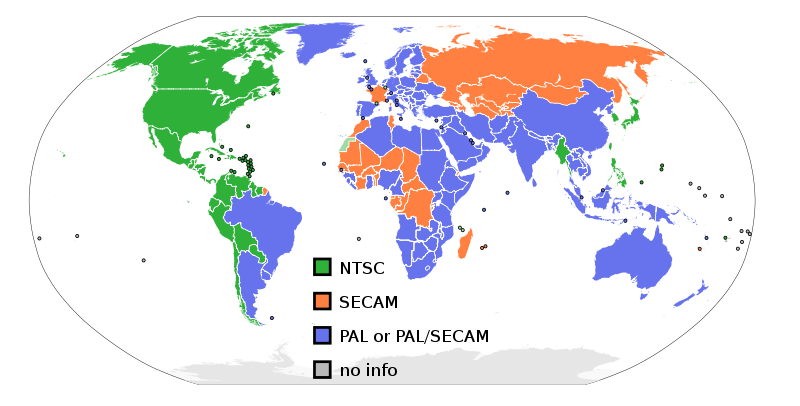
    It's not a computer thing so much as a TV thing. Threading on dangerous ground here so if I'm wrong somebody straighten us out. Fundamentaly I think its a regional issue. NTSC in the North America recording format and PAL for Europe, Middle and far east.

    PAL DVDs have 576 pixels of vertical resolution versus 480 pixels of vertical resolution. Just to make things more interesting NTSC updates the image more frequently than PAL (30 times per second versus 25 times per second). Upshot is that most DVD players in the US won't read PAL DVDs.


    Here is a map from Wikipedia

    post-4526-1229452909.png


    HTH,

    Steve

  9. I got my copy yesterday, very nice! can someone please let me know, does the filter come with the DVD? or sold separately? I checked the website does not specify.

    thanks!

    They are sold separately because there are different sizes for the different lenses. Reef Photo has the filters for US folks.


    Have fun!

    Steve

  10. Hi All,


    The DVD is aimed mainly at users who are either thinking of getting into filter photography or have bought filters, but are scared to used them because they feel they won't get anything from that dive. So the video follows real dives and then shows the shots. Hopefully giving you a flavour or what is and isn't possible in filter photography. We have priced the DVD as cheap as we could (it is much cheaper than other UW Photo DVDs) because it is about our product and we want people to watch it and to take better filter shots as a result.


    There are discussion and demonstrations of the techniques of filter photography, but to be honest the techniques of filter photography are pretty straightforward and certainly wouldn't fill 90 minutes of content. Instead I talk quite a bit about the elements that go through my mind while shooting and also discuss why I think some of the images I shot work well and others do not.


    Alex


    p.s. During next year Peter and I plan to make several more films. The first will be on macro photography - and in style will be different from this. That film won't follow specific dives but will be subdivided into the elements of the technique - showing clearly the before and afters of various adjustments that make the difference. That will also be for both compact and SLR cameras.

  11. Hi All,


    The DVD is aimed mainly at users who are either thinking of getting into filter photography or have bought filters, but are scared to used them because they feel they won't get anything from that dive.


    hey thats me !!!


    p.s. During next year Peter and I plan to make several more films. The first will be on macro photography - and in style will be different from this. That film won't follow specific dives but will be subdivided into the elements of the technique - showing clearly the before and afters of various adjustments that make the difference. That will also be for both compact and SLR cameras.


    now i cant wait for these to hit the shelves.


    I will order my magic dvd when internet explorer have got rid of their virus. not putting details over the www with that thing lurking about.


    will it be with me by christmas alex if i order in a day or two.


    good write up steve.


    stew

  12. Steve, you'll witness my lack of computer skills. As a wide angle guy, Ive wanted to try it. It should be alot of fun to play with :)

    Edited by vazuw
  13. During next year Peter and I plan to make several more films.


    And a lovely pair of movie stars you'll make, too! :)

  14. Just received my copy of the DVD, and watched the whole thing in one sitting (both the DSLR and Compact sections). I found it extremely well done, and recommend it to anyone ordering a Magic Filter or just trying to learn how to use it. As has been mentioned, it isn't necessarily terribly enlightening for someone who has already used the Magic Filter extensively, but even so, it is enjoyable, and Alex does a great job both teaching and commentating.

  15. I just got my copy as well and watched the whole thing. Great stuff!


    I bought an original Magic Filter a while back but haven't been anywhere tropical to try it out yet (the local murky California waters are less than ideal for this kind of shooting).


    I'm heading off to do some wreck shooting in Truk with the D3 and Sigma 15mm FE soon, and I have some questions. I searched through the forums to see if some of this has already been addressed. I don't see anything so far, so I'll go ahead and ask:

    1. On a sunny day (and near the middle of the day), what's a rough max depth at which this thing will still be useful? Some of the wrecks are quite deep (200ft), and I assume I shouldn't even try for those, but I'm not sure what a reasonable cut-off point is.
    2. If it's cloudy (or early/late in the day), should I just mount the strobes and forget about the filter (leave it off for the dive)?
    3. Am I likely to run into issues attempting to manually white balance at depth? I tried some white balancing off of a gray card in the murky Lembeh waters and had a lot of problems in anything deeper than 20ft.
    4. If I go ahead and take the strobes on some dives and use them for some interior shots (with filter), will I likely be able to fix up the white balance issues in NX after the fact or is it hopeless? I can obviously take a gray card shot as a reference, but I"m not sure that's enough...
    5. Are there reasonable tests I can do with the filter over the next few weekends in the greenish dark California waters? I'm not worried about ending up with keepers, just about getting some experience with the filter before going on the trip.

    Thoughts and feedback on any of these questions would be most welcome.


    Thanks!


    Liz Hanks

    http://lizhanks.com/

  16. Got the filter in the mail the other day....

    Ordered the DVD today....

    Cannot wait to watch it.

    Blue Heron Bridge and USVI.. here I come in only 5 weeks! Yahoo!


    My diving is not unlike the man answering questions about s*xual activity, commenting that it is only once per year.

    The questioner asked, why are you so excited about this topic if you only get to do it once a year?

    The man answered...."Because tonight is the night!"

  17. I'm heading off to do some wreck shooting in Truk with the D3 and Sigma 15mm FE soon, and I have some questions. I searched through the forums to see if some of this has already been addressed. I don't see anything so far, so I'll go ahead and ask:

    1. On a sunny day (and near the middle of the day), what's a rough max depth at which this thing will still be useful? Some of the wrecks are quite deep (200ft), and I assume I shouldn't even try for those, but I'm not sure what a reasonable cut-off point is.
    2. If it's cloudy (or early/late in the day), should I just mount the strobes and forget about the filter (leave it off for the dive)?
    3. Am I likely to run into issues attempting to manually white balance at depth? I tried some white balancing off of a gray card in the murky Lembeh waters and had a lot of problems in anything deeper than 20ft.
    4. If I go ahead and take the strobes on some dives and use them for some interior shots (with filter), will I likely be able to fix up the white balance issues in NX after the fact or is it hopeless? I can obviously take a gray card shot as a reference, but I"m not sure that's enough...
    5. Are there reasonable tests I can do with the filter over the next few weekends in the greenish dark California waters? I'm not worried about ending up with keepers, just about getting some experience with the filter before going on the trip.


    Hi Liz,


    For wrecks I use the filters down to about 18m. Although the best colours come at about 15m. I have seen many photos taken with them in Truk - and they work particularly well on the shallower wrecks. It is worth quizzing the guides as to the exact depths - not the seabed depth, but the depth of the exact features of the wreck. For example the Giannis D wreck in Egypt, that is on the Magic Filters website as the mouse over animation:

    http://www.magic-filters.com/magicindex.html

    is actually in 23m of water - but the photos are taken from about 15m or so of depth.


    With the D3 there is less of a need to worry about it being cloudy because the camera is so good at high ISO. Actually flat light can be quite beneficial for filter photography (as long as you have good high ISO performance) as it opens up more shooting directions. That said, strong, directional sunlight, coming right over your shoulder, is the best for really bringing out the colours and details in a subject. An big advantage of your camera is being able to do filter shots early and late in the day, when the intensity is less, but there is good direction on the light, particularly in the shallows.


    I have not shot the original Magic Filter with the D3. But on the D700 I had no problems. As it says in the vid, make sure that the WB target is illuminated by direct sunlight. Actually you can use the White Balance memory bank on the D3 to store several WB settings for different depths (these can also be labelled through the menus) and you could keep them as a reserve, if for some reason you cannot get a setting. The other reason why a camera cannot set WB is because you are underexposing the target. Stick it on P to set the white balance! This catches a few people out.


    You should be able to get something reasonable out of strobe shots with the filter. It is not an idea way to shoot, but it is understandable if a wreck has a particular feature you want to shoot with strobes and then the rest of the dive requires filters. Mike V showed examples of this in his original Wetpixel review:

    http://wetpixel.com/i.php/full/magic-filter-review/

    But ideally you would want to dedicate one dive to strobes and one to filters.


    Although I have shot the D3 in California, I have not tried the filters. But I'd encourage you to give them a go. Trying the filters in CA will be beneficial in helping you get used to reading the light and setting WB Etc. This post gives you a flavour of what you might expect to get:

    http://wetpixel.com/forums/index.php?showtopic=27507&hl


    Hope that this helps


    Alex

  18. For wrecks I use the filters down to about 18m. Although the best colours come at about 15m. I have seen many photos taken with them in Truk - and they work particularly well on the shallower wrecks. It is worth quizzing the guides as to the exact depths - not the seabed depth, but the depth of the exact features of the wreck. For example the Giannis D wreck in Egypt, that is on the Magic Filters website as the mouse over animation:

    http://www.magic-filters.com/magicindex.html

    is actually in 23m of water - but the photos are taken from about 15m or so of depth.


    With the D3 there is less of a need to worry about it being cloudy because the camera is so good at high ISO. Actually flat light can be quite beneficial for filter photography (as long as you have good high ISO performance) as it opens up more shooting directions. That said, strong, directional sunlight, coming right over your shoulder, is the best for really bringing out the colours and details in a subject. An big advantage of your camera is being able to do filter shots early and late in the day, when the intensity is less, but there is good direction on the light, particularly in the shallows.

    Good to know. Most of the wrecks are sitting in 100'-200', so even the top structures are often well outside of the recommended range. I'm still a bit confused as to why the high ISO capabilities help with cloudy days, as well as with the lack of light in the late and early mornings, but not necessarily with depth. I may be misinterpreting though... I guess I'm still wondering if it's worth taking the filter down to 100' (and below) and cranking up the ISO.


    I have not shot the original Magic Filter with the D3. But on the D700 I had no problems. As it says in the vid, make sure that the WB target is illuminated by direct sunlight. Actually you can use the White Balance memory bank on the D3 to store several WB settings for different depths (these can also be labelled through the menus) and you could keep them as a reserve, if for some reason you cannot get a setting.

    I love the idea of keeping some depth-labeled settings in the camera. I assume I'll also be taking a lot of shots of my gray card before shooting, but it's always nice to have the little out-of-camera JPGs at least somewhat color-balanced to begin with.


    The other reason why a camera cannot set WB is because you are underexposing the target. Stick it on P to set the white balance! This catches a few people out.

    Good grief. Of course; that makes sense. It's very likely what I was doing wrong.


    You should be able to get something reasonable out of strobe shots with the filter. It is not an idea way to shoot, but it is understandable if a wreck has a particular feature you want to shoot with strobes and then the rest of the dive requires filters. Mike V showed examples of this in his original Wetpixel review:

    http://wetpixel.com/i.php/full/magic-filter-review/

    But ideally you would want to dedicate one dive to strobes and one to filters.

    Super. I hadn't seen that review. The plan is definitely to set up differently ahead of time, when we're doing multiple dives on a single wreck. I'm just not sure that will always be the case.


    Although I have shot the D3 in California, I have not tried the filters. But I'd encourage you to give them a go. Trying the filters in CA will be beneficial in helping you get used to reading the light and setting WB Etc. This post gives you a flavour of what you might expect to get:

    http://wetpixel.com/forums/index.php?showtopic=27507&hl

    Yep, I had seen those shots, but our vis is more often than not nowhere near that good. Southern and Central California tend to have very different conditions :blush: In any case, good advice. I'll give it a try over the next few weekends.


     

    Hope that this helps

    Goodness, yes. Thanks a ton for all the detailed answers!


    Liz

  19. I received my copy of the DVD yesterday and view the first 11 chapters. It is as advertized? The Doctor gives a straight forward presentation of how and why to use the filter and a follow up evaluation of the images. In addition, there are tips on composition and shot setups. So, the mystery is gone from the filters, but not the magic.


    Also worth reading are Steve’s (front page) and Mike Veitch’s reviews.


    http://wetpixel.com/i.php/full/magic-filter-review/

Reef Photo & Video

Account

Navigation

Search

Search

Configure browser push notifications

Chrome (Android)
  1. Tap the lock icon next to the address bar.
  2. Tap Permissions → Notifications.
  3. Adjust your preference.
Chrome (Desktop)
  1. Click the padlock icon in the address bar.
  2. Select Site settings.
  3. Find Notifications and adjust your preference.