



I am a beginner, and I have been reading a lot of good things about Magic-Filter. However, I cannot understand why exact same effect cannot be achieved with a PhotoShop filter? All it does is adds some red shift to every pixel, this must be trivial change to do in post processing. And since most people shoot RAW this and white balance will not be any more lossy than it is to do this with the filter. Am I wrong?
Shooting Technique, Workflow and Editing / Archived topic
Magic-Filter vs. PhotoShop
Started by chphoto ·
- 40Posts
- 40Replies
Read-only discussion
Magic-Filter vs. PhotoShop
40 posts
-
-
I am a beginner, and I have been reading a lot of good things about Magic-Filter. However, I cannot understand why exact same effect cannot be achieved with a PhotoShop filter? All it does is adds some red shift to every pixel, this must be trivial change to do in post processing. And since most people shoot RAW this and white balance will not be any more lossy than it is to do this with the filter. Am I wrong?
Colour filters on a camera filter out light so, for example, you don't add red, you remove cyan. Does anyone ever look at the other layers of controls in the Adobe RAW Converter? I'd better be careful. This subject may be a bit of a sacred cow on this site! Is that Emperor butt-naked?
-
Its a good question and one I get asked regularly. The main reason I developed the Magic Filter for myself (before it was made commercially available) was because I was disappointed with what I could achieve just using Photoshop and RAW converter.
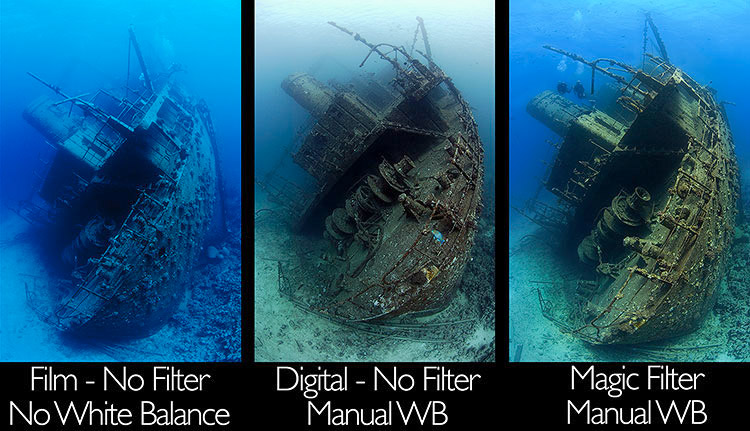
These three shots are a chronological sequence that kind of show my thought process. On the left was an old slide shot taken, then shooting with digital I took the middle shot. I felt that this was an improvement, but was disappointed that the strong white balance adjustment required washed the blue water background out. This particular shot encouraged me to experiment with filters for two reasons. First to require a less extreme white balance adjustment - so that colours were shifted less in post processing - meaning less noise and also more subtle rendering of hues. And second because the filter attenuates blue wavelengths, rendering them darker and helping to hold blue water backgrounds. I tested many filter combinations and the resulting recipe was the Magic filter - which I used (still in the 3-layer sandwich to take the photo on the right).
That said, I still take plenty of available light shots without a filter. At shallow depths, for example, there is no need for a filter and I don't use one. Here is an example shot taken without a filter - that I think looks just fine:

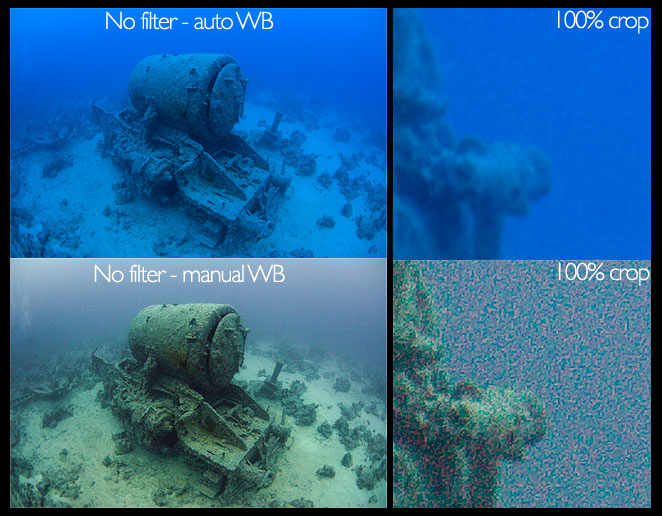
However at depth balancing the light before it strikes the sensor is advantageous for the best quality results. Strong white balance adjustments, even in the RAW converter generate colour noise, as you can see here when compared to an unadjusted shot. Filters help to balance light prior to the electronics, meaning less strong white balance adjustments and therefore less colour noise:
But in the end RAW + Photoshop will give you perfectly useable results and without the need to dedicate a dive to filter photography. These two images were taken with a compact camera. One with filter and one without. If you cover up the picture that is taken with a filter with your hand - I think most people would be pleased with the colours in the other shot.
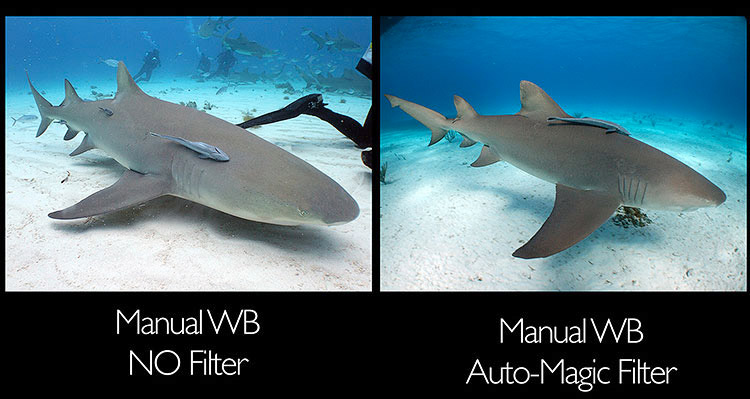
These three images come from this page, which has more info.
Hope that this helps,
Alex
-
This may be a stupid question but, When you say manual wb, are you setting this underwater at the shooting depth or out of water before the dive
-
The end results are almost identical - although a few users have demonstrated a minor quality improvement (slightly less noise) in setting in camera at the time of shooting - but I do mean minor.
Alex
-
The end results are almost identical - although a few users have demonstrated a minor quality improvement (slightly less noise) in setting in camera at the time of shooting - but I do mean minor.
Alex
Interesting to know about that. I am shooting a Canon 30D and WB is a series of steps and was going to try to WB every few feet. Nice to know it is not needed. (I just got a set of 3 Magic Filters to carry from now on after having some strobe issues and figure they are now going with me everywhere. Hopefully I my next trip I get a chance to try them out.)
Edit to Add: Your comment about your dolphin shot is a bit of an understatement

-
Why all the color noise just from manual wb? How is manual wb any different from changing the camera setting say from sunny to cloudy?
-
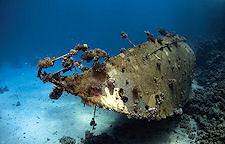
This shot at around 60 feet (20m). No white balance in camera. No processing in camera. No filter. No flash. Colour correction all done with Adobe RAW converter. Published.
-
It was my understanding that the white balance chosen at the time the photograph was taken makes no difference at all to the pixels stored in the raw image. The white balance information is stored along with the image and then the raw processor just applies that white balance. Most raw processors will let you set the white balance to whatever you want after the fact. There have been many times where I've gone for a dive with my white balance set incorrectly and all I have had to do is set the white balance in Lightroom to the same settings as if I'd chosen the correct white balance and I get the exact same result.
That said, I can fully understand the difference between using a filter at the time the shot was taken and trying to manipulate the pixels after the fact. If you take an extreme example where all the red was taken out of part of the subject. How do you know how much red to add back in? Was the original subject red (and now appears black), was the subject purple (and now appears blue) or was it blue (and now appears blue)? As previously mentioned, the filter attenuates the wavelengths unaffected by the water so that you even up all the wavelengths and the camera can still capture the relative levels.
-
Exactly. Thats why I dont understand all the color noise on the 100% crop above in the unfilterd example compared to the filtered shot
-
The noise is because of the need to increase the colour channels which are lost due to attenuation by the water. This has nothing to do with white balance.
White balance is all about correcting minor variations in the channels because the light is not actually white. At depth, you no longer have what would be considered "white light" because so much of the red (and other colours, too) is missing. There's only so much you can do with pixel manipulation and one of the side effects is noise (mainly because the signal for those colour channels is so low). White balance adjustments are basically pixel manipulation.
The idea behind the filters is to filter out the colours that are not lost due to attenuation so that all colours are on a roughly even footing. You will have to increase the exposure (slower shutter speed, wider aperture or increased ISO) but you'll be able to fairly accurately record the relative amounts of red, blue and green.
For example, if you take a photograph of a white slate at depth without strobes and it will appear blue. You can increase the red channel to correct this, but as the amount of red light recorded is low, relative to the blue and green, you will also be increasing the amount of noise in that channel. If instead you had a filter on the camera, and took a photo of the white slate, the blue and green channels would be decreased to around the same as the red. As you would increase the exposure, they would all be in reasonable range so the signal to noise ratio was higher and you would not notice the noise.
-
Example One: shot of me (on the left) by another diver on a Sea & Sea compact that made RAW files and picture converted by me - published.
Example Two: when I went to the Maldives but my flashguns went to Thailand (as in-camera processed).
Example Three: RAW conversion on the same - published several times (Fuji S2).
Example Four: When I jumped in without the flashguns (strobes) switched on and found myself face-to-face with a good subject - published several times (Nikon D200).
Learn to use the RAW converter.
Fixing a filter can offer difficulties if your want to alternate between strobe-lit pictures and natural light. I prefer to use strobe mainly because I can make the lighting more interesting with better modelling rather than be limited by top light.
The need to increase exposure to compensate for the loss of light through the filter can cause an increase in noise due to higher ISO being used.
I guess there is more than one way to skin a cat.
Get a D3.
-
It was my understanding that the white balance chosen at the time the photograph was taken makes no difference at all to the pixels stored in the raw image. The white balance information is stored along with the image and then the raw processor just applies that white balance. Most raw processors will let you set the white balance to whatever you want after the fact. There have been many times where I've gone for a dive with my white balance set incorrectly and all I have had to do is set the white balance in Lightroom to the same settings as if I'd chosen the correct white balance and I get the exact same result.
That said, I can fully understand the difference between using a filter at the time the shot was taken and trying to manipulate the pixels after the fact. If you take an extreme example where all the red was taken out of part of the subject. How do you know how much red to add back in? Was the original subject red (and now appears black), was the subject purple (and now appears blue) or was it blue (and now appears blue)? As previously mentioned, the filter attenuates the wavelengths unaffected by the water so that you even up all the wavelengths and the camera can still capture the relative levels.
Thats what I thought, so both 100% crops should have the same level of noise? whether filtered or not?
-
Fixing a filter can offer difficulties if your want to alternate between strobe-lit pictures and natural light.
It can offer difficulties but it does not have to. Alex has said repeatedly that magic filters are for ambient light shooting and should not be combined with strobes. There are filters that can be used in combination with strobes and strobe filters. I use them always with wide angle. They are not as effective for ambient shooting but are better than no filter at all.
The need to increase exposure to compensate for the loss of light through the filter can cause an increase in noise due to higher ISO being used.It can result in an increase in noise but it is generally a moot point since most shooting is not on the edge of darkness. I've never had a case where a filter forced me to switch to an ISO I didn't want to use, and even if I did in the future I'd rather have my noise evenly distributed in the channels than to have it all lumped into the red channel and have red posterization to boot. In addition, filters actually help with sunball shots because they slow down the green channel and give a better white balance on the sunball itself.
Finally, I will say that filter shooters probably do know how to use a raw converter. I certainly do and I don't consider it a substitute.
-
It can offer difficulties but it does not have to. Alex has said repeatedly that magic filters are for ambient light shooting and should not be combined with strobes. There are filters that can be used in combination with strobes and strobe filters. I use them always with wide angle. They are not as effective for ambient shooting but are better than no filter at all.
It can result in an increase in noise but it is generally a moot point since most shooting is not on the edge of darkness. I've never had a case where a filter forced me to switch to an ISO I didn't want to use, and even if I did in the future I'd rather have my noise evenly distributed in the channels than to have it all lumped into the red channel and have red posterization to boot. In addition, filters actually help with sunball shots because they slow down the green channel and give a better white balance on the sunball itself.
Finally, I will say that filter shooters probably do know how to use a raw converter. I certainly do and I don't consider it a substitute.
If you are getting the results you need, then that's OK. As I said, it's just a matter of Korean cooking. I still sell pictures I took in 1980 with Fuji400 film and a Wratten 85 stuck to the back of a Nikonos 15mm lens. When I get my new Nikon D4x (hadn't you heard?) or manage to get a housing and suitable lens for the Leica S2, I won't throw away older stock material because it's not good enough!
-
Example One: shot of me (on the left) by another diver on a Sea & Sea compact that made RAW files and picture converted by me - published.
Example Two: when I went to the Maldives but my flashguns went to Thailand (as in-camera processed).
Example Three: RAW conversion on the same - published several times (Fuji S2).
Example Four: When I jumped in without the flashguns (strobes) switched on and found myself face-to-face with a good subject - published several times (Nikon D200).
Learn to use the RAW converter.
Fixing a filter can offer difficulties if your want to alternate between strobe-lit pictures and natural light. I prefer to use strobe mainly because I can make the lighting more interesting with better modelling rather than be limited by top light.
The need to increase exposure to compensate for the loss of light through the filter can cause an increase in noise due to higher ISO being used.
I guess there is more than one way to skin a cat.
Get a D3.
Maybe you could "enlighten" us on the use of the Raw converter by writing something up as an example on the steps you used. I would be interested as I have used the magic filters, but also have some shots that I have not had the best of luck with on fixing where I didn't have stobes or filters. I would like to fix them to something more reasonable and have done some things/techniques but always looking for something that may be better.
-
I wrote an article about this back in 2005 I think - check the gallery. It explains about using the RAW converter and the white balance picker to correct white balance. And it goes into detail on using the channel mixer.
I no longer use the channel mixer as I prefer to use complimentary filters.
Cheers
James
-
If you are getting the results you need, then that's OK. As I said, it's just a matter of Korean cooking. I still sell pictures I took in 1980 with Fuji400 film and a Wratten 85 stuck to the back of a Nikonos 15mm lens. When I get my new Nikon D4x (hadn't you heard?) or manage to get a housing and suitable lens for the Leica S2, I won't throw away older stock material because it's not good enough!
Profit is one measure of the suitability of a technique but not a good one. I do understand your perspective, though. I'm after the best result I can get and that isn't ambient light with all correction done in post but I wouldn't hesitate to use that combination if it turned out to be necessary. I would not use a magic filter in combination with strobe though I believe it could be done with the right strobe filters.
One thing that I believe is consistently forgotten with photographers is that light isn't RGB, it's a continuous spectrum. Our cameras and our eyes are RGB, loosely speaking, so it's easy to forget. Proper function of color conversion in a raw converter relies on assumptions regarding the illuminant and underwater ambient light is nothing like that. Filters can substantially improve that situation and will result in better color performance from the converter software. You can't simply crank the red gain in photoshop and restore color to its proper glory. The saving grace is that we don't really know what the proper colors are underwater and don't really care.
-
While I do agree that in good conditions you get pretty much the same results using a good RAW converter as you would using a filter, there are exceptions.
Again, because of where I happen to reside, I end up doing some shooting in conditions I probably shouldn't. The picture below is taken at the wreck of the ship-of-the-line Kronprins Gustaf Adolf that sank outside Helsinki in 1799. She lies in 20 meters of very, very green water. Visibility on a good day can be 10+ meters, but more likely we have something like 5-6 meters due to the closeness of the site to two major shipping lanes. In this instance, the viz was around 6 meters - the lenght of the anchor shank approximately.

Exposure was 30 sec, f11, ISO 400 using a D300 and 10.5mm. In this picture I have used a pretty strong filter - Kodak Wratten cc70M (cc20M+cc50M). This one is pretty much straight from the camera apart from levels adjustment and defishing.
Now, I have done the same using a variety of filters as well as without. If I shoot with no filter, there's basically information in only the green channel in the picture. This in my eye tends to lead to a very low contrast image and trying to correct this using the RAW converter or channel mixer results in lots of colour noise. Even with the 70cc magenta filtration I get almost no blue! Hence, I'm currently looking for a stack of a cc50M and something bluish. I suppose what I would need is something like a Lee v98 that looks like this. Unfortunately, you cannot get it in a material suited for backmounting to the 10.5mm.
So I think there are cases where filters are more or less a necessity, while in others you can definitely get away without. And while I certainly have achieved very good results with the Magics in the tropics, I have indeed sometimes lamented the inability to shoot flash on the same dive - something you might want to do if you do not have full control over the dives you do on a trip.
And oh, the real reason for me to go to magenta filters specifically is that the end result of these experiments will be in B&W as in this non-defished version of above here.
timo
-
Maybe you could "enlighten" us on the use of the Raw converter by writing something up as an example on the steps you used. I would be interested as I have used the magic filters, but also have some shots that I have not had the best of luck with on fixing where I didn't have stobes or filters. I would like to fix them to something more reasonable and have done some things/techniques but always looking for something that may be better.
http://www.divernet.com/cgi-bin/articles.p...CS3+RAW+CONVE...
Sorry. The new server has speed problems and you will have to be patient while it loads. It's merely a starting point. (...and Spec should read 512mb of RAM.)


