



I would (my housing does not support LV access) use LV sometimes for WA, specially when shooting to the sun, as my eyes sometimes hurt from looking directly at it waiting for the subject/model to pass by. For macro I prefer the clean image of my Inon straight VF.
Photography Gear and Technique / Archived topic
Liveview on DSLRs : Would you use it over the traditional VF?
Started by Drew ·
- 36Posts
- 36Replies
Read-only discussion
Liveview on DSLRs : Would you use it over the traditional VF?
36 posts
-
-
The main thing Ive noticed with liveview is it can be much more fatiguing because Im holding the camera and strobes out in front of me. With a compact it wasnt a problem, but the DSLR added enough on its noticeable. I also find it tends to be less stable as a result, and balancing the camera setup becomes more important, both in buoyancy and front/back balance and the like.
With the 50D, the liveview focus point cant be moved around on the Ikelite. So even for macro I find it less useful than it could be, unless Im focussing in the centre, which makes the magnifier option usable.
I would (my housing does not support LV access) use LV sometimes for WA, specially when shooting to the sun, as my eyes sometimes hurt from looking directly at it waiting for the subject/model to pass by. For macro I prefer the clean image of my Inon straight VF.That is the point of this thread, to provide feedback to manufacturers and have them acknowledge and increase the functionality of Live View LCDs in their housings and also consider things like balance and handling as a package. It's not hard for manufacturers and/or their dealers to hook up with say, Stix, and optimize their port systems for handling and balance.
They can also optimize the rear window for the LCD and look for materials to reduce reflection. Obviously they can't do everything but that's why this feedback is important for them to know what photogs want.
-
Drew,
It seems to me that the value of LV really relates to it's use for video, more than still photography; and manufacturers will need to start incorporating features of video housings (as you imply), and develop 'hybrid' housings.
The challenge may be to create housings that retain the design features of both types of photography without compromising either - and folks like yourself who are familiar with both will have the most to contribute. For example, if hoods are created for the LCD, it will need to be foldable, or at least not interfere with VF photography. There is probably a place for add on accessories like hoods.
Maybe we will start to see housings that are more elongated like video housings for better balance etc. Other options may include using separate monitors if the cameras will facilitate this, and electronic viewfinder designs may be the best of both worlds.
A little flash I just had; companies like Light and Motion may have an advantage, utilizing electronic camera controls that will allow more flexibility in housing shape and design.
-
Drew,
It seems to me that the value of LV really relates to it's use for video, more than still photography; and manufacturers will need to start incorporating features of video housings (as you imply), and develop 'hybrid' housings.
The challenge may be to create housings that retain the design features of both types of photography without compromising either - and folks like yourself who are familiar with both will have the most to contribute. For example, if hoods are created for the LCD, it will need to be foldable, or at least not interfere with VF photography. There is probably a place for add on accessories like hoods.
Maybe we will start to see housings that are more elongated like video housings for better balance etc. Other options may include using separate monitors if the cameras will facilitate this.
A little flash I just had; companies like Light and Motion may have an advantage, utilizing electronic camera controls that will allow more flexibility in housing shape and design.
I'll disagree Jeff. Liveview isn't just for video (but obviously video is integral to Live View for cameras that have it). As Davide (and 30+% of respondents) has pointed out, there are uses for it in many situations. It's about expanding technique and developing ideas for uses. It may not help in studio/pool situations but out at sea it can be very handy. I wish I had liveview last year in a few baitballs. I would've seen the bryde's coming through via my peripheral vision. I'm sure that french guy wished he had liveview since he had to stick his eye in the VF and a shark ripped his hand and face storming out of the baitball.
 Having liveview for multiple whales allows you to compose your shots seeing what is coming into frame etc. That's just a few uses for WA.
Housing manufacturers will have to keep thing modular. The LCD is not for every situation nor is the VF.
-
I'll disagree Jeff. Liveview isn't just for video (but obviously video is integral to Live View for cameras that have it). As Davide (and 30+% of respondents) has pointed out, there are uses for it in many situations. It's about expanding technique and developing ideas for uses. It may not help in studio/pool situations but out at sea it can be very handy. I wish I had liveview last year in a few baitballs. I would've seen the bryde's coming through via my peripheral vision. I'm sure that french guy wished he had liveview since he had to stick his eye in the VF and a shark ripped his hand and face storming out of the baitball.
 Having liveview for multiple whales allows you to compose your shots seeing what is coming into frame etc. That's just a few uses for WA.
Housing manufacturers will have to keep thing modular. The LCD is not for every situation nor is the VF.
For me personally LV will have to get better, predominantly bigger, before I find it to be a high value feature, the type of situations you mention notwithstanding. And that may just be my poor old eyes. So at present, it's not the housings that limit it for me.
Now if I had a large plug in monitor, that may well be a different story.
But I must admit this discussion has prompted me to think about using LV more, and I may sing a different tune after my Oceanic Whitetip trip when we have swarms of them around.
-
Definitely a bigger, higher res LCD (something we video guys always clamor for) would be best.

3" LCD is so last decade for video.
Not to curb your newfound enthusiasm for LV, with the whitetips, unless you lock focus and know where they are coming from, I think the AF via the VF would be better the majority of times.
The AF on LV isn't quick enough for a moving target. -
The main thing Ive noticed with liveview is it can be much more fatiguing because Im holding the camera and strobes out in front of me. With a compact it wasnt a problem, but the DSLR added enough on its noticeable. I also find it tends to be less stable as a result, and balancing the camera setup becomes more important, both in buoyancy and front/back balance and the like.
I have the exact opposite 'fatigue' sensation. I've tried a couple of dives with my old prescription mask, and tried the OVF. [since I normally dive with a Hydro-optix, there's no way I'd be able to close-focus to look into an OVF, much less physically get it up against the domed mask without horribly scratching it up.] I find my diving position is pretty cleanly horizontal or slightly 'knees down' in a frog position, but craning my neck back to get a horizontal orientation shot with my mask crammed against the viewfinder is fatiguing and painful; I feel like I'm always "pulling" the camera back into me and my neck ends up raw rubbing against my BCD edging and/or wetsuit collar. Holding it more outstretched (not straight armed, just a bit further forward, like maybe 12-14" nose-to-LCD), is much more natural and allows me to even have the camera slightly below me and look at the VF from a bit of an angle, ambient light permitting of course. If the Ike housign for the E-330 permitted the monitor to be angled just a bit that would be superb (again, ambient light permitting - angling the LCD toward the sun might be the worst possible idea on really sunny, shallow dives!).
My rig is pretty neutral, but is a bit front-buoyant what with the 8" dome, so I do get some wrist fatigue from the LV shooting position, that I might not if I was 'hugging' the whole rig closer to the body. But that combined with the ability to wear a wider angle Hydrooptix mask, and the better overall peripheral vision around the camera even when shooting, is still better than the alternative neck pain to me.
The biggest difference of course being I'm there to dive and SEE the sights around me, not just always thru a camera; pictures are a fun obsession, but I won't cry if I don't get any keepers (whine yes, cry no
). I'm not doing this for a living or for competition...if I were, my priorities would likely change. But I'd still miss my live-view crutches. -
Definitely a bigger, higher res LCD (something we video guys always clamor for) would be best.
3" LCD is so last decade for video.
Not to curb your newfound enthusiasm for LV, with the whitetips, unless you lock focus and know where they are coming from, I think the AF via the VF would be better the majority of times.
The AF on LV isn't quick enough for a moving target. I'm pretty sure Harald from Seacam can make you one of these!
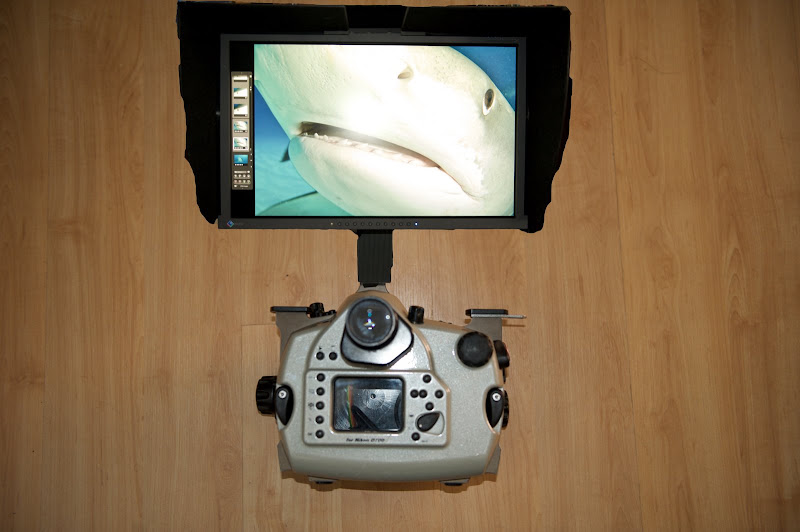.jpg)
Seriously though, a large LCD mounted on my focus light connection would probably change my mind.
-
Well if you don't mind the handling nightmare, Gates can house the 5.6" RED monitor... I'm sure they can do a HDMI version for you. Oh if you have to ask how much, you can't afford it. Your kids college funds will handle it though
-
I dont think theres any easy way to make something inherently less fatiguing from an arms perspective if you have to hold it out vs holding it close to your body. The only real option is neutral buoyancy or very close to it regardless of shooting angle, and thats not easy to achieve for my setup. I also think many dry/wetsuits arent particularly friendly towards long periods of outstretched arms.
As far as necks go, as I said for me a 45 degree VF seems a better solution as it lets my head stay closer to straight rather than having to crane it up, which is needed for both LV and normal optical if Im trying to be close to the bottom.
I came from compacts so I dont think Im being arbitrary or traditionalist Ive had a fair bit of experience with both options, more with the LV if anything. I found my first DSLR extremely annoying because it has such a small VF, wth my next one I found it quite helpful. Ive tried using the LV for slow moving macro and found it useful, but havent yet found a way where its less fatiguing whenever Im shooting from an angle that has my floats away from vertical. If that can be done I might find it more generally viable, but I dont see how a manufacturer can really do that.
Otara
-
The phase contrast detection on the E520 makes it very usable for macro and WA reef scenes. While there's still a lag of sorts, the LCD is able to focus and show DOF. If you have the camera set for continuous AF, theres not that much shutter lag. For framing static macro subjects it is sometimes easier with the LCD due to being able to put the camera where you can't put your head. Any dynamic movement though, requires the OVF.
-
Having just bought an E-520 I was looking forward to using LV underwater. Imagine my surprise when I found that shooting fish shots is easier with the VF than with the screen. It is too hard to identify the fish against a background before you zoom in and if you zoom in first it harder to find as both eyes are on the screen as opposed to one on VF and the other open to 'find' the subject.
I found it as Gary says, good for macro and WA although I only tried a couple of those shots.
Anything moving and its the VF for me.
PS I find the same situation with shooting bird shots above the water.
-
I did my first dive with 5DmkII last weekend. I thought about using live view, but you need to press a button to autofocus. I prefer using the shutter button for focus, so I ended up not using the live view at all.
-
Firstly, let me say I do not shoot DSLR yet. CJ and I shoot G9's and we've made an unholy commitment to developing UW and topside systems for our four cameras. That said, I would make the shift to DSLR tomorrow if usable LV was available. I am sure its only just around the corner as, apparently, the pre-production model 450D had this but the LV was detuned in the retail version. I was hopeful that the 50D may have incorporated this capability. Maybe the 60D will?
-
That said, I would make the shift to DSLR tomorrow if usable LV was available.
It's available, but not in the canon system. Try sony a300/350 in any shop. They came out after my purchased my sony a100 with ikelite housing. Now I regret that I haven't waited a bit longer. I tried it in a shop and it's as fast as the standard AF. First I thought it's just a gimmick but in several situation I just missed the option. Also very useful above water.
-
When shooting UW:
I think many people have misunderstood the LiveView on cameras such as the D300. This is how I use it:
I use the handheld LiveView mode on my D300 alot. Never tried it in macro, only with Tokina Fisheye 10-17 and 8" DOME. It's great when shooting close to the bottom, it's great when shooting a model as you can easier communicate with it, and easier find her/him when he/she gets out of the finder. It's great those time when you need to hold the camera in position or places you can't go yourself.
The display on the D300 is very good. If I would have a less good display I might not have used LiveView.
As it takes about haf a second (after you press the shutter) before it starts looking for focus, it doesn't work with moving objects or when shooting with extremely short focus depth (macro).
When shooting into the sun, close to the surface it's very hard to see the sunball in the display.
When it's very dark, the display gets noisy and shows little color. Still usable though.
For macro I think I would go for the tripod mode, lock the focus, zoom in on the display and move the camera so that focus is achieved and then press the shutter. I do that on land often but have yet to try it uw. The reason for doing it uw is that when zooming the display you get a very very good idea of when it's super sharp. This requires good lightning though.
The AF in tripod mode sucks, never use it.
One drawback with LiveView is that it can be harder to keep the camera still.
One major drawback with the viewfinder is that it's really hard to see the whole viewfinder (with all data). At least in a Ikelite housing. I'm very happy for that the D300 can show shooting data on the main display (the mini display on the top is hard to light and often hidden behind strobe arms and such things).
I would love to have a phase detection in real LiveView (no 0.5 sec delay) and then I would probably use in on macro as well. It could be good on super macro where it's so easy to miss the object and just see blur in the viewfinder (due to super short focus depth.
It would also be great if I had a real-time histogram.
/Peter Segerdahl

