Skip to content

Photography Gear and Technique / Archived topic

In praise of high ISO

Started by loftus ·

  • 40Posts
  • 40Replies

Read-only discussion

In praise of high ISO

40 posts
  1. One of the advantages of the newer cameras particularly full frame is their high ISO capabilities; and I am an advocate of utilizing the ISO control more freely as a third exposure control mechanism in addition to aperture and shutter speed. The D3/D700 is the present king of high ISO, but the D3x and 5D MKII are pretty close at least up to 1600 ISO. No longer do we have to think so much about keeping the ISO as low as possible in order to avoid noise and loss of quality as we operated in the past.

    When I dive now, I have a new exposure rule of thumb - 100 ISO for every 10 feet, and I play with ISO as I do my aperture and shutter speed dial.(Sorry you metric guys, the conversion is not as convenient) I think it is much more than just a low noise issue. I think higher ISO allows better penetration of those areas beyond our strobes that are only illuminated by ambient light, and the result is more subtle display of the tonal ranges of the underwater landscape. Strobes can now be used in much more subtle fashion, to just paint in the bare minimum of light required. For my own photography I think this conveys a better mood and feel of the experience of being there. Though there is some loss of image quality at high ISO if one one were to scrutinize similar images at the surface, I think the benefits of high ISO at depth or other low ambient light situations far outweigh the loss in quality. Here's an example. ISO 800 at 80 feet.
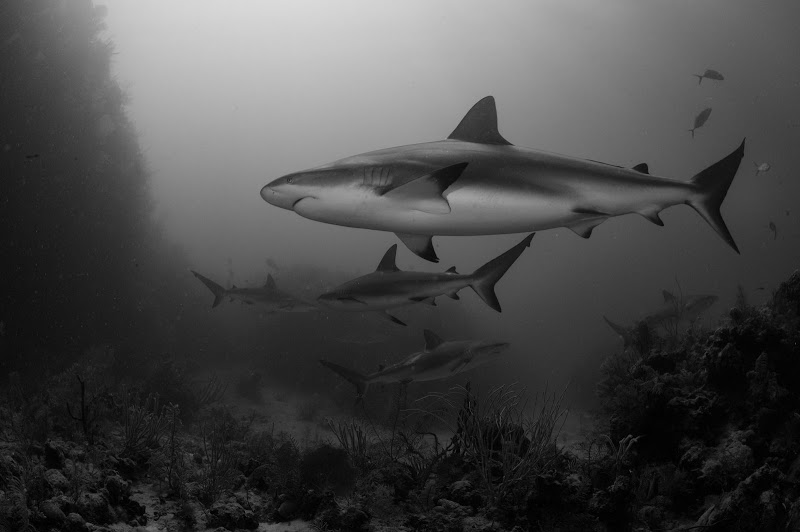
    Jardin%20de%20la%20Reina2009-02-1610712.jpg

    Edited by loftus
  2. I find that I loose dynamic range at higher ISOs, Jeff. I am surprised that you find higher ISOs allow a more subtle display of the tonal ranges of the underwater landscape.


    I find that the opposite is true - that higher ISOs reduce the range of tones that can be captures underwater. In your example - I think that the camera has coped because you have shot horizontally and used a camera with very good dynamic range. I don't think that the high ISO is a significant contributor.


    Alex

  3. I find that I loose dynamic range at higher ISOs, Jeff. I am surprised that you find higher ISOs allow a more subtle display of the tonal ranges of the underwater landscape.


    I find that the opposite is true - that higher ISOs reduce the range of tones that can be captures underwater. In your example - I think that the camera has coped because you have shot horizontally and used a camera with very good dynamic range. I don't think that the high ISO is a significant contributor.


    Alex

    I agree that one loses dynamic range with higher ISO's, so I am not arguing for using higher ISO's when ambient light is adequate. I agree, always still use the lowest ISO for the given ambient conditions. What I am saying is that we can now turn up ISO with far less loss of dynamic range than was previously possible. As a rule, as we descend, ambient light decreases, obviously viz conditions will alter this. Previously turning up the ISO for a scene like the image above, I think would have just turned the background and terrain to mush even if the foreground was well lit. If the background is not an important part of the image and one is relying on strobe lighting exclusively, then of course there is no value to turning up ISO.

    Edited by loftus
  4. Previously turning up the ISO for a scene like the image above, I think would have just turned the background and terrain to mush even if the foreground was well lit. If the background is not an important part of the image and one is relying on strobe lighting exclusively, then of course there is no value to turning up ISO.


    Humm, when I read your first post my first reaction was "why?".

    Even back in the film era when I had the chance of going with higher ISO film on deeper dives, most of the time I chose not to.

    Although I agree that the ISO setting is a much more useful tool for digital than it was with film. As your example clearly shows.

    I feel that natural light images can be done on higher ISO, with better dynamic range at almost any depth with a very wide or fisheye lens.

    If I was in a situation like that I would just set my camera at the desired setting:

    - A nice aperture for DoF and lens resolution (around f/8-11);

    - A nice speed to stop motion (maybe 1/50s);

    Then I would just top the ISO enough to get the results I want (with the least possible ISO).

  5. Jeff, I do think that you raise an important point - that with the latest cameras that ISO needs to be thought of as an additional control of exposure - as the cost on image quality is very small.


    I shoot ISO 800 pretty much as a default in temperate conditions.


    Alex

  6. Hardly a recent development. The Canon 5D has been around for over 3 1/2 years now.


    Jeff, I do think that you raise an important point - that with the latest cameras that ISO needs to be thought of as an additional control of exposure - as the cost on image quality is very small.


    I shoot ISO 800 pretty much as a default in temperate conditions.


    Alex

    Edited by herbko
  7. Hardly a recent development. The Canon 5D has been around for over 3 1/2 years now.

    True, but not something I've not seen talked about in underwater circles, and probably the new cameras are about 1 stop better than even the 5D

    Edited by loftus
  8. Humm, when I read your first post my first reaction was "why?".

    Even back in the film era when I had the chance of going with higher ISO film on deeper dives, most of the time I chose not to.

    Although I agree that the ISO setting is a much more useful tool for digital than it was with film. As your example clearly shows.

    I feel that natural light images can be done on higher ISO, with better dynamic range at almost any depth with a very wide or fisheye lens.

    If I was in a situation like that I would just set my camera at the desired setting:

    - A nice aperture for DoF and lens resolution (around f/8-11);

    - A nice speed to stop motion (maybe 1/50s);

    Then I would just top the ISO enough to get the results I want (with the least possible ISO).

    My point is that with newer high ISO cameras if after you went through the above process and you required ISO 800 let's say, you could be fairly certain the resulting image with a D700 (or 5D I & II, D3x etc) would be significantly better both in terms of noise and DR in the shadows than with a D200.

    That's been my experience owning both these cameras. For me the effect is one of the camera being able to 'penetrate' better into the shadows bringing out more detail and adding more depth to the image. This is also something clearly evident in topside high ISO images at night with these cameras. Difficult to quantify I know, except with side by side comparisons.

    Edited by loftus
  9. Have a question about iso. I just recently aquired a D700 and iso can be set to auto on this. I have found you can shoot in low light situations without flash on the surface, not sure how applicable this would be underwater. I found this to be extremely useful when the camera chooses the iso based on lighting and the user manages shutter speed and aperture. Since most lighting is done with strobes don't know how useful this technique would be. I have noticed that iso 3200 on my D700 is very useful and the resulting grain I see is similar to film grain and not noise. Interesting to note you can set a limit on the camera to how high the iso can go if you want to keep it above 3200 and not let it dip to 6400 (which in some shots is acceptable btw). D700 is an amazing camera. :lol:


    Tony

  10. Have a question about iso. I just recently aquired a D700 and iso can be set to auto on this. I have found you can shoot in low light situations without flash on the surface, not sure how applicable this would be underwater. I found this to be extremely useful when the camera chooses the iso based on lighting and the user manages shutter speed and aperture. Since most lighting is done with strobes don't know how useful this technique would be. I have noticed that iso 3200 on my D700 is very useful and the resulting grain I see is similar to film grain and not noise. Interesting to note you can set a limit on the camera to how high the iso can go if you want to keep it above 3200 and not let it dip to 6400 (which in some shots is acceptable btw). D700 is an amazing camera. :lol:


    Tony

    I think auto ISO will probably work well for ambient light wide angle stuff where strobe is either not used or only to a minimal degree to paint in a little foreground light.

  11. I think auto ISO will probably work well for ambient light wide angle stuff where strobe is either not used or only to a minimal degree to paint in a little foreground light.

    Does Auto-ISO work with something active in the hotshoe? I don't think it does.

  12. Does Auto-ISO work with something active in the hotshoe? I don't think it does.

    According to the manual Auto ISO works with flash. I assume that would mean with a flash in the hot shoe in addition to the built-in flash.

  13. According to the manual Auto ISO works with flash. I assume that would mean with a flash in the hot shoe in addition to the built-in flash.

    Interesting ... I know it doesn't work with the internal flash.


    EDIT ... did some quick testing.


    As I had experienced before, with the internal flash activated, Auto-ISO did not work ... didn't matter if I had the internal flash on Manual or TTL, the ISO was the ISO set on the dial ... in a dark room it still used ISO 200 as that was set. In the same dark room, it used 2000 when that was what was set.


    Interestingly ... with my old Canon 430EX in the hotshoe, Auto-ISO does seem to work ...

    Edited by jeremypayne
  14. Really interesting discussion. I think something of a revolution is going to happen in underwater photography when full frame sensors become the norm for the "advanced amateur" DSLRs like the D90. By that time, at the rate technology is evolving, I assume the high ISO capabilities and dynamic range would be several times better than even the most expensive cameras today. Wide angle available light photography would probably become just as common as the strobe lit close focus WA shots you see today. I think underwater landscapes more akin to above water ones will become a more prominent artform. Add something like a magic filter and some photographers probably wouldn't even need strobes depending on what they were doing. Even if you were using strobes, faster ISOs which are just as clean as base would mean strobes wouldn't need to be as powerful; meaning faster recycle times and longer battery life, right?

  15. Hardly a recent development. The Canon 5D has been around for over 3 1/2 years now.

    I'm with Herb on this one :lol:...


    It's nice that Nikon has made some recent advances, though :wub:.

    Edited by segal3
  16. I'm with Herb on this one :lol:...


    It's nice that Nikon has made some recent advances, though :wub:.

    Cool; show us some 'historic' high ISO underwater images so the developmentally delayed Nikon guys can catch up. :P

    Edited by loftus
  17. Yet another thread that gets pulled into the pit of C vs N.


    Nikon DX users have plenty to celebrate with FX ISO performance as the gap was pretty wide, especially coming from the D200/D2x to the D3/D700. Plus the jump from a 12mp ceiling to 24 is pretty steep.


    With Canon, the ISO performance has been around since the 1Ds and 1D and the steps have been incremental, as has been the resolution increases. So I guess normalcy made it less interesting with ISO noise or resolution increases, so it's not as broadly touted. :lol:

  18. Yet another thread that gets pulled into the pit of C vs N.

    There I was, just trying to have a nice discussion of high ISO underwater......... :lol:

    Actually C vs N is irrelevant in the discussion, is the point I tried to make. (Anyway the D3 is already almost 1.5 years old)

    I'd just like to see folks explore this more, as people have topside.

    Here's a recent 3200 ISO image of my daughter playing her new guitar I bought from Jeremy, at a recent gig.


    Kyra

    Edited by loftus
  19. Cool; show us some 'historic' high ISO underwater images so the developmentally delayed Nikon guys can catch up. :lol:


    18 March 2007. ISO 1600. From deep dark Monterey.


    img_0548.jpg

  20. Yet another thread that gets pulled into the pit of C vs N.


    I really wasn't trying to start that. I was amused to see Alex now has ISO800 as the default setting for temperate waters. I seem to remember reading his post on this board that he sees no value in good high ISO image quality for underwater use when he was shooting with the D2x. So I couldn't resist commenting.

    Edited by herbko
Marelux

Account

Navigation

Search

Search

Configure browser push notifications

Chrome (Android)
  1. Tap the lock icon next to the address bar.
  2. Tap Permissions → Notifications.
  3. Adjust your preference.
Chrome (Desktop)
  1. Click the padlock icon in the address bar.
  2. Select Site settings.
  3. Find Notifications and adjust your preference.