Skip to content

Photo / Video Showcase / Archived topic

Grain versus Noise

Started by NCmermaid ·

  • 34Posts
  • 34Replies

Read-only discussion

Grain versus Noise

34 posts
  1. Grain has to do with the size of the silver crystals in film and how they clump within the emulsion layer, whereas noise is an electronic phenomenon whereby the desired signal is destroyed by electronic noise. Grain tends to be more uniform across an image (at least into the midtones) as is evident in the first image of Tim's whereas noise tends to manifest more in the shadows and in underexposed parts of an image. Film will exhibit characteristic grain pattern for that film irrespective of under or over exposure. Grain patterns vary according to the emulsion and developing process, which is why in the film days photographers may have preferred the look of one film over another. As far as I am aware noise patterns do not vary in appearance, say from sensor to sensor, except in the degree of noise, and pixel size.

    Sure grain was not always desirable, but at times it was actually desired to impart a certain textured look to the image, noise is rarely desired in the same way. That is why filters still exist that impart the look of one film or another to digital images. Underwater photography probably has fewer situations where the textured look of grain is desirable, except possibly wreck photography. Topside I would frequently choose to impart a grainy appearance to images in both landscape and portraiture situations.

    There are certainly similarities in that both may detract from the image, and both impart a granular appearance, but the textures they impart certainly look different to me.

    Edited by loftus
  2. If you have some time download the new beta version of Lightroom 3. (free) They have added a grain slider in the develop module which mimics the look of film grain. You can add "grain" as you like and play with different effects.


    Hey Steve, thanks for the link. I can't wait to check that out!


    Loftus: That was a GREAT explanation and to quote Justice Potter Stewart, "I shall not today attempt further to define the kinds of material I understand to be embraced within that shorthand description...; and perhaps I could never succeed in intelligibly doing so. But I know it when I see it.." :D


    Karen

  3. Raggies??? I'm just going to venture a guess that you are referring to the Sand Tiger Sharks. Did I guess right? Those were all taken in North Carolina which has some of the most incredible diving on the planet. Great wreck diving with lot's of Sharks, huge schools of baitfish, big Amberjacks, schooling barracuda...well, that's what we call them on THIS side of the ditch! ^_^


    You are right... Raggies is the name given to Sand Tiger Sharks in South Africa.

    Where is DA spot in North Carolina. I have seen couple of pictures with wrecks and sharks, but I am not able to pu a name on the place. It seems like a avery interesteting spot to dive. What is the best season to visit North carolina for clear water and sharks?


    Thank you


    Damien

  4. OK, OK I was being provocative in equating grain and noise: the distribution and appearance of grain in the midtones is often much more aesthetically acceptable than digital noise in the lower tones, and its spatial characteristics are almost always less obtrusive than digital noise. Both are, however, the intrusion of random or pseudorandom data onto the optical information that reaches the detector.


    Tim


    :)

  5. OK, OK I was being provocative in equating grain and noise: the distribution and appearance of grain in the midtones is often much more aesthetically acceptable than digital noise in the lower tones, and its spatial characteristics are almost always less obtrusive than digital noise. Both are, however, the intrusion of random or pseudorandom data onto the optical information that reaches the detector.


    Tim


    :)

    I agree Tim. I'm just trying to beat a point to death that grain was, and still is (simulated) used as an artistic textured effect for some images; whereas the nature and appearance of noise generally makes it much less useful for this purpose. :)

  6. When I scan film to high levels of magnification the grain can look quite appealing. However, noise never does. Just one point as a pedant: When colour film is processed the silver is entirely removed by the bleach leaving the colour-coupled dyes - so the grain in colour film is slightly more complex. Kodachrome being non-substantive had the colour-couplers added during processing, which accounts for its perceived additional sharpness.

    Edited by John Bantin
  7. OK, OK I was being provocative in equating grain and noise: the distribution and appearance of grain in the midtones is often much more aesthetically acceptable than digital noise in the lower tones, and its spatial characteristics are almost always less obtrusive than digital noise. Both are, however, the intrusion of random or pseudorandom data onto the optical information that reaches the detector.


    Tim


    :island:


    This gets my prize for this month's Pseuds Corner!

  8. All of the digital B&W look to smooth and flat, no contrast. In fact, they look somewhat Panatomic without the lovely silver that made Pan films so beautiful. Thus they look flat and listless.

  9. This gets my prize for this month's Pseuds Corner!


    What do you expect when I have to struggle under the handicap of three degrees?


    Just don't mention quantum mechanics...


    Tim


    :island:

  10. All of the digital B&W look to smooth and flat, no contrast. In fact, they look somewhat Panatomic without the lovely silver that made Pan films so beautiful. Thus they look flat and listless.


    Is that inherent to the digital medium, or an artefact of poor processing? My Nikon D200 produces quite pleasing, contrasty images in monochrome mode (jpeg), which require a strong, steep curves adjustment along with pulling in the ends of the levels adjustment in Photoshop to reproduce on a RAW file after monochrome conversion.


    Tim


    :island:

  11. Maybe someone has an old (shot on film) black and white underwater image that they consider to have attractive grain?


    It may just bet that tastes have changed?


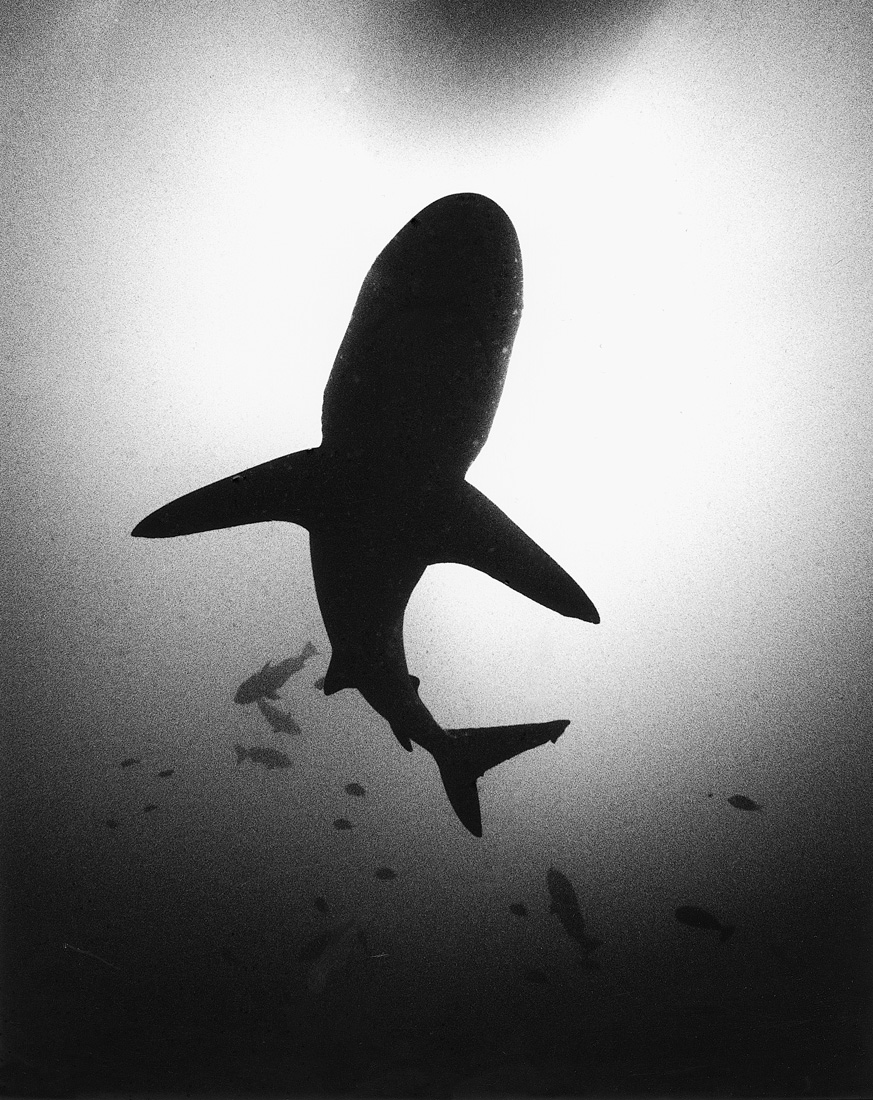
    Here's an old shot of mine taken in Yap with a Nikonos V, 12mm lens and very fast Fuji B&W film (1600 Neopan). It shows off the grain effect of this type of fast film. I liked it in B&W, not colour. Literally the last film shot I ever took. post-6326-1264774540.jpg

  12. ..and here's shot I did on fast colour film (probably Fuji 400) with an enlarged section. I don't know if you can see the grain at 72dpi but it actually gives a nice 'David Roberts' feel.

    post-4197-1264786413.jpg

    post-4197-1264786427.jpg

    Edited by John Bantin
  13. what are the plug ins that add grain? is there one for aperture?

  14. I've just added this pic to by blog 'The worst whale pic you'll ever see', so I thought I'd add it to this growing collection also, as the grain is very obvious. from most points of view its a terrible picture. I hadn't left shore intending to shoot anything larger than a nudibranch so was totally unprepared. I found some old b&w 400 ASA in the bottom of my bag (I had planned on shooting with velvia 50). It was shot with an old Nik III, no lightmeter, and an old plastic Subawider supplementary lens for those of you old enough to remember them. The negs were then developed and duplicated on to slide film through filters to give a bluey green tint. The end product was then scanned. So massively over-processed from a very dodgy original. But two decades on I still like it. Its not going to win any awards but I like the grainy look. Far as I know the ones I shot then are still the only photographs of a humpback underwater in British coastal waters (unless anyone knows different?)


    MBI000830-700pix24bitJPGED1CR.jpg


    I've put a bit more detail in my blog and will be uploading a few more from this series soon. For those intersted you can get there from here . If anyone knows of other whale pics from UK waters I would be interested to hear about it.


    Colin

Sea & Sea

Account

Navigation

Search

Search

Configure browser push notifications

Chrome (Android)
  1. Tap the lock icon next to the address bar.
  2. Tap Permissions → Notifications.
  3. Adjust your preference.
Chrome (Desktop)
  1. Click the padlock icon in the address bar.
  2. Select Site settings.
  3. Find Notifications and adjust your preference.