Skip to content

Shooting Technique, Workflow and Editing / Archived topic

Need help understanding dome port theory

Started by Ol Dirty Diver ·

  • 14Posts
  • 14Replies

Read-only discussion

Need help understanding dome port theory

14 posts
  1. I just maxed out my credit card on the following dream rig:

    • Nikon D700
    • Nikon 16-35mm f/4 (the new lens...better than the 14-24mm?)
    • Sea & Sea MDX-D700 housing
    • Zen 8" optical dome port
    • Sea & Sea extension ring 40

    I hoped that I would finally have a nice sharp image through to the corners, but apparently the rig still needs more optimization (see attached images taken at f/5.6 and f/11). Because the lens I'm using is so new I haven't been able to find any advice online from others using it underwater. In an effort to figure out what I need to do, I've been reading up on dome port theory online and while the terminology and math starts to get over my head, I think I get the gist. But there's still a few things I'm not sure about which I was hoping someone on here could answer:

    • From this article I learned that it "must be such that the camera lens' primary principal plane ends up at the dome's centre of curvature. Positioning the lens in that manner ensures that its underwater field of view will be identical to its in-air field of view." Where exactly on the lens is its "primary principal plane"? I'm guessing this may be aligned with the outermost element of the lens (which I know moves in a zoom), but I can't be sure from the other resources I checked.
    • If I should manage to align the lens' principal plane with the dome's center of curvature, does this actually yield the best possible image quality underwater for a particular lens/dome port? Is the issue of corner fuzziness eliminated assuming the lens' minimum focusing distance can handle the distance to the virtual image?
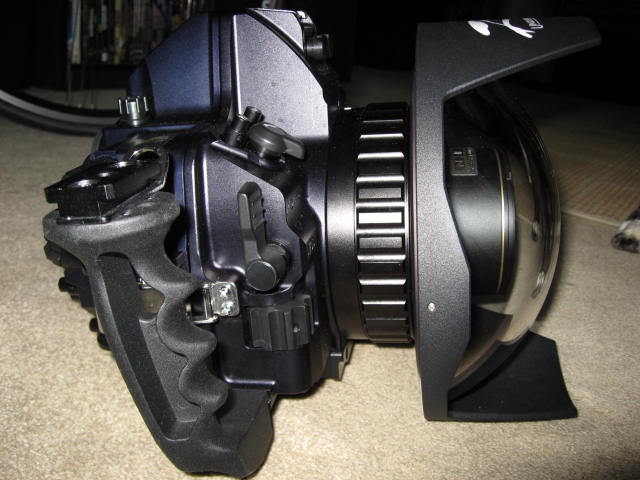
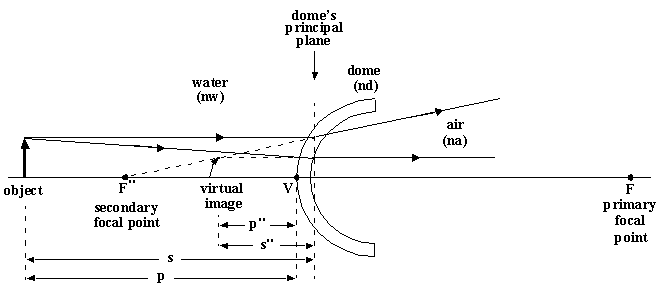
    • It appears that dome ports are not actually complete half domes (as indicated in the dome port theory articles, such as this diagram), but instead only sections of a half dome. Indeed, the Zen website admits this about my dome port: "[it is] an 8" segment of a much larger BK7 crystal glass dome". Therefore, if I was trying to achieve positioning the lens' principle plane at the dome's center of curvature, should the front element of the lens be recessed in the housing and certainly not protruding into the dome port itself? What is the penalty of allowing the lens to protrude into the dome port? I'm guessing the problem of corner blurriness is exacerbated the further the lens protrudes inside the dome port (i.e., the closer the lens is to hitting the dome port itself)?

    I suspect that this is the reason I'm dealing with corner blurriness. I really don't think it's an issue of the minimum focusing distance of my lens being too short to accommodate the distance to the virtual image. I can estimate that the virtual image (at infinity) is 3 x radius - 4 x dome thickness in front of the outer surface of the dome port (reference). In my case this is some distance greater than 12"; since my dome port is only a section of a half-sphere, the opening of which is 8" across, the radius of my dome must be something greater than 1/2 the 8" diameter of the opening (I emailed Zen to learn the exact radius). My lens has a minimum focusing distance of ~11", as measured from the sensor. With the D700/16-35mm I measured the distance from the sensor to outer edge of lens at ~7", meaning I can focus as close as 4" away from the outer edge of the lens, easily accommodated by the over 12" I have to work with outside the dome + the distance between the lens and dome. It seems that I have plenty of focusing distance to spare, so I really don't think I have any need to use diopters, which I'd prefer to avoid anyway to preserve image quality and depth-of-field.


    So is my theory correct so far? Is it really in our interest to try to position the lens' outermost element (which I'm assuming to be the "primary principal plane" or close enough to it for my purpose) at the center of curvature of the dome port? If this is necessary for good corner resolution, then I can understand why my rig is failing in this regard: my lens protrudes too far into the dome port. I knew I'd need an extension ring, so I got the one recommended by Sea & Sea for the Nikon 17-35mm (extension ring "40"), which was also suggested by the vendor to be all I'd need (*note that the new 16-35mm is 0.7" longer than the 17-35mm). But if you look at the attached photo you'll see that I'm hardly using much of the real estate of that beautiful dome, due to the lens still coming so close to the inner face. I'd estimate that there is about an inch between the outer edge of the lens and inner face of the dome, and that the outermost element of the lens is receded ~3/4" inside the outer edge of the lens, so that there is probably 1.5 - 2" of space between the outer element of the lens and the inner face of the dome.


    An obvious solution is simply to go ahead and buy another extension ring, or test someone else's out. The latter is not an option because I don't know other photographers with this sort of gear, and the former is not something I want to do carelessly since I am already so strapped having bought all this already. I want to be sure it would be the solution, and I figured if I could understand the theory I could perhaps precisely measure how much more extension I'd need. There are two options for the extension after all, the thinner "SX" extension ring, and putting on another thicker "40". It really looks to me like I could afford to double the extension, which would be unfortunate because the current amount of extension is already adding so much bulk. I know that another option still is to simply forget about using a rectilinear lens and opt for a fisheye, but it so happens that I have important assignment which requires images shot at 24mm and minimizing distortion.


    If anyone actually read through this entire post and can advise me, I'd be much obliged. There's no doubt that this new Nikon lens will become very popular with underwater photographers, so I feel that my observations and whatever conclusions we arrive at regarding housing/dome port/extension ring combinations with this lens will be of great value to other photographers who acquire this lens in the future. Thanks in advance for your assistance.
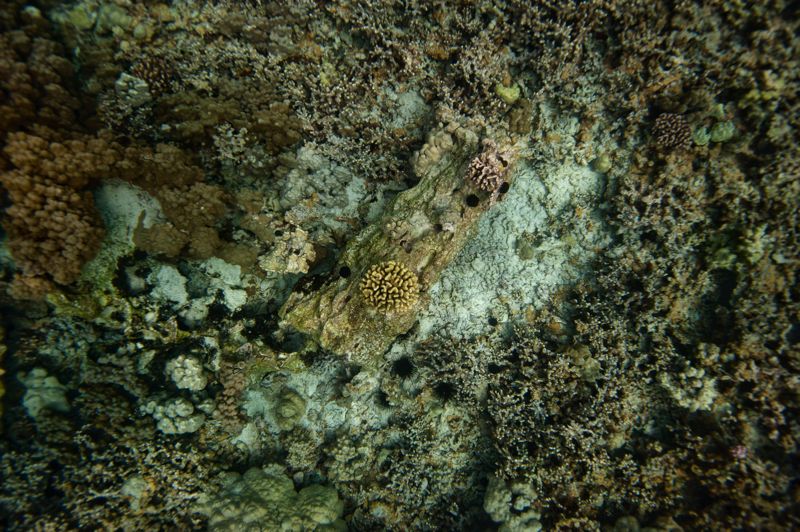
    post-8896-1269752200.jpg

    post-8896-1269752212.jpg

    post-8896-1269752220.jpg

  2. Hi Kurt,

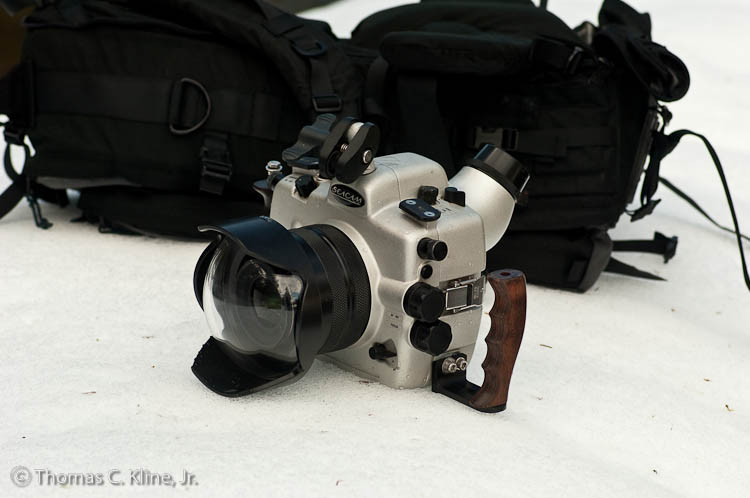
    I think you are going to need more port extension. Your lens is protruding quite a bit more into the dome than mine. Note that I am using a different housing set up than you. Here is a shot that I took last weekend of a Seacam housing with the Seacam wideport and their recommended 65mm of port extension (made up by combining a 30 with a 35mm port extension tube) with the 16-35VR on a D2H inside it.


    I posted pix I took with this set up in the new lens thread here: http://wetpixel.com/forums/index.php?showt...mp;#entry245480


    My zoom control ring arrived today from Key Largo but with blowing (gusts up to 65 mph) rain and snow it looks like is a no-go this weekend for more shots.

    Hopefully S&S will come out with a specific recommendation for your setup soon. :o

    Tom

    post-3540-1269756932.jpg

    Edited by Tom_Kline
  3. Thanks, Tom. Your results give me hope. I'm pretty sure I just need more extension. At least I finally learned how dome ports work in the process of trying to figure it out.

  4. This article was really helpful to me to understand dome port theory.

    http://www.underseacameras.com/wisscms-en-243.aspx

    It would seem you would need a larger extension ring to align the front element of the lens with the base of the dome.

  5. I think using this lens on a D700 underwater will be a much greater challenge concerning corner sharpness compared to the D2-series that Tom uses. A DX-body might be the only way to get near the quality in Toms shots.


    good luck

  6. You need 2 reference points to properly align a lens & dome port - entrance pupil/nodal point of lens (internal to lens) & center of curvature of the dome. The nodal point moves as the lens is zoomed. Most guys I know would set up for the WA end (16mm). Just looking at your pic, the dome is less than 180 deg. Can't tell if lens is at min or max extension, but it seems to extend too far into dome.


    Nodal point info is not easy to find for a lot of lenses. A very simple method I learned for determining approximate location (close enough for initial setup) is the following. (It may sound mickey mouse but it works.)


    1) Install lens on camera body & place on flat surface.

    2) Take a soda straw (large diameter like for frosted drinks works better) & hold one end at 9 o'clock position on front outside edge of lens, so that straw opening is over the front element.

    3) Look thru camera viewfinder. Importance to maintain straw/lens position where they make contact. A helping hand may be good at this point.

    4) Move the far end of straw horizontally side to side to a position where you can look down the full length of the straw thru the viewer. Fix this position.

    5) With straw at this position, extend the centerline of the straw to intersect centerline/axis of lens. The intersection point is the nodal point of the lens.

    6) Repeat procedure with straw at 3 o'clock to confirm nodal point location of lens. (Best 2 out of 3 if you like).


    Hope this makes sense.

    Edited by jcclink
  7. I think using this lens on a D700 underwater will be a much greater challenge concerning corner sharpness compared to the D2-series that Tom uses. A DX-body might be the only way to get near the quality in Toms shots.


    good luck


    This is a good point. 16mm on the DX format is like 24mm on FF in terms of angle of view. Plus the port I used is designed for 20mm and longer FL on FF. I would use the Superdome on FF. The 16-35VR should work OK towards the longer end, 18-35 or 20-35, for smaller radius ports such as an 8 inch. One may have to reserve use of the 16mm end when the corners are just blue water or something else not too critical.


    There is a lot written on other lenses of this FL range from C and N on here on WP, not the easiest to adapt to UW use.

    Edited by Tom_Kline
  8. Calculating effective dome radius assuming port flange is placed on horizontal base. X is measured horizontally from dome vertical centerline to point on dome surface. Y is measured vertically from upper most point of dome down to same surface point.


    X*2 + (R-Y)*2 = R*2


    (X*2 + Y*2)/Y = 2R


    (I tried to diagram this but it didn't translate in post - sorry.)


    With this calculation & location of lens nodal point you can calculate the extension ring required to correctly position the lens within the dome port.


    Diopter also probably required to obtain close enough focus for virtual image. (My reference is Nexus domes & 17-55mm lens, using +3 or +4 diopter.)

    Edited by jcclink
  9. Hey Kurt aside from the math, just curious, are you planning to free dive with this rig?


    Steve

  10. This is a good point. 16mm on the DX format is like 24mm on FF in terms of angle of view. Plus the port I used is designed for 20mm and longer FL on FF. I would use the Superdome on FF. The 16-35VR should work OK towards the longer end, 18-35 or 20-35, for smaller radius ports such as an 8 inch. One may have to reserve use of the 16mm end when the corners are just blue water or something else not too critical.

    Yep: "As an empirically derived rule of thumb, good corner image quality is limited with rectilinear lenses to those with a field of view not exceeding 90~100 degrees. Beyond this (and for critical applications, even below this) the image corners will remain of lower quality than the centre of the image. It important to understand that this is due to the optical constraints of using a simple, concentric dome port and has little to do with the camera lens. No matter how good the camera lens is, it cannot compensate for an inherent optical problem caused by using a simple concentric dome port!" (reference). Referring to this table of field of view associated with focal length on full frame, it becomes apparent that an FX user shouldn't shoot any wider than 18-22mm with a rectilinear lens, corresponding to 100-90° FOV (in the diagonal dimension). The way I'm thinking of this is that since the virtual image is on a sphere concentric with the dome, the wider the field of view the more "thickness" of that spherical image the lens is trying to capture, and there is simply a limit to how thick of an image the lens can capture due to its limited depth-of-field.


    You need 2 reference points to properly align a lens & dome port - entrance pupil/nodal point of lens (internal to lens) & center of curvature of the dome.

    I'm confused about the particular location in the lens that needs to be aligned with the dome's center of curvature. This article states that it's the lens' "primary principal plane" (which could be considered synonymous with the 'primary principal point' for our purpose). You mention the entrance pupil/nodal point, which may actually be different points considering that they are distinguished from each other in the Wikipedia article on cardinal points: "The nodal points are widely misunderstood in photography, where it is commonly asserted that the light rays "intersect" at "the nodal point", that the iris diaphragm of the lens is located there, and that this is the correct pivot point for panoramic photography, so as to avoid parallax error. These claims are all false, and generally arise from confusion about the optics of camera lenses, as well as confusion between the nodal points and the other cardinal points of the system. The correct pivot point for panoramic photography can be shown to be the centre of the system's entrance pupil." The principal points/planes are also distinguished from the nodal points in that Wikipedia article:

    • "The two principal planes have the property that a ray emerging from the lens appears to have crossed the rear principal plane at the same distance from the axis that that ray appeared to cross the front principal plane, as viewed from the front of the lens. This means that the lens can be treated as if all of the refraction happened at the principal planes. The principal planes are crucial in defining the optical properties of the system, since it is the distance of the object and image from the front and rear principal planes that determines the magnification of the system. The principal points are the points where the principal planes cross the optical axis."
    • "The front and rear nodal points have the property that a ray aimed at one of them will be refracted by the lens such that it appears to have come from the other, and with the same angle with respect to the optical axis. The nodal points therefore do for angles what the principal planes do for transverse distance."

    Ohhh, wait a minute...just read this: "If the medium on both sides of the optical system is the same (e.g., air), then the front and rear nodal points coincide with the front and rear principal points, respectively." Guess that clears up the confusion.


    Thanks for your advice on determining the optimal lens-dome distance, and the dome's true radius. I'll try those.


    Diopter also probably required to obtain close enough focus for virtual image. (My reference is Nexus domes & 17-55mm lens, using +3 or +4 diopter.)

    I tried to reason out of the necessity for a diopter in my original post. Based on the minimum focus distance of the 16-35mm (~11", from sensor plane) and the sensor-lens outer element distance with my D700/16-35mm (~7"), I figured that I could focus as close as ~4" in front of the lens. Even with my lens protruding into the dome so much, I've still got ~2" between the lens outer element and the dome's inner surface. I expect that the calculations for optimum extension will suggest that I increase the distance nearly another 2", so that my lens should be able to focus almost as close as the outer surface of the dome. In spite of that, you still think one would help?


    Hey Kurt aside from the math, just curious, are you planning to free dive with this rig?

    It's the only way I dive, so of course. :o I've already used a Sea & Sea with NX dome port, so I'm used to the bulk, but that's why I'm displeased at having to add more bulk with these extension rings (I'm already planning to buy the Nikon 16mm fisheye now...). On the plus side, my new Sea & Sea housing is negatively buoyant (while my previous was quite positive)...Makes descent much easier.

    Edited by Ol Dirty Diver
  11. way I'm thinking of this is that since the virtual image is on a sphere concentric with the dome, the wider the field of view the more "thickness" of that spherical image the lens is trying to capture, and there is simply a limit to how thick of an image the lens can capture due to its limited depth-of-field.

    The virtual image is only spherical for an infinite object plane. For an object plane at finite distances it is aspherical. Source: Optical Fundamentals of Underwater Photography, Second edition 1972 Author: Gomer McNeil


    This same source states that the lens' entrance pupil is to be located at the center of the dome's curvature.


    The 16-35VR lens focuses close enough not to require a diopter. I did some test shots today at the minimum focus distance to prove this to myself - see the new lens thread.


    There are several WP threads on using diopters with the 17-35 which you may want to check out. One clearly shows the reduced angle of view that results - I looked for it but no luck.

    Edited by Tom_Kline
  12. a couple other things to consider.


    firstly, you clearly do need more extension, but no so much to put the front element recessed into the dome's opening.


    as tom mentioned above, the dome's virtual image is closer than the real distance. the 12" you calculated is the virtual image at infinity, things closer than infinity will have a closer virtual image. diopter's are sometimes used to re-balance the lens' focus range with this. you pay for it with reduced sharpness & FOV.


    secondly what aperture are you shooting? a lot of discussion on WP has revolved around using these superwides lately and the consensus seems that soft corners are a big problem. to mediate this, people are shooting these lenses at small apertures (f/8+) and with the biggest domes they can get (in the 9"+ range). sounds like many people are getting unacceptable results with 8" domes and lenses like canon's 16-35mm and nikon's 14-24mm.


    so get more extension and stop the lens down as much as you can. lucily you're shooting a D700 so you can set iso400 or 800 and still have great image quality. cheers,


    chris

  13. Through a great deal of critical thinking (and head scratching), I think I calculated the exact amount of extension I need. For some reason, Zen couldn't provide me with the parameters of radius and glass thickness corresponding to their 8" dome port, so I tried to measure and calculate these (11.433cm and 0.5cm, respectively). Then I had to determine the location of the entrance pupil of the 16-35mm f/4. For this I followed up on the advice I received in the Digideep forum to check out Underwater Photography Magazine #36 (May/June 2007) - "Domes" (p.36) by Pete Atkinson. I used the method recommended (aligning pins) to measure the entrance pupil at 2.5cm @ 16mm (from outer edge of filter over lens) and 3.5cm @ 24mm (entrance pupil moves between these points, going back to shallow position @ 35mm). This method also seemed worthwhile for determining the entrance pupil location, but I couldn't be sure about a few things. Anyway, with these parameters I was finally able to calculate that I need 6.433cm of extension @ 16mm (5.433cm @ 24mm), and I think this is probably accurate to within 0.2cm.


    Although Zen wasn't able to provide me with the parameters of their dome port, Ryan Canon @ reefphoto.com did share the following:

    "
    I'm not able to offer the exact dimensions you are requesting, but maybe I can help in another way. When we've calculated theoretical dome port positions in the past, they are only right about half the time. We've resorted to actual in water testing to determine the best combination, and are working on that now for 16-35/4.


    Our preliminary testing indicates 70mm of extension and a +2 diopter to be the best combination. Sea & Sea Extension Ring 40 + SX Extension Ring equal 60mm of extension. We are not evaluating if the difference between these two extension lengths justifies producing a dedicated 70mm extension ring for Sea & Sea.
    "

    It's funny to have calculated the amount of extension I need so precisely when I'm limited to only two lengths of extension ring from Sea & Sea, the 40 (4cm) and SX (2cm). I already have the 40, so I've ordered the SX and will hope that 6cm of extension is close enough. I still wonder what the penalty is of having too much extension though (so that the entrance pupil is placed behind the dome's center of curvature), say, if I used two 4cm extension rings (for 8cm of total extension) instead?


    as tom mentioned above, the dome's virtual image is closer than the real distance. the 12" you calculated is the virtual image at infinity, things closer than infinity will have a closer virtual image. diopter's are sometimes used to re-balance the lens' focus range with this. you pay for it with reduced sharpness & FOV.

    The closest that my lens would need to focus is the outside face of the dome port. Based on my calculations this would ideally be 8.933cm from the outside edge of my filter (for 16mm), but will actually be 8.5cm with my extension rings. This plus the 17.7cm sensor-filter distance of my D700/16-35mm will put the sensor 10.3" away from the outside face of the dome, and the lens' minimum focusing distance is 12" (10.8" @ 20-28mm) according to Nikon. Thus, my lens won't quite be able to focus at the dome's outer face, but will be close enough that I don't think a diopter would be worthwhile. How much real distance does 1.7" of virtual distance (the difference between my minimum focusing distance and the sensor-dome face distance) correspond to?


    I'll pick up my new extension ring this week and hopefully find that my calculations have been worthwhile. I also hope they'll help others who pick up this lens, and I would be interested in hearing whether others' experiences corroborate my findings. I wanted to share a few recent photos with my existing setup, though (i.e., too little extension), just to show the quality I'm getting in spite of the corner softness issue. I've been shooting at f/8 as a compromise between image quality and corner softness reduction.


    4543055718_47c3362958_o_d.jpg


    4542422747_7a154e36c0_o_d.jpg


    4478557216_24eeaa7145_o_d.jpg


    4477933115_5d5a6eb181_o_d.jpg

  14. Hi


    Thread is maybe a bit old, but I do have couple of questions if you don't mind.


    1. What happened after you picked up this additional extension ring? Are photos better? After a year do you have anything else to add to this topic in terms of improving sharpness in corners for 16-35 on d700?

    2. What is your experience with 8'' dome and fisheye lenses ... if any?

    3. Why did you opt for Zen dome ... is it really better then standard Sea & Sea fisheye dome?


    Thanks,

    Marko

Isotta

Account

Navigation

Search

Search

Configure browser push notifications

Chrome (Android)
  1. Tap the lock icon next to the address bar.
  2. Tap Permissions → Notifications.
  3. Adjust your preference.
Chrome (Desktop)
  1. Click the padlock icon in the address bar.
  2. Select Site settings.
  3. Find Notifications and adjust your preference.