Skip to content

Photography Gear and Technique / Archived topic

Testing lenses underwater.

Started by Paul Kay ·

  • 39Posts
  • 39Replies

Read-only discussion

Testing lenses underwater.

39 posts
  1. Dave, If you print a large ref chart it may be as simple as taping it to the side of the pool. You might try just leaving enough extra material so you can tape it above the water line. Depends on the lens and distance your trying to test.


    John, I can't decide if your last comment was the scurilous hack talking or the intrepid reviewer. :) Just curious, what percentage of the images that you get sent to you would you consider good enough to print?


    Cheers,

    Steve


    Intressting question!!

  2. A large test chart is not needed! Smaller test charts are quite adequate - placed centrally and on the diagonal in the corners and at intervals along the diagonal if needed. The aim is to see the drop in image quality into the corners, not the overall variance in the whole image area. If the lens is correctly centered and aligned the images from the diagonals should show similar results. Laminating an A4 print is fairly cheap - few laminates will stand up to submersion eventually as few use truly waterproof adhesives, but test charts can always be reprinted.


    The real question we need to know the answer to from the scurilous hack, is whether the images with mushy corners are actually used by the magazine - if they are then lens testing might just be an academic exercise :) .

  3. A large test chart is not needed! Smaller test charts are quite adequate - placed centrally and on the diagonal in the corners and at intervals along the diagonal if needed. The aim is to see the drop in image quality into the corners, not the overall variance in the whole image area. If the lens is correctly centered and aligned the images from the diagonals should show similar results. Laminating an A4 print is fairly cheap - few laminates will stand up to submersion eventually as few use truly waterproof adhesives, but test charts can always be reprinted.


    The real question we need to know the answer to from the scurilous hack, is whether the images with mushy corners are actually used by the magazine - if they are then lens testing might just be an academic exercise :) .


    I like the large siemens star (can be printed in A4) for surface shots. To check focusing and focus rendition in the center compared with the edges...

    I have to check it underwater...

    http://www.panavision.asia/resources/panavision-tools/

  4. Hey all,


    i now feel i am in a position to truly test my lenses and housing and ports both topside and underwater.


    I have printed Steve's linked test sheet and will get on a method that shows results which truly compare lenses and port set ups at different distances and apertures.


    A do think that the test sheet is a little over complicated, maybe i could create a 'wetpixel' specific sheet which has specific spots which need to be tested, i.e corners and edges and central focus?


    Think we could really get this moving and produce a comparable test for all new buyers out there.


    Olly

  5. @Paul Kay


    A few months ago, I decided it was time to find out ,what would be optimal underwater performance of my particular lenses in my particular dome ports. So, that meant the tedious trial and error of pool testing with a variety of lenses, ports, port extension, and diopters. I even borrowed some lenses from Canon Professional Services to test a few lenses I did not own. Show here are::


    * Canon EOS1DsMKII


    * Sea cam housing with wide port, fish eye port, and super dome (S45 viewfinder)


    * Port extensions from PVL25mm through PVL55mm


    * +1, +2, and +4 diopters


    * Canon lenses ­ 15mm, 14mm, 16-35mm, 17-40mm,


    20mm, 24mm F-1.8, 35mm F1.8, and 24-70mm zoom


    Thanks,

  6. Since art directors love to 'discover' pictures within pictures, thereby awarding themselves the credit for making a picture out of nothing, they love to crop off-centre. To this end I have now equipped myself with a D800 and 15mm so that I can shoot lots of extra space all round my subject. Of course, the dome port needs to give a sharp image across the frame which mine do with fish-eye lenses. However, if you are the one that needs pleasing, make your own mind up if it's sharp enough.

  7. post-23126-0-61715300-1344228192_thumb.jpg


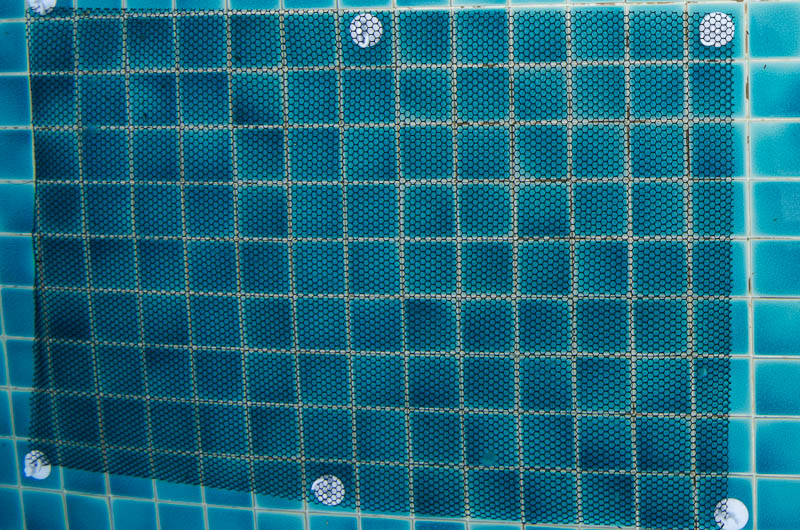
    Here's the latest iteration of my plastic garden mesh test chart, 1m x 1.5m, attached to the bottom of the pool with bathroom sucker hooks. This is the Sigma 8-16 at f16 behind a custom 8" hemispherical dome, If it doesn't fill the angle of view, I simply place it in the corner of the picture. I hook my feet over the edge of the pool to get more stability floating on the surface. Attached to the side of the pool might be better for camera shake.

    When I built housings, I was always careful to build the domes so the centre of curvature coincided with the apparent front entrance pupil of each lens. I liked the 18mm f2.8 a lot. The corner looked good to me, but I was looking at a slide with an 8x loupe. With the advent of digital and zoom rectilinear lenses like the 12-24 and 8-16,the corners seemd bad, but then I was looking at them at 100% on a good monitor. I tried the 18mm the other day on the D7000 with the 9" Nauticam dome and the corners were far better than I can get at an equivalent aperture with the 12-24. But on a crop sensor the 18 is not usefully wide. I will be interested t try it on a full-frame camera sometime.

  8. I have been using this software and charts with another guy in Sydney to test still and cine lenses

    http://www.imatest.com/


    I produces some really interesting results, and really shows where lenses fail on the corners. The guy the owns it (Pawel Achtel) has created a rig that locks the camera in place too so that the results are repeatable. He used it when testing the resolution of Nikonos lenses for his Deep X rig. We will be also testing my Gates Deep Epic with the Tokina 10-17, 11-16, Canon 16-35L, plus we have some other results with Zeiss MkII behind Aquatica domes.


    I'm sure if anyone is based in Sydney and had any more lenses and port options we could organise something.

  9. A very inexpensive test chart to do, at whatever size you want will be a simple white 3mm thickness PVC board (I use one with around 1 m wide). Then one simply mark (at the edges) 5 or 10 cm spaces all around. To make the grid (to focus or to evaluate edge sharpness or lens distortion - optical or chromatic) just use black electrical tape. It's quite easy and quick to make lots of horizontal and vertical lines (the grid) and two at the diagonals.


    Then you can put in in the pool floor or (better) at a pool wall (just make tho small holes at the corners and suspend it with some line and weights (out of the water) at the pool side. You can even use a tripod with a quick release plate so you can repeat results at exact the same distance while you change lens/port/extensions.


    Cheers,

  10. This is a great idea. Along with standards for target and shooting distance how about the same for target illumination?


    I happen to write procedures for work and would be happy to contribute to a writen testing procedure.

  11. I am new to this forum. I go underwater for more than 41 years and underwater photographer for 20 years. I have a Nikon D300 in Sealux CD300 UW housing. Objectives: Nikkor 10.5 DX and sigma 17-70 macro. I want to buy a wide angle zoom and are very torn between this two: Nikkor 12-24 f4 or Nikkor 10-24 f3 ,5-4, 5. Some of you advise me on the right choice? thanks

  12. The inclusion of illumination tests will be welcome and useful for someone who is not sure about what to buy or just wants to knows exactly the light quality and intensity of one's strobes/video light.

  13. Did this thread ever get anywhere.. it seems to have died a death?


    I am having some dome port dilemmas which a Sea & Sea MDX 5II and a 16~35mm USM L lens and I was hoping to find a conclusion here.


    There are lots of good ideas here, Is anyone interested in trying to resurrect this?


    I can knock up a test chart and share it, if we can agree on some content... I propose a combination of the mesh idea of Pete Atkinson and smaller charts positioned at key places.


  14. The problem of too many lens/domes/strobes on the market will be a challenge to test everything. I've done my tests with my Subal gear and my lens in order to exclude /include some bad/good combinations and to have a good feel of distances/magnifications that each combo can deliver. I've used the test chart I've mentioned above.


    I don't mind to where some thoughts and some personal conclusions if there are some more people that have done the same thing, so we can start some sort of database.

    But of coarse that it will be just a starting point, because I believe that each photographer should do his own test with is own gear.

    Edited by Rui_Guerra
  15. Has anyone tried a 35/1.8 or 50/1.8 in a small dome (like the zen dp-100)? Just wondering...I have a 10-17 but just thinking about how some of my other lenses might do.


    Yes, I am kinda bored, thinking about upcoming trip, etc :)

  16. I have recently been up to no good in my wife's soaker tub. (I live a long way from the ocean)

    I tested the Nikon 8-15 Fisheye and Nikon 20mm f/1.8. My goal was to assess the Seacam Superdome vs 8 inch glass Subal FE port with differing extensions. The Subal port chart calls for a 20 mm extension, as does Seacam. Adam Hanlon reported using a 30mm extension with the Superdome when testing the 20mm f/1.8. (Not sure where he got his secret sauce.)

    I used the D850 in Nauticam with the appropriate port adapters.

    My results showed no clear difference between the two ports with the 8-15mm (no big surprise) but images with both lenses were sharper with a longer extension (33mm) with the Subal dome. There was minimal vignetting with the 8-15, and none with the 20mm lens. I purchased a 28mm ring for Subal/3 and got similar results to the 33mm ring, but without vignetting.

    The 20mm rectilinear performed quite poorly below f/11 and was marginal (by Nikonos standards) at f/16. That is the smallest aperture on that lens. It performs well centrally, and would be OK with blue water at the edges. No diopter was used.

    The 20mm lens did perform much better with the Superdome, and 20mm extension, although not great. Same conclusion as above.

    The 8-15 was good in both ports, with some improvement with the 28mm extension over the 20mm with the Subal port. I did not test the Superdome at longer extensions. Circular images where good with both ports, and also showed vignetting at 33mm extension, but not 28mm on Subal

    Conclusion:

    The 8-15 performed well in all setups, somewhat improved with the 28mm extension.

    The 20mm lens was marginal in performance with the Subal dome and acceptable with Superdome. Probably not worth the extra effort.

    The point of all this was to decide whether the Superdome was worth humping around the world with it's size and weight. I concluded that apart from over/unders there was not much advantage to me. I think in future I will leave my Superdome at home.


    Edited by ianmarsh
  17. 1 hour ago, ianmarsh said:

    I have recently been up to no good in my wife's soaker tub. (I live a long way from the ocean)

    I tested the Nikon 8-15 Fisheye and Nikon 20mm f/1.8. My goal was to assess the Seacam Superdome vs 8 inch glass Subal FE port with differing extensions. The Subal port chart calls for a 20 mm extension, as does Seacam. Adam Hanlon reported using a 30mm extension with the Superdome when testing the 20mm f/1.8. (Not sure where he got his secret sauce.)

    I used the D850 in Nauticam with the appropriate port adapters.

    My results showed no clear difference between the two ports with the 8-15mm (no big surprise) but images with both lenses were sharper with a longer extension (33mm) with the Subal dome. There was minimal vignetting with the 8-15, and none with the 20mm lens. I purchased a 28mm ring for Subal/3 and got similar results to the 33mm ring, but without vignetting.

    The 20mm rectilinear performed quite poorly below f/11 and was marginal (by Nikonos standards) at f/16. That is the smallest aperture on that lens. It performs well centrally, and would be OK with blue water at the edges. No diopter was used.

    The 20mm lens did perform much better with the Superdome, and 20mm extension, although not great. Same conclusion as above.

    The 8-15 was good in both ports, with some improvement with the 28mm extension over the 20mm with the Subal port. I did not test the Superdome at longer extensions. Circular images where good with both ports, and also showed vignetting at 33mm extension, but not 28mm on Subal

    Conclusion:

    The 8-15 performed well in all setups, somewhat improved with the 28mm extension.

    The 20mm lens was marginal in performance with the Subal dome and acceptable with Superdome. Probably not worth the extra effort.

    The point of all this was to decide whether the Superdome was worth humping around the world with it's size and weight. I concluded that apart from over/unders there was not much advantage to me. I think in future I will leave my Superdome at home.

    If one dome is 10 cm radius and the other is 12 with the same lens you need two cm more.

    Fisheye lenses tend to have the entrance pupil right at the end of the lens you can find those on panotools https://wiki.panotools.org/Entrance_Pupil_Database#First_party_lenses

    For a fisheye lens generally you can try the longest extension until it sees the petals and vignettes and this gives you the best set up. On a fisheye lens I doubt you will be able to see the difference between a 10 cm and 12 cm radius but for a rectilinear lens those 2 cm are worth times 4 for focus distance. You should double check you are using the superdome with the correct extension for the rectilinear lens. In general 20 mm is not very wide however and large domes are not so important. Looking at this lens the entrance pupil is probably inside the housing so if you were using extensions (that will not vignette as the dome is huge) you are probably in a situation where the lens has a lot of distortion and the quality is compromised. Looking at entrance pupils of other nikon prime lenses they all look pretty poor performers.

    Zoom like 10-24 or 14-24 that are longer lenses will most likely do better at least at wide end due to the geometry of the housing.

    As you can read I do a lot of tests in the sink or pools....

  18. Super helpful:)


    I have not heard of this recipe before, but it does make sense. I am not clear on how Subal, Seacam etc come up with their recommendations, I am guessing by doing tests in their kitchen sinks also:)))


    ian

  19. 13 minutes ago, ianmarsh said:

    Super helpful:)


    I have not heard of this recipe before, but it does make sense. I am not clear on how Subal, Seacam etc come up with their recommendations, I am guessing by doing tests in their kitchen sinks also:)))


    ian

    Nauticam has a macro slide and I can confirm their numbers on the lenses I have to be accurate and backed up by theory. They have no idea of the theory I just explained to you but their empirical work matches it confirming the theory is accurate!

    For other manufacturers I have had no dealings so I cannot make any comments what I can say is that once you know  a few parameters you will know very soon what you need...

    Edited by Interceptor121
Backscatter

Account

Navigation

Search

Search

Configure browser push notifications

Chrome (Android)
  1. Tap the lock icon next to the address bar.
  2. Tap Permissions → Notifications.
  3. Adjust your preference.
Chrome (Desktop)
  1. Click the padlock icon in the address bar.
  2. Select Site settings.
  3. Find Notifications and adjust your preference.